

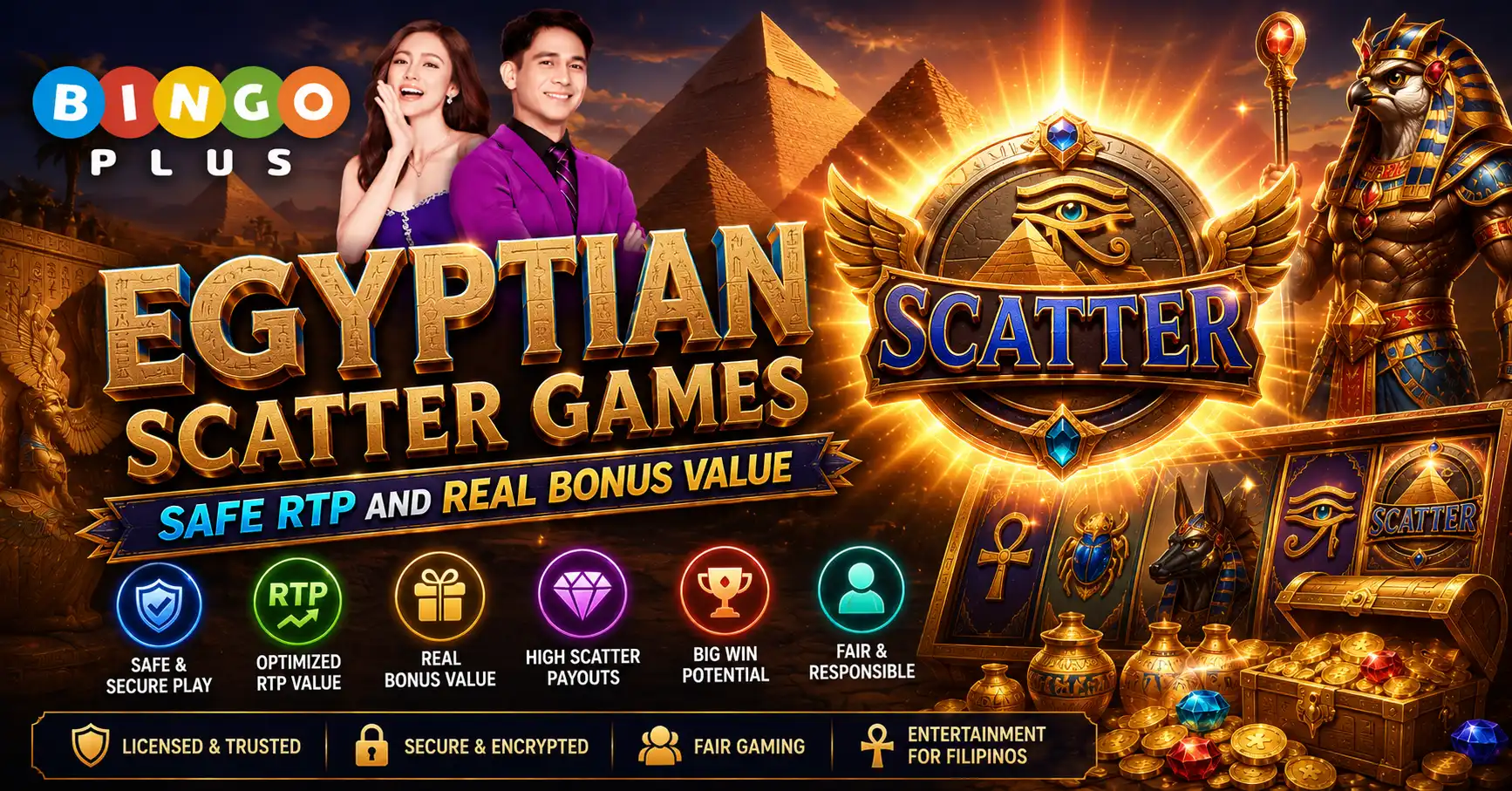
Egyptian scatter games use pyramids, pharaohs, scarabs, golden tombs, and hidden treasure to create the impression that a major discovery could arrive on the next spin. The attractive theme does not remove the financial risks behind the reels.
Players face three genuine concerns: depositing through a cloned website, encountering an unclear withdrawal policy, or playing a game whose mathematical structure they do not understand. A large jackpot graphic cannot answer any of those questions.

Before I use an Egyptian-themed game on BingoPlus or another Philippine platform, I apply three non-negotiable standards:
- The operator, brand, and exact domain must match a current PAGCOR regulatory record.
- The game must disclose its RTP, volatility, paytable, scatter conditions, and maximum win.
- The platform must publish its KYC, wagering, withdrawal-limit, and account-verification rules.
- Click to spin for free and win the ultimate prize!
No scatter system can guarantee profit. Bet responsibly, live a wonderful life. Gambling carries financial risk, and players remain responsible for their decisions and losses.
What Are Egyptian Scatter Games?
Egyptian scatter games are digital reel games based on ancient Egyptian mythology, archaeology, royal tombs, and treasure-hunting narratives. Their main feature is usually a scatter symbol that activates free spins or another bonus without needing to land on a standard payline.
Common visual entities include:
- Pharaohs and queens
- Pyramids and temples
- Scarab beetles
- Ankh symbols
- Golden masks
- Hieroglyphic tablets
- The Eye of Horus
- Egyptian gods such as Anubis and Ra
The underlying game mechanics frequently include:
- Three-to-five-scatter triggers
- Free-spin rounds
- Expanding wilds
- Sticky wilds
- Scatter multipliers
- Retriggerable bonuses
- Collect meters
- Cascading reels
- Progressive multipliers
- Hold-and-win features
The Egyptian theme is only the presentation layer. Two games that look nearly identical can use different reel strips, symbol weights, RTP settings, hit frequencies, feature probabilities, and payout caps.
PAGCOR Legality and Domain Verification
What PAGCOR Regulation Covers
The Philippine Amusement and Gaming Corporation is the primary government regulatory reference for gaming operations directed at eligible players in the Philippines. PAGCOR is a Philippine regulator; its authority should not be presented as a licence covering every Asian jurisdiction.
Players can review the PAGCOR Electronic Gaming Licensing Department, which provides official regulatory materials and links to approved operator resources.
PAGCOR also publishes its list of accredited gaming system administrators, registered brands, and approved domains. The list available during this review is dated July 16, 2026.
The record identifies details such as:
- Gaming system administrator
- Approved game offering
- Main brand
- Registered sub-brand
- Main domain
- Approved subdomain
- Additional registered URL
A recognizable brand name is not sufficient. The exact hostname in the browser should match an address shown in the current PAGCOR record.
My Pre-Deposit Domain Check
I use the following process before entering payment or identity information:
- Open the official PAGCOR website manually.
- Visit its electronic gaming regulatory section.
- Download or open the current registered-brand and domain list.
- Search for the operator and brand.
- Compare the complete domain character by character.
- Check the domain extension, spelling, and approved subdomain.
- Confirm that the page uses HTTPS.
- Review the cashier, KYC, privacy, bonus, and withdrawal terms.
- Save the verified customer-support route.
This check should be applied to BingoPlus and every competing platform. A copied logo, sponsored advertisement, app icon, or “official” badge is not independent proof of authorization.
Does a PAGCOR Domain Match Prevent Every Scam?
No single measure provides 100% protection against phishing. Fraudsters can create lookalike domains, fake social accounts, cloned login screens, and misleading advertisements.
Cross-checking the current PAGCOR list still reduces exposure to:
- Misspelled brand domains
- Unregistered mirror websites
- Fake registration pages
- Unapproved APK downloads
- Impersonated payment screens
- Unofficial agent links
- Fraudulent support accounts
Players should always use the latest PAGCOR record. Regulatory status and approved domains can change, so an old screenshot should not be treated as current verification.
Warning Signs I Do Not Ignore
I stop the review when:
- The domain is missing from PAGCOR’s current list.
- The legal operator is not disclosed.
- An agent requests a password or one-time code.
- Payment must be sent to an unexplained personal account.
- The withdrawal policy is hidden until after deposit.
- The website promises guaranteed returns.
- An APK comes from an unrelated file-sharing service.
- The cashier opens an unexplained third-party domain.
- Support asks for remote control of the player’s device.
Regulatory verification reduces identity and platform risk. It does not make a negative-expectation game profitable.
Egyptian Scatter Game Mathematics
RTP and House Edge
Return to Player (RTP) represents the theoretical percentage of stakes returned over a very large number of rounds. It is not the percentage a player should expect during one session.
The relationship is:
House Edge = 100% − RTP
For a game with 96% RTP:
100% − 96% = 4% house edge
If total turnover reaches ₱20,000, the long-run modelled loss is:
₱20,000 × 4% = ₱800
Actual short-term results can differ sharply. A player may win a large bonus early or lose the available balance without triggering one.
Check for Multiple RTP Configurations
Some game providers offer the same title with different RTP versions. An operator might select one configuration from several approved settings.
For example:
- Version A: 96.20% RTP
- Version B: 94.50% RTP
- Version C: 92.00% RTP
The associated house edges would be:
- 3.80%
- 5.50%
- 8.00%
At ₱50,000 of turnover, the theoretical loss difference between 96.20% and 92.00% RTP is:
₱50,000 × (8.00% − 3.80%) = ₱2,100
I therefore check the information panel inside the actual game. A provider’s marketing page may describe a different configuration from the version offered by a particular platform.
Where the RTP Is Distributed
An Egyptian scatter game may concentrate a large share of its theoretical return inside free spins or a rare treasure feature.
A simplified mathematical distribution could be:
- Base-game wins: 65%
- Scatter feature: 21%
- Other bonus mechanics: 10%
- Total RTP: 96%
This does not mean the scatter feature pays 21% when triggered. It means scatter-feature outcomes contribute approximately 21 percentage points to the game’s theoretical return across its entire mathematical cycle.
When a large share of RTP sits inside a rare bonus, the base game may produce long periods of small wins or no meaningful return. That structure commonly creates higher balance volatility.
Scatter Trigger Probability
A scatter normally pays or triggers a feature independently of fixed paylines. Its true probability depends on:
- Reel-strip composition
- Virtual reel weighting
- Number of reels
- Scatter distribution per reel
- Required scatter count
- Game-state modifiers
- Bonus-purchase rules
- Persistent collection meters
If the probability of a bonus trigger on one spin is p, the expected interval is:
Expected Spins Between Triggers = 1 ÷ p
If the estimated trigger probability is 1 in 180:
1 ÷ (1/180) = 180 spins
That is an average across many rounds, not a countdown. A bonus may trigger twice within 20 spins or fail to appear for 600 spins.
Probability of at Least One Trigger
The simplified probability of obtaining at least one feature within N independent spins is:
P(at least one trigger) = 1 − (1 − p)ᴺ
Using a hypothetical trigger probability of 1/180, the chance of at least one trigger within 100 spins is:
1 − (179/180)¹⁰⁰ ≈ 42.7%
Under that model, approximately 57.3% of 100-spin sessions would produce no trigger.
Extending a session because a feature appears “overdue” is therefore dangerous. The previous losing spins do not force the next result to contain a scatter.
Why Two-Scatter Near-Misses Are Misleading
Many Egyptian games frequently display two scatter symbols when three are required. The final reel may slow down, show several bonus symbols, and stop just outside the triggering position.
That animation does not prove that a bonus is becoming more likely.
Unless the game rules explicitly use a persistent collection mechanic:
- A near-miss does not increase the next spin’s probability.
- A long losing sequence does not create a debt owed by the RNG.
- Increasing the stake does not make the third scatter appear.
- Switching spin speed does not improve the mathematical return.
- Stopping the reels manually does not normally change the result.
The safe response to a losing sequence is not a larger bet. It is to follow the loss and time limits set before play began.
Volatility, Variance, and Hit Frequency
Hit frequency indicates how often a spin generates any winning combination. Volatility describes how returns are distributed by size and frequency.
A game can display frequent wins while still draining a balance. Many of those wins may be smaller than the original stake.
For example, a ₱20 spin that returns ₱6 is technically a winning event but creates a ₱14 net loss.
When comparing Egyptian scatter games, I examine:
- Published RTP
- Volatility rating
- Hit frequency, if disclosed
- Estimated feature frequency
- Maximum win
- Payout cap
- Minimum and maximum stake
- Scatter requirements
- Retrigger conditions
- Multiplier limits
- Wild-symbol behaviour
- Bonus-buy cost
- Alternative RTP settings
A maximum win of 10,000x does not indicate strong expected value. It represents an extreme outcome whose probability may be exceptionally low.
A Practical Bankroll Framework
No staking pattern eliminates a built-in house edge. Bankroll rules can only control exposure and prevent impulsive decisions.
My basic framework is:
- Use a separate entertainment budget.
- Never use money needed for bills or debt.
- Divide the budget into fixed session amounts.
- Keep each spin near 0.5% to 1% of the session balance.
- Set a hard loss limit.
- Set a session timer.
- Do not increase stakes after losses.
- Do not reload automatically.
- Stop when the activity no longer feels recreational.
With a ₱2,000 session balance:
- 0.5% stake = ₱10
- 1% stake = ₱20
At ₱20 per spin, 200 spins generate:
₱20 × 200 = ₱4,000 turnover
The player has wagered twice the starting balance because returned funds were reused. Turnover, rather than the original deposit alone, drives expected loss.
RNG Fairness and Technical Checks
A Random Number Generator selects results according to the approved mathematical model. Fairness does not mean that wins and losses alternate evenly.
A credible game should provide:
- Provider identity
- Game rules
- Paytable
- RTP percentage
- Winning combinations
- Scatter conditions
- Bonus mechanics
- Maximum payout
- Applicable game version
- Jurisdiction-specific restrictions
The reel animation commonly represents a result already selected by the system. Faster spinning, changing devices, pressing stop, or playing at a certain hour does not normally alter the RTP.
I also distinguish between two separate checks:
- Platform verification: Is the operator and domain recognized by PAGCOR?
- Game verification: Does the title disclose its provider, rules, RTP, paytable, and feature mechanics?
A legitimate operator can offer games with high volatility. A fair RNG can still produce severe short-term losses.
Exposing the Bonus Wagering Trap
10x and 30x Rollover Are Not Equivalent
A headline bonus is not automatically withdrawable money. The important question is which balance the wagering multiplier covers.
Common formulas include:
Bonus-only requirement
Required Turnover = Bonus × Multiplier
Deposit-plus-bonus requirement
Required Turnover = (Deposit + Bonus) × Multiplier
Assume a player deposits ₱1,000 and receives a ₱1,000 bonus.
With 10x wagering on the bonus:
₱1,000 × 10 = ₱10,000 turnover
With 30x wagering on the bonus:
₱1,000 × 30 = ₱30,000 turnover
With 30x wagering on the deposit and bonus:
(₱1,000 + ₱1,000) × 30 = ₱60,000 turnover
The three offers may use the same “100% bonus” headline while creating radically different financial exposure.
Estimating Expected Wagering Cost
A practical first estimate is:
Expected Wagering Loss = Required Turnover × House Edge
For a game with 96% RTP, the house edge is 4%.
For ₱10,000 turnover:
₱10,000 × 4% = ₱400 expected loss
For ₱30,000 turnover:
₱30,000 × 4% = ₱1,200 expected loss
For ₱60,000 turnover:
₱60,000 × 4% = ₱2,400 expected loss
A simplified bonus estimate is:
Estimated Bonus Value = Bonus − Expected Wagering Loss
Using a ₱1,000 bonus:
- 10x bonus-only: ₱1,000 − ₱400 = ₱600
- 30x bonus-only: ₱1,000 − ₱1,200 = −₱200
- 30x deposit plus bonus: ₱1,000 − ₱2,400 = −₱1,400
These figures are theoretical estimates, not promises. They exclude volatility, bonus expiration, maximum-bet violations, withdrawal caps, game exclusions, and the possibility that the balance reaches zero before wagering is completed.
Game Contribution Can Change Everything
An Egyptian scatter game might contribute only 20% toward bonus wagering.
The adjustment is:
Actual Wagering = Required Credited Turnover ÷ Contribution Rate
If the promotion requires ₱30,000 in credited turnover:
₱30,000 ÷ 0.20 = ₱150,000 actual wagering
At a 4% house edge:
₱150,000 × 4% = ₱6,000 theoretical loss
A large bonus becomes unattractive when the eligible game contribution is low.
Bonus Terms I Read Before Depositing
I check:
- Whether wagering covers the bonus or deposit plus bonus
- Wagering multiplier
- Eligible games
- Game-contribution percentage
- Maximum permitted stake
- Bonus expiration
- Withdrawal cap
- Restricted payment methods
- Prohibited betting patterns
- KYC deadline
- Minimum withdrawal
- Maximum withdrawal
- Rules for cancelling the bonus
- Treatment of winnings after cancellation
If the material terms are missing or contradictory, I assign the offer no mathematical value.
KYC Verification and Withdrawal Protection
KYC verification allows an operator to confirm identity, legal age, account ownership, and payment ownership. It can also reduce duplicate accounts, unauthorized access, and fraudulent withdrawals.
Possible requirements include:
- Government-issued identification
- Selfie or liveness verification
- Verified mobile number
- Date of birth
- Address information
- Proof of payment ownership
- Source-of-funds documents in selected cases
I recommend completing KYC before accumulating a large balance. Discovering an account-name or document mismatch only after requesting a withdrawal can cause avoidable delays.
Players should upload documents only through a verified official channel. Passwords and one-time codes should never be supplied to an agent.
Withdrawal Limits and Processing Rules
Before depositing, I record:
- Minimum withdrawal
- Daily and monthly limits
- Supported payout methods
- Published processing time
- Account-name matching rules
- KYC status
- Withdrawal fees
- Pending-request restrictions
- Bonus-related payout caps
- Security-review procedures
- Official escalation channel
A pending withdrawal does not automatically prove misconduct. Delays can result from incomplete KYC, mismatched payment ownership, active wagering requirements, transaction limits, or compliance checks.
A trustworthy platform should still provide a visible status, a clear document request, and a verified support route.
My Final Egyptian Scatter Games Checklist
I compare Egyptian scatter games as mathematical products, not treasure-hunting adventures.
Before risking real money, I require:
- A current PAGCOR-listed operator
- An exact registered-domain match
- HTTPS and verified support
- Published RTP and game version
- Clear scatter-trigger rules
- A complete paytable
- Stated volatility information
- Transparent KYC requirements
- Defined withdrawal limits
- Complete wagering conditions
- A fixed personal loss limit
- No guaranteed-profit language
BingoPlus and every alternative platform should face the same examination. Brand recognition never replaces regulatory verification, game mathematics, and careful review of financial terms.
Frequently Asked Questions
Do Egyptian scatter games require KYC before withdrawal?
Usually, yes. The operator may require KYC verification to confirm identity, age, account ownership, and payment ownership before approving a withdrawal.
How do I know whether an Egyptian scatter game is fair?
Verify the operator and exact domain through PAGCOR, then check the game provider, RTP, paytable, scatter rules, applicable version, and RNG disclosures. Fair operation does not guarantee short-term winnings.
Why is my Egyptian scatter game withdrawal pending?
Common causes include incomplete KYC, mismatched payment details, unfinished wagering requirements, withdrawal limits, security review, or processing queues. Check the official transaction status and contact verified support using the request reference number.