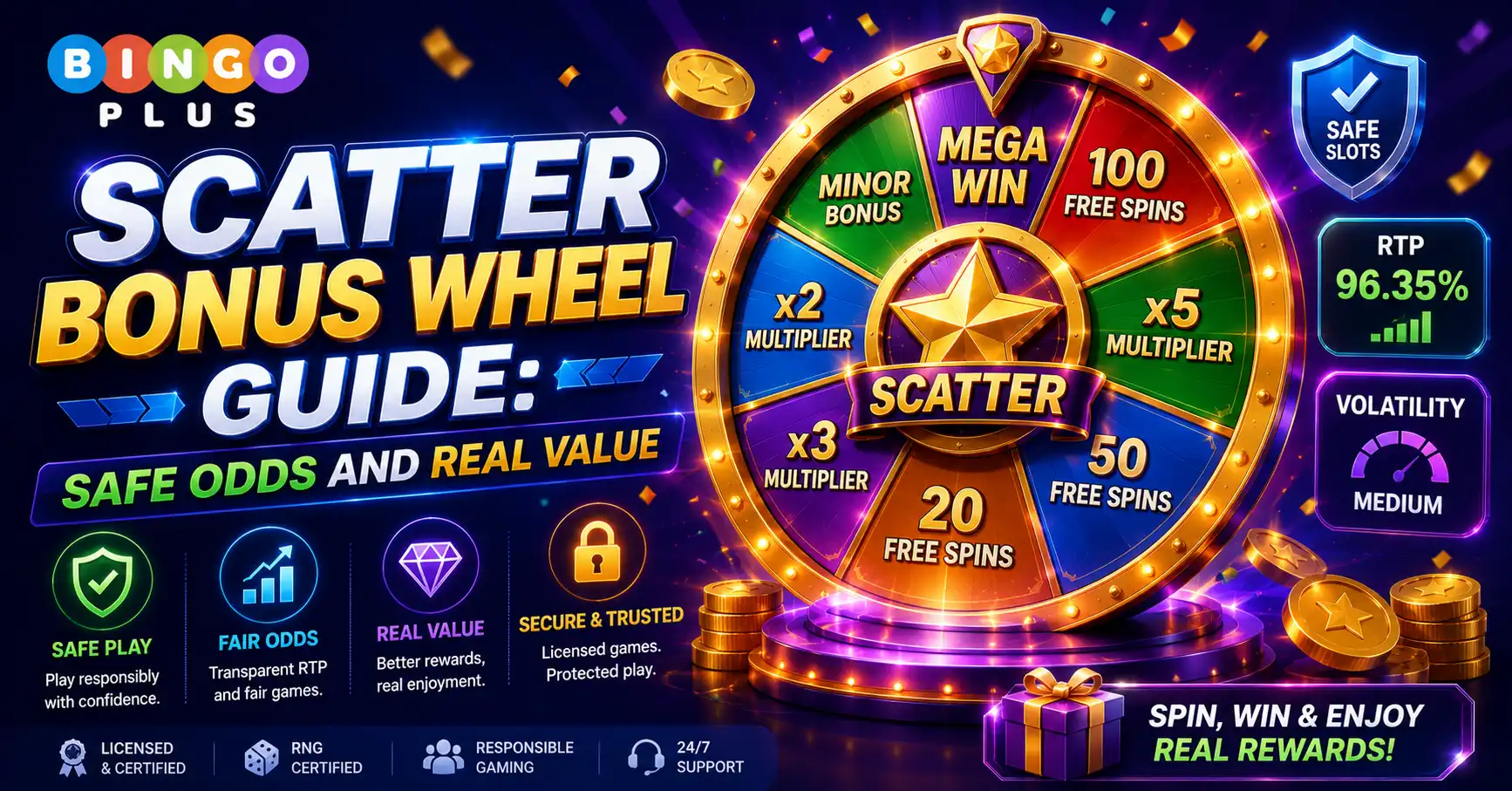





Scatter multipliers can turn an ordinary free-spins round into the most valuable part of a slot.
They can also create a false impression of easy profit.
A game may advertise multipliers reaching 10×, 100×, or 500×, while the probability of receiving those values remains extremely low. Players then chase rare outcomes, increase stakes after losses, or deposit through an imitation site that copies a legitimate brand.
Withdrawal risk adds another layer.
A multiplier win may still be restricted by unfinished wagering, incomplete KYC verification, a maximum-win cap, or a payment account that does not match the registered player.

Before I deposit on BingoPlus or assess any Philippine-facing gaming platform, I apply three non-negotiable standards:
- The exact domain must match a current PAGCOR-registered domain or URL.
- The game must disclose credible RTP, scatter, multiplier, retrigger, and maximum-win rules.
- The operator must publish clear KYC, wagering, withdrawal, and responsible-gaming policies.
- Click to spin for free and win the ultimate prize!
A large multiplier is not proof of good mathematical value.
A polished website is not proof of legal authorization.
Bet responsibly, live a wonderful life. Gambling involves financial risk, no result is guaranteed, and every wager remains the player’s responsibility.
What Are Scatter Multipliers?
A scatter multiplier is a payout modifier connected to scatter symbols or the bonus feature they activate.
It may multiply:
- A direct scatter payout
- Every win during free spins
- One selected winning combination
- The total value of a cascade
- A collected prize
- A bonus-round total
- A jackpot-related award
The effect depends entirely on the game rules.
A displayed 5× multiplier may apply to one symbol win rather than the entire feature balance.
Common scatter multiplier structures
Popular formats include:
- Fixed trigger multipliers
- Random multiplier symbols
- Progressive free-spin multipliers
- Cascading multipliers
- Persistent multipliers
- Multiplier wilds
- Retrigger multiplier upgrades
- Collected multiplier values
- Multiplier wheels
- Jackpot qualification multipliers
Each structure produces a different probability curve.
I never compare them by maximum value alone.
Core Entities Behind Scatter Multipliers
Our team evaluates multiplier games through these technical entities:
- Scatter symbol
- Free spins
- Random number generator
- Return to Player
- House edge
- Volatility
- Variance
- Multiplier weighting
- Trigger frequency
- Retrigger probability
- Feature RTP
- Maximum win
- Paytable
- Virtual reel mapping
These terms describe where the theoretical return comes from and how unevenly it may arrive.
They also reveal whether the headline multiplier has meaningful average value or exists mainly as a rare upper limit.
Verify PAGCOR Licensing Before Evaluating Multipliers
Why legal verification comes first
Multiplier mathematics cannot protect money deposited through a fake domain.
Fraudulent sites may copy:
- PAGCOR logos
- BingoPlus branding
- Game-provider artwork
- Promotional banners
- License certificates
- Payment icons
- Customer-service profiles
- Jackpot counters
PAGCOR has warned that illegal gaming websites may falsely claim accreditation, use copied PAGCOR branding, and display fabricated certificates.
For Philippine users, the Philippine Amusement and Gaming Corporation, or PAGCOR, is the primary official regulatory reference for checking licensed gaming operations, registered brands, approved domains, and gaming system administrators.
PAGCOR states that it regulates games of chance and issues licenses to gaming operations within Philippine territory.
Check the official PAGCOR domain whitelist
PAGCOR publishes the List of PAGCOR-Accredited Gaming System Administrators and Registered Brands and Domain Names/URLs.
The current official PDF is dated June 30, 2026 and records gaming system administrators, registered brands, main domains, subdomains, and additional approved URLs.
Use these official references:
- PAGCOR Electronic Gaming Licensing Department
- PAGCOR Registered Brands and Domain Names PDF
- PAGCOR Responsible Gaming Information
Before accessing BingoPlus, I use this process:
- Open PAGCOR’s official regulatory website.
- Open the latest registered-brand and domain PDF.
- Search the document for BingoPlus.
- Confirm the associated gaming system administrator.
- Compare the complete address character by character.
- Verify the root domain rather than trusting the page title.
- Bookmark the confirmed address.
The regulatory document is stronger evidence than a logo displayed by the platform itself.
Root domain versus deceptive subdomain
Consider this address:
bingoplus.secure-slot-example.com
The controlling root domain is:
secure-slot-example.com
The word “bingoplus” is only a subdomain label.
Phishing operators also use:
- Extra letters
- Missing letters
- Hyphenated brand names
- Similar-looking characters
- Alternative extensions
- Redirect links
- Words such as “official,” “VIP,” or “secure”
I do not log in through a link received from an unknown message, unofficial group, social-media profile, or private agent.
Can the official list prevent every attack?
Checking PAGCOR’s list materially reduces phishing risk, but no process can provide a literal 100% guarantee.
Other threats include:
- Malware
- Stolen credentials
- Fake customer-support accounts
- Remote-access scams
- Compromised browser extensions
- One-time-password theft
- Shared-device sessions
- DNS manipulation
My additional safeguards are simple:
- Use a bookmarked verified address.
- Confirm HTTPS.
- Never share passwords or one-time codes.
- Refuse screen-sharing requests.
- Do not install unknown files.
- Avoid transfers to personal wallets.
- Log out after using shared devices.
- Complete payments only inside the verified platform flow.
How Scatter Multipliers Work
Fixed trigger multipliers
A fixed trigger multiplier depends on the number of scatter symbols that land.
A hypothetical structure may be:
- 3 scatters: 10 free spins at 1×
- 4 scatters: 15 free spins at 2×
- 5 scatters: 20 free spins at 3×
This structure rewards less probable trigger combinations with stronger feature conditions.
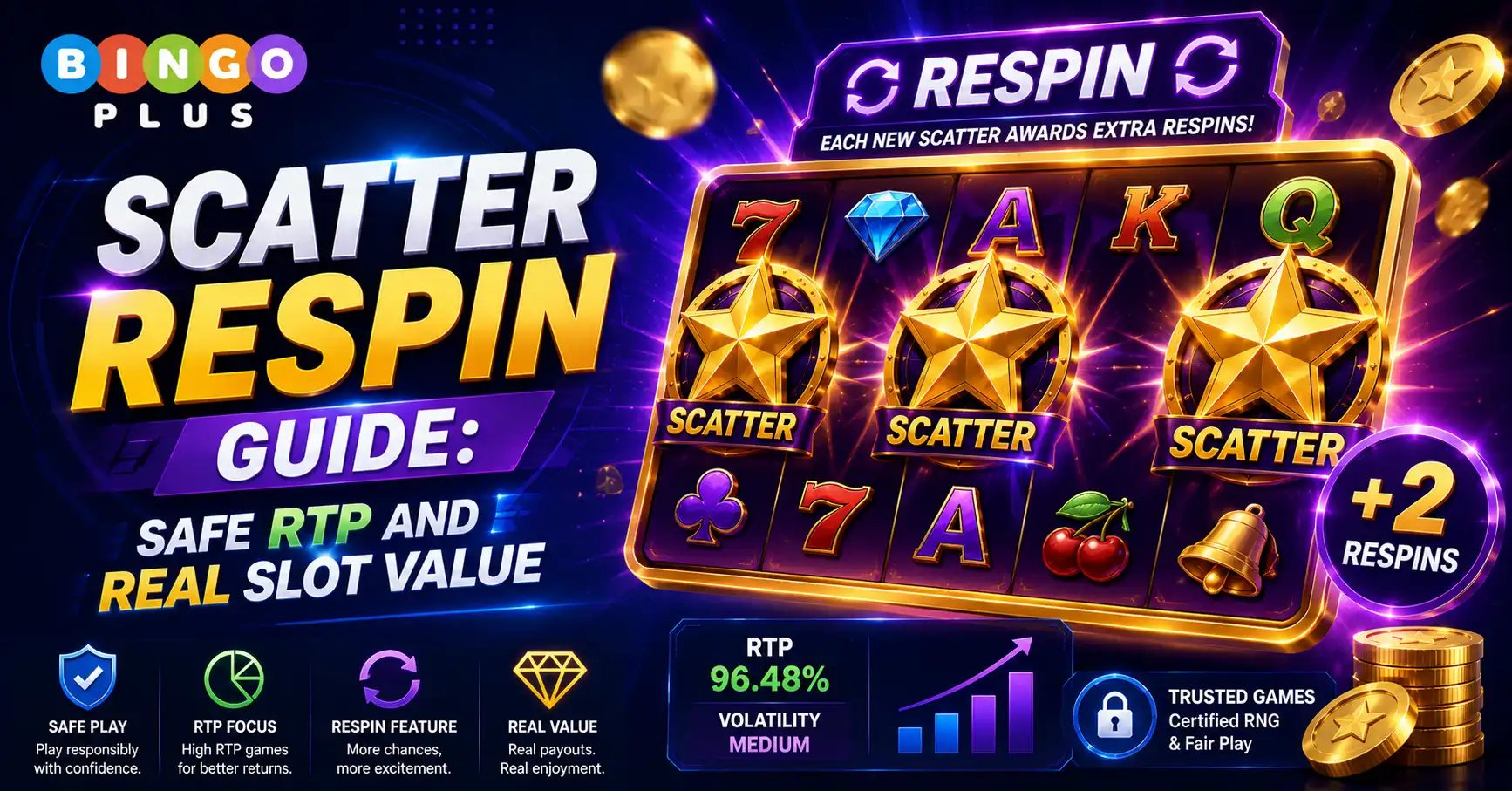
BingoPlus describes scatter games as titles where three symbols commonly activate free spins, while four or five may award additional spins or multiplier enhancements.
One BingoPlus game guide for Super Ace Scatter presents a tiered format in which additional scatters can increase the number of free spins and the starting multiplier. Players should still verify the current live paytable because game configurations and published descriptions may change.
Random multiplier symbols
Some games generate multiplier symbols carrying values such as:
- 2×
- 3×
- 5×
- 10×
- 25×
- 50×
- 100×
- 500×
The values may be added together or applied individually.
Suppose four multiplier symbols appear:
[
2×+3×+5×+10×=20×
]
If the qualifying symbol win is ₱100:
[
Final\ Win=₱100\times20
]
[
Final\ Win=₱2,000
]
The important question is not whether a 500× symbol exists.
It is how frequently each multiplier value is generated.
Progressive multiplier ladders
A progressive multiplier increases after each qualifying event.
For example:
[
1×\rightarrow2×\rightarrow3×\rightarrow5×\rightarrow10×
]
The progression may occur after:
- A cascade
- A winning spin
- A collected scatter
- A retrigger
- A meter milestone
- A consecutive win
BingoPlus describes Super Ace as using free-spin multipliers that can rise during cascades, with additional scatters potentially retriggering more spins.
The displayed maximum is not the average multiplier.
Most feature rounds may end before reaching the highest level.
Persistent multipliers
A persistent multiplier does not reset after every win.
It may remain active:
- Until the cascade ends
- Throughout the free-spins round
- Until a retrigger occurs
- Until the grid resets
- Across a collection sequence
Persistent multipliers can create stronger feature value than temporary multipliers.
They also tend to increase variance because a strong early multiplier can affect multiple later wins.
Multiplier wilds
A multiplier wild substitutes for regular symbols and multiplies the resulting combination.
If two multiplier wilds appear, the game may:
- Add their values
- Multiply their values
- Apply only the highest value
- Apply each wild to separate winning combinations
For a 2× wild and a 3× wild:
Additive treatment:
[
2+3=5×
]
Multiplicative treatment:
[
2\times3=6×
]
The paytable must state which rule applies.
Scatter retrigger multipliers
Some games increase the multiplier whenever the feature retriggers.
A possible structure is:
- Initial feature: 1×
- First retrigger: 2×
- Second retrigger: 3×
- Third retrigger: 5×
This creates a compound value structure.
The retrigger adds more spins and improves the value of those spins.
The Mathematics Behind Multiplier Value
Maximum multiplier versus expected multiplier
A maximum multiplier tells players the upper limit.
It does not reveal expected value.
The expected multiplier is:
[
E(M)=\sum_{i=1}^{n}p_i m_i
]
Where:
- (p_i) is the probability of multiplier (i)
- (m_i) is the multiplier value
Assume this hypothetical distribution:
- 2× with 60% probability
- 3× with 25% probability
- 5× with 10% probability
- 10× with 4% probability
- 100× with 1% probability
Then:
[
E(M)=
(0.60\times2)+
(0.25\times3)+
(0.10\times5)+
(0.04\times10)+
(0.01\times100)
]
[
E(M)=1.20+0.75+0.50+0.40+1.00
]
[
E(M)=3.85×
]
The game advertises a 100× maximum, but the average multiplier in this simplified example is 3.85×.
That is the number with greater mathematical relevance.
Weighted multiplier distributions
Multiplier values are rarely equally likely.
A game may display ten possible values, but lower values can carry most of the probability weight.
A hypothetical wheel may show:
| Multiplier | Probability |
|---|---|
| 2× | 40% |
| 3× | 25% |
| 5× | 15% |
| 10× | 10% |
| 20× | 6% |
| 50× | 3% |
| 100× | 1% |
The visual wheel may give each segment a similar size.
The underlying RNG weighting may not be equal unless the rules explicitly state that it is.
Expected multiplied payout
The simplified expected value of a multiplied win is:
Base\ Win
\times
Expected\ Multiplier
]
If:
- Base qualifying win: ₱50
- Expected multiplier: 3.85×
Then:
₱50\times3.85
]
[
Expected\ Multiplied\ Win=₱192.50
]
This estimate applies only to the multiplier event being analyzed.
It does not mean the entire spin has positive expected value.
Trigger probability must be included
A multiplier has no value on spins where it does not activate.
The complete simplified model is:
Trigger\ Probability
\times
Average\ Base\ Feature\ Win
\times
Expected\ Multiplier
]
Assume:
- Trigger probability: 0.5%
- Average base feature win before multiplier: 20× stake
- Expected multiplier: 3×
Then:
[
Feature\ EV=
0.005\times20\times3
]
[
Feature\ EV=0.30\ betting\ units\ per\ spin
]
At a ₱10 stake:
[
0.30\times₱10=₱3
]
The feature contributes a theoretical average of ₱3 per base spin under these assumptions.
That value is already part of the total game RTP.
RTP and Scatter Multipliers
RTP is the long-run theoretical return
Return to Player, or RTP, estimates the percentage of total wagering returned over a very large sample.
The corresponding house edge is:
[
House\ Edge=100%-RTP
]
For a slot with 96% RTP:
[
House\ Edge=100%-96%
]
[
House\ Edge=4%
]
If cumulative wagering reaches ₱20,000:
[
Expected\ Loss=
₱20,000\times0.04
]
[
Expected\ Loss=₱800
]
This is a long-run theoretical average.
It does not predict the result of one session.
Multiplier RTP is already inside total RTP
Multiplier wins are not added on top of the published RTP.
They are one component of it.
A simplified structure may be:
[
Total\ RTP=
Base\ Game\ RTP+
Scatter\ Trigger\ RTP+
Multiplier\ RTP+
Other\ Feature\ RTP
]
For example:
- Base-game RTP: 60%
- Scatter-trigger RTP: 10%
- Multiplier feature RTP: 22%
- Other-feature RTP: 4%
Then:
[
60%+10%+22%+4%=96%
]
The player does not receive 96% plus another 22%.
The multiplier contribution is already included in the 96% total.
Feature dependency
A game is feature-dependent when a large part of its RTP is concentrated in scatter multipliers.
Compare two hypothetical 96% games.
Game A
- Base-game RTP: 78%
- Multiplier-feature RTP: 14%
- Other features: 4%
Game B
- Base-game RTP: 56%
- Multiplier-feature RTP: 36%
- Other features: 4%
Game B may produce:
- More losing spins
- Weaker ordinary wins
- Longer dry periods
- Greater dependence on one strong multiplier round
- Higher bankroll exhaustion risk
The total RTP is identical.
The distribution is not.
Volatility and Variance
Why multiplier games are often volatile
A multiplier increases payout dispersion.
Most rounds may receive low values, while a small number receive extreme values.
That structure raises variance.
Variance can be expressed as:
[
Variance=E[(X-\mu)^2]
]
Where:
- (X) is an individual result
- (\mu) is the expected result
- (E) represents expected value
Standard deviation is:
[
Standard\ Deviation=\sqrt{Variance}
]
Players do not need the exact variance figure to understand the practical effect.
Higher variance means actual results can sit far above or below the theoretical average.
Low-volatility multiplier game
A lower-volatility design may use:
- Frequent 2× or 3× multipliers
- Modest maximum values
- Regular small wins
- Shorter dry periods
- Lower feature dependency
High-volatility multiplier game
A higher-volatility design may use:
- Many low or zero multiplier events
- Rare 50× to 500× values
- Longer losing sequences
- Strong feature dependency
- Wide bonus-round outcomes
- Large maximum-win claims
Two games can share the same RTP while creating completely different bankroll paths.
Multiplier frequency versus multiplier size
Consider two hypothetical features.
Feature A
- Trigger frequency: 1%
- Average base feature win: 10×
- Average multiplier: 2×
[
EV_A=0.01\times10\times2
]
[
EV_A=0.20\ units
]
Feature B
- Trigger frequency: 0.25%
- Average base feature win: 20×
- Average multiplier: 4×
[
EV_B=0.0025\times20\times4
]
[
EV_B=0.20\ units
]
Both contribute the same simplified expected value.
Feature B is likely to feel far more volatile because its value arrives less frequently.
Additive Versus Multiplicative Values
Additive multiplier model
If multiplier values are added:
[
2×+3×+5×=10×
]
A ₱100 qualifying win becomes:
[
₱100\times10=₱1,000
]
Multiplicative multiplier model
If the values multiply:
[
2×\times3×\times5×=30×
]
The same ₱100 win becomes:
[
₱100\times30=₱3,000
]
The difference is substantial.
The paytable should specify whether multiple values are:
- Added
- Multiplied
- Applied sequentially
- Applied only to selected combinations
- Limited by a maximum cap
Never assume the more favorable interpretation.
Cascading Multiplier Mathematics
How cascades increase multiplier exposure
A cascading game removes winning symbols and drops new symbols into place.
The multiplier may increase after every successful cascade:
- First win: 1×
- Second consecutive win: 2×
- Third consecutive win: 3×
- Fourth consecutive win: 4×
Suppose the base wins are:
- First cascade: ₱20
- Second cascade: ₱30
- Third cascade: ₱40
- Fourth cascade: ₱50
The total is:
[
(₱20\times1)+
(₱30\times2)+
(₱40\times3)+
(₱50\times4)
]
[
₱20+₱60+₱120+₱200=₱400
]
Without multipliers, the same base wins total:
[
₱20+₱30+₱40+₱50=₱140
]
The multiplier sequence adds:
[
₱400-₱140=₱260
]
The catch is probability.
Long cascade sequences may be rare.
Conditional progression
A player cannot calculate cascade value from the maximum multiplier alone.
The relevant probability is:
[
P(\text{reach level }k)
]
If each additional cascade has a conditional probability of 30%, then reaching the fourth cascade requires three consecutive successful continuations:
[
0.30^3=0.027
]
That equals 2.7%, under this simplified assumption.
The highest multiplier may appear infrequently even when it is prominently advertised.
Retrigger Mathematics
Expected feature cycles
If each bonus round has a retrigger probability (r), a simplified geometric model gives:
[
Expected\ Cycles=\frac{1}{1-r}
]
Assume:
[
r=0.20
]
Then:
[
Expected\ Cycles=\frac{1}{0.80}
]
[
Expected\ Cycles=1.25
]
If the initial feature awards ten spins:
[
Expected\ Spins=10\times1.25
]
[
Expected\ Spins=12.5
]
Retrigger with multiplier upgrades
Assume:
- Initial ten spins use 1×
- First retrigger adds five spins at 2×
- Second retrigger adds five spins at 3×
The average value depends on:
- Probability of first retrigger
- Probability of second retrigger
- Average win per spin
- Whether the multiplier applies retroactively
- Maximum retrigger count
A rising multiplier may look powerful, but later stages can carry extremely low probabilities.
Maximum Wins and Payout Caps
Maximum multiplier is not maximum cash win
A 500× multiplier may apply to a small base win.
For example:
[
₱2\times500=₱1,000
]
A smaller 20× multiplier applied to a ₱100 base win produces:
[
₱100\times20=₱2,000
]
Multiplier size and base-win size must be assessed together.
Maximum-win limits
Games may cap winnings at:
- A fixed multiple of the stake
- A fixed cash amount
- A per-feature maximum
- A per-spin maximum
- A jackpot limit
- A daily platform limit
Suppose a slot caps wins at 10,000× stake.
At a ₱10 stake:
[
Maximum\ Win=10,000\times₱10
]
[
Maximum\ Win=₱100,000
]
If calculated symbol wins and multipliers produce ₱140,000, the game may stop at ₱100,000.
The rules should explain how the cap is applied.
Does Increasing the Stake Improve Multipliers?
In most fixed game configurations, a higher stake increases cash exposure without changing the probability distribution.
If the stake doubles:
- Potential cash wins double
- Potential cash losses double
- Cash variance increases
- Bankroll duration falls
- Multiplier probability usually remains unchanged
A 10× multiplier remains 10×.
Only the cash amount changes.
Configuration exceptions
Some games offer:
- Ante bets
- Enhanced scatter bets
- Multiple RTP settings
- Bonus-buy modes
- Jackpot-eligible stake levels
- Different multiplier distributions
An enhanced bet may increase trigger frequency while charging more per spin.
The correct comparison is:
[
Value\ Efficiency=
\frac{Expected\ Feature\ Return}{Total\ Spin\ Cost}
]
A higher trigger frequency is not automatically better if the cost rises faster than expected return.
Bonus Buys and Multiplier Features
A bonus buy lets the player purchase direct entry into a scatter feature.
Suppose:
- Base stake: ₱10
- Feature cost: 100× stake
- Purchase price: ₱1,000
- Bonus-mode RTP: 96.5%
The theoretical expected return is:
[
₱1,000\times0.965=₱965
]
The expected loss is:
[
₱1,000-₱965=₱35
]
This does not mean a purchase will return close to ₱965.
One feature may return ₱50, while another may return several thousand pesos.
The expected result emerges only across a large sample.
Multiplier bonus buys compress risk
A bonus buy compresses many potential base-game spins into one expensive event.
That creates:
- Faster bankroll movement
- Higher cash variance per click
- Less session duration
- Greater emotional pressure
- Stronger temptation to repurchase after a weak result
I never treat a bonus buy as a shortcut to profit.
It is a high-cost way to access variance.
Practical Bankroll Strategy
Calculate available spins
Use:
[
Available\ Spins=
\frac{Session\ Bankroll}{Stake}
]
With a ₱3,000 bankroll:
At ₱30 per spin:
[
\frac{₱3,000}{₱30}=100\ spins
]
At ₱10 per spin:
[
\frac{₱3,000}{₱10}=300\ spins
]
At ₱5 per spin:
[
\frac{₱3,000}{₱5}=600\ spins
]
More spins do not guarantee a strong multiplier.
They provide more capacity to withstand normal losing sequences.
Stake percentage
Use:
[
Stake\ Percentage=
\frac{Stake}{Bankroll}\times100
]
For a ₱3,000 bankroll and a ₱30 stake:
[
Stake\ Percentage=1%
]
For a ₱5 stake:
[
Stake\ Percentage\approx0.167%
]
A 1% stake can deplete a small bankroll rapidly in a high-volatility multiplier game.
My practical controls
Before the first spin, I set:
- A fixed entertainment bankroll
- A maximum stake
- A cash loss limit
- A session-time limit
- No stake increases after losses
- No immediate bonus-buy repurchase
- No borrowing
- No use of essential money
A bankroll rule cannot remove the house edge.
It only controls the scale and speed of exposure.
Bonus Wagering Requirements Exposed
A strong game can be attached to a weak promotion
Promotional multiplier offers may include:
- Enhanced free spins
- Multiplied bonus winnings
- Deposit bonuses
- Cashback
- Wagering credits
- Tournament prizes
The offer may also impose:
- 10× or 30× rollover
- Deposit-plus-bonus wagering
- Reduced game contribution
- Maximum stake limits
- Maximum convertible winnings
- Expiry periods
- Withdrawal restrictions
- KYC conditions
Evaluate the game and the promotion separately.
Basic rollover formula
Use:
[
Required\ Turnover=
Wagering\ Base\times Rollover
]
The wagering base may be:
- Bonus only
- Deposit plus bonus
- Free-spin winnings
- Multiplied promotional winnings
- A fixed bonus balance
Example: 10× bonus-only rollover
Assume:
- Deposit: ₱1,000
- Bonus: ₱500
- Rollover: 10× bonus
Then:
[
Required\ Turnover=
₱500\times10
]
[
Required\ Turnover=₱5,000
]
Example: 10× deposit-plus-bonus rollover
Using the same values:
[
Required\ Turnover=
(₱1,000+₱500)\times10
]
[
Required\ Turnover=₱15,000
]
Both promotions advertise 10×.
The second requires three times the wagering.
Compare 10× and 30× rollover
For a ₱500 bonus:
[
10×=₱5,000
]
[
30×=₱15,000
]
Assume the eligible slot has 96% RTP and a 4% house edge.
The expected wagering cost is:
[
Expected\ Cost=
Turnover\times House\ Edge
]
At 10×:
[
₱5,000\times0.04=₱200
]
At 30×:
[
₱15,000\times0.04=₱600
]
The ₱500 bonus linked to 30× wagering carries an estimated gaming cost of ₱600 before restrictions and variance.
Calculate real mathematical bonus value
Use:
[
Estimated\ Bonus\ Value=
Bonus-
Expected\ Wagering\ Cost-
Restriction\ Cost
]
Assume:
- Bonus value: ₱500
- Turnover: ₱15,000
- House edge: 4%
- Estimated restriction cost: ₱100
Then:
[
Expected\ Wagering\ Cost=
₱15,000\times0.04
]
[
Expected\ Wagering\ Cost=₱600
]
[
Estimated\ Bonus\ Value=
₱500-₱600-₱100
]
[
Estimated\ Bonus\ Value=-₱200
]
Under these assumptions, the offer has negative estimated mathematical value.
Multiplier caps can reduce promotion value
Suppose promotional free spins produce a ₱5,000 result, but the maximum convertible amount is ₱1,000.
The effective conversion rate is:
[
Conversion\ Rate=
\frac{₱1,000}{₱5,000}
]
[
Conversion\ Rate=20%
]
The advertised game multiplier created ₱5,000.
The promotion allows only ₱1,000 to enter the withdrawal process.
Game contribution can multiply wagering volume
Suppose required qualifying turnover is ₱10,000, but the multiplier slot contributes only 20%.
Then:
[
Actual\ Betting\ Volume=
\frac{₱10,000}{0.20}
]
[
Actual\ Betting\ Volume=₱50,000
]
Always check the contribution table before accepting the offer.
KYC Verification and Withdrawal Limits
KYC does not change multiplier outcomes
Know Your Customer, or KYC verification, confirms identity, age, payment ownership, and account eligibility.
It does not alter:
- RNG outcomes
- RTP
- Scatter frequency
- Multiplier weighting
- Volatility
- Retrigger probability
- Paytable values
KYC affects whether the player can use payment services, claim promotions, or withdraw funds.
Common KYC requirements
A regulated operator may request:
- Government-issued identification
- Date-of-birth verification
- Mobile-number verification
- Selfie or facial matching
- Address information
- Payment-account ownership
- Source-of-funds information when required
I complete available verification before building a large balance.
Waiting until after a major multiplier win can expose avoidable account mismatches.
Check withdrawal conditions early
Review:
- Minimum withdrawal
- Daily withdrawal limit
- Monthly withdrawal limit
- Processing time
- Payment-channel limits
- Account-name matching
- Pending-withdrawal rules
- Bonus restrictions
- Maximum-win rules
- Manual-review conditions
A platform can advertise fast withdrawals while imposing limits that delay access to a large balance.
Never pay an unofficial release fee
Treat any separate payment demand as a serious warning sign when it claims to cover:
- Withdrawal unlocking
- Tax clearance through a personal wallet
- Account synchronization
- RNG verification
- Multiplier activation
- VIP release
- Anti-fraud clearance
- Withdrawal insurance
Legitimate conditions should appear in the official terms and verified platform flow.
Responsible Gaming and Player Protection
PAGCOR’s responsible-gaming resources provide player-protection information and exclusion procedures for people who believe gambling is becoming harmful. Available self-exclusion periods include six months, one year, and five years.
PAGCOR has also stated that licensed operators are required to integrate responsible-gaming controls such as self-exclusion and betting limits.
Useful controls include:
- Deposit limits
- Betting limits
- Session reminders
- Cooling-off periods
- Self-exclusion
- Account closure
- Access restrictions
- Support resources
A scatter multiplier is an entertainment mechanic.
It is not income, an investment, or a reliable way to recover previous losses.
My Scatter Multiplier Evaluation Checklist
Before playing a multiplier-focused game on BingoPlus, I review six areas.
1. Regulatory safety
- Exact domain appears in the current PAGCOR record
- Gaming system administrator is identifiable
- Official terms are accessible
- Responsible-gaming controls are available
2. Multiplier rules
- Fixed, random, progressive, or persistent structure
- Additive or multiplicative treatment
- Which wins receive the multiplier
- Reset rules
- Maximum multiplier
- Maximum-win cap
3. Mathematical transparency
- Published RTP
- House edge
- Trigger frequency
- Expected multiplier
- Multiplier weighting
- Feature RTP contribution
- Volatility
4. Feature mechanics
- Number of required scatters
- Free spins awarded
- Retrigger conditions
- Cascade rules
- Sticky or multiplier wilds
- Bonus-buy cost
- Separate feature RTP
5. Bankroll exposure
- Stake as a percentage of bankroll
- Available spins
- Game volatility
- Maximum acceptable loss
- Session duration
- Bonus-buy exposure
6. Promotion and withdrawal safety
- Wagering base
- Rollover multiple
- Game contribution
- Maximum stake
- Conversion cap
- KYC requirements
- Withdrawal limits
My priority order is fixed:
- Verified domain
- Withdrawal reliability
- Transparent multiplier rules
- Suitable volatility
- Competitive RTP
- Promotional value
The highest multiplier is rarely the most useful comparison point.
The strongest analysis combines probability, average payout, trigger frequency, total cost, and withdrawal conditions.
Frequently Asked Questions
Does KYC verification affect scatter multiplier results?
No. KYC does not change RTP, multiplier weighting, scatter frequency, or RNG outcomes. It confirms identity, age, payment ownership, and withdrawal eligibility.
Can the operator decide when a high multiplier appears?
A legitimate game should generate multiplier values through its approved RNG and mathematical configuration. Previous losses, higher stakes, manual reel stops, and long dry sequences do not force a large multiplier.
Why is my withdrawal pending after a multiplier win?
Common reasons include incomplete KYC, unfinished wagering requirements, promotional conversion caps, payment-account checks, withdrawal limits, or manual security review. Review the applicable terms and contact support only through the PAGCOR-verified official domain.