

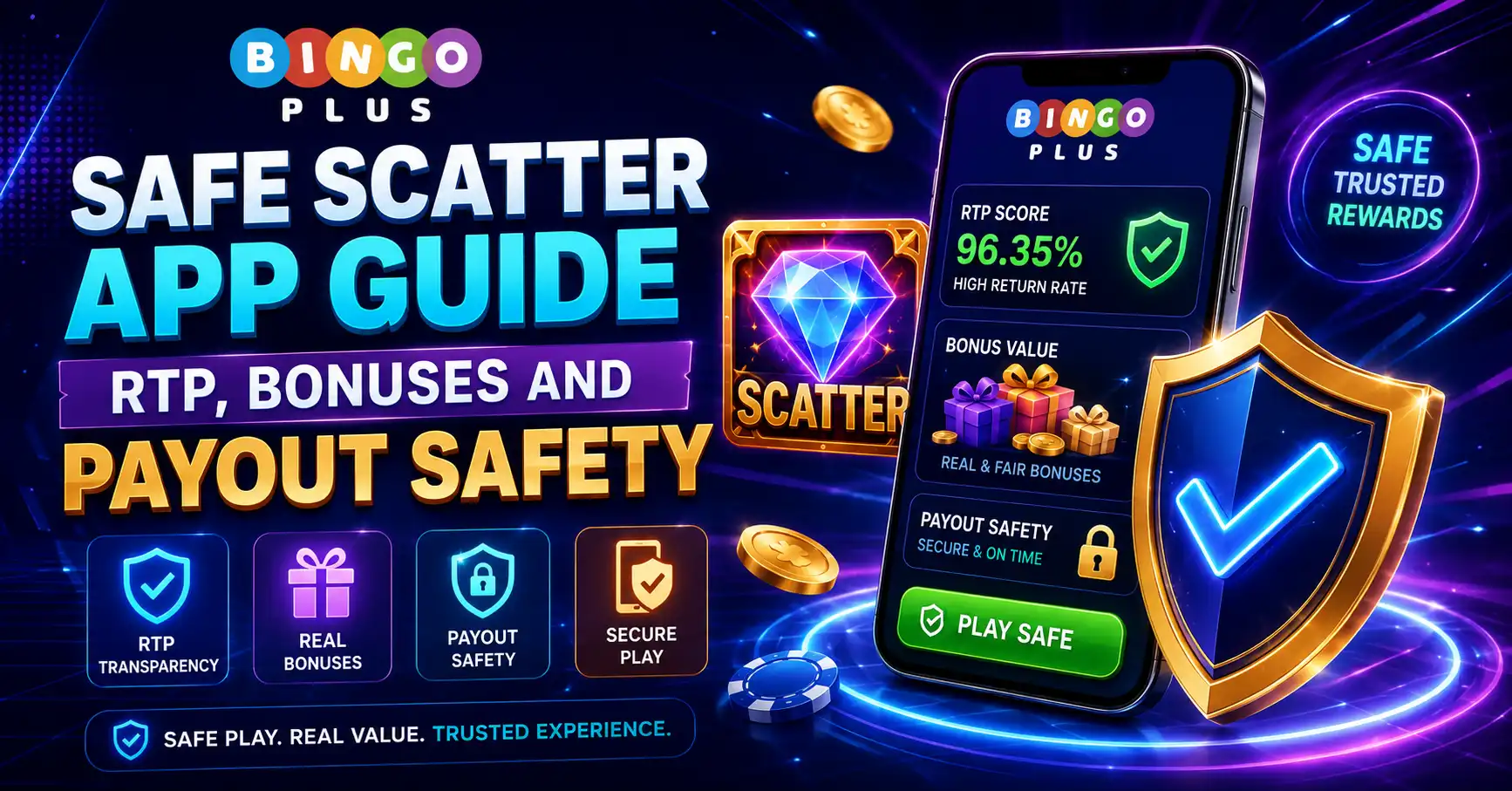
A polished gaming interface can hide an unregistered operator, modified APK, unfair bonus contract, or withdrawal process built to frustrate players.
I have reviewed enough platforms to know that attractive graphics and a copied regulatory logo prove very little. The real evidence sits behind the interface: legal identity, registered domain, game mathematics, and payment rules.

My three non-negotiable standards for any safe scatter app are:
- The operator, brand, and exact domain must match current official records.
- The game must disclose verifiable RTP, rules, provider details, and RNG information.
- KYC, wagering requirements, and withdrawal limits must be readable before any deposit.
- Click to spin for free and win the ultimate prize!
Bet responsibly, live a wonderful life. Gambling carries financial risk, every result is uncertain, and players remain responsible for using only money they can afford to lose.
What Makes a Scatter App Safe?
A scatter app offers games in which special symbols can activate free spins, cash awards, multipliers, jackpots, or secondary bonus rounds.
Scatter symbols often pay without following a fixed payline. Their behaviour depends entirely on the published game rules.
A scatter may qualify:
- Anywhere on the visible grid
- On specific reels only
- On consecutive reels
- Once per reel
- Several times on one reel
- During the base game
- Through a collection meter
- During an existing bonus round
Common mechanics include:
- Free-spin triggers
- Feature retriggers
- Cascading wins
- Sticky or expanding wilds
- Progressive multipliers
- Mystery symbols
- Fixed or progressive jackpots
- Bonus-buy features
- Maximum-win caps
These features do not establish safety. A safe product requires both a legitimate platform and a transparent mathematical model.
PAGCOR Licensing and Domain Verification
For Philippine-facing online gaming, the primary official authority is the Philippine Amusement and Gaming Corporation, or PAGCOR.
PAGCOR is a major official compliance standard for lawful Philippine gaming operations. It should not be treated as a universal regulator for every Asian jurisdiction, since local laws and regulatory authorities differ.
The PAGCOR Electronic Gaming Licensing Department publishes regulatory materials and current lists covering accredited operators, brands, domains, affiliates, and support providers.
Check the Current Official Lists
A logo inside an app cannot establish that the operator or download address is authorised.
I cross-check the service against:
- PAGCOR-accredited gaming system administrators, brands, and registered domains
- PAGCOR-approved brands and domains of licensed casinos
- PAGCOR Electronic Gaming Licensing Department
The current documents available when this guide was reviewed were dated July 20, 2026. Regulatory information can change, so players should open the live PAGCOR page instead of relying on an old screenshot or cached article.
The gaming-system-administrator list and licensed-casino list cover different regulatory categories. Search both when the operator type is unclear.
My BingoPlus Verification Process
Before entering a password, payment detail, or identity document, I:
- Open pagcor.ph directly rather than through an advertisement.
- Select the latest registered-brand and domain document.
- Search for BingoPlus and its named operator.
- Compare the complete destination domain character by character.
- Confirm that any subdomain belongs to the registered root domain.
- Verify that the connection uses HTTPS.
- Check the app-download domain separately.
- Reject shortened URLs and unexplained redirects.
- Reach customer support only through the verified platform.
This process substantially reduces phishing exposure. It cannot provide a literal 100% guarantee, because compromised devices, stolen accounts, malicious advertisements, and social-engineering attacks remain possible.
Reject access points involving:
- Misspelled brand names
- Added words or hyphens
- Unlisted domain extensions
- APK files hosted on public file-sharing services
- Private-message payment agents
- Requests for wallet PINs or one-time passwords
- Support accounts reached only through social media
- Pressure to deposit before verification
Never send identification documents through Telegram, Facebook Messenger, WhatsApp, or another unverified private channel.
What PAGCOR Verification Does Not Guarantee
An official regulatory match can connect a brand and domain with an accountable operator. It does not promise:
- A profitable session
- Frequent scatter triggers
- A particular RTP
- Positive bonus value
- Immediate withdrawals
- Unlimited transaction amounts
- Approval of incomplete KYC
- Protection from every form of fraud
Platform legitimacy and game value are separate questions.
A regulated platform may offer a high-volatility game. A high-RTP title may still be unsafe when opened through a copied domain or modified installation package.
How Scatter Game Mathematics Works
The spinning animation is only the presentation layer. An underlying mathematical model selects outcomes and calculates payouts.
That model may control:
- Virtual reel strips
- Symbol weighting
- Scatter frequency
- Wild frequency
- Trigger probability
- Retrigger probability
- Multiplier distribution
- Jackpot probability
- Hit frequency
- Maximum-win probability
- RTP allocation
- Volatility and variance
A legitimate digital game normally uses a random number generator, or RNG, to produce outcomes according to its approved configuration.
The reel animation displays the selected outcome. It does not create a new probability while the symbols are moving.
Estimating Scatter Trigger Probability
Assume an illustrative five-reel game activates free spins when scatters appear on at least three reels.
If each reel has an independent scatter probability p, the trigger probability can be estimated as:P(X≥3)=k=3∑5(k5)pk(1−p)5−k
Using an illustrative 8% scatter probability per reel:p=0.08
The estimated result is:P(X≥3)≈0.004526
This equals approximately:0.453%≈1 trigger per 221 rounds
This is an educational model, not a disclosed probability for a specific BingoPlus game.
Real titles may use:
- Different probability weights on each reel
- Several scatter positions
- Reel-specific blocking rules
- One-scatter-per-reel counting
- Conditional feature logic
- Separate base-game and bonus reels
- Mystery-symbol transformations
- Market-specific configurations
Players generally cannot determine the real trigger probability by counting visible symbols.
More Scatters Mean Sharply Lower Probability
Using the same five-reel model with an 8% probability per reel, the probability of exactly three scatters is:P(X=3)=(35)(0.08)3(0.92)2≈0.433%
The probability of exactly four is:P(X=4)=(45)(0.08)4(0.92)≈0.0188%
Four scatters would occur far less frequently under this simplified model.
That matters when a paytable advertises:
- Extra free spins for four or five scatters
- Larger starting multipliers
- Premium bonus modes
- Direct cash awards
- Jackpot eligibility
- Maximum feature packages
The largest advertised prize can contribute to theoretical RTP while remaining exceptionally rare.
Near-Misses Have No Predictive Value
Two scatters followed by a third symbol stopping outside the active grid can feel like a near win. That visual result does not improve the next round.
For independent outcomes:P(next result∣previous results)=P(next result)
A long sequence without a bonus does not make the feature “due.” Treating previous losses as evidence of an approaching win is the gambler’s fallacy.
RTP and House Edge
Return to player, or RTP, estimates the proportion of eligible wagers returned across a very large mathematical sample.RTP=Total eligible wagersTheoretical player returns×100
A game with 96% RTP has a theoretical house edge of:100%−96%=4%
If total wagering reaches ₱25,000, the modelled cost is:₱25,000×0.04=₱1,000
This does not mean one player will lose exactly ₱1,000. Short sessions can finish well above or below the theoretical average because of variance.
Scatter Features May Hold Much of the RTP
Total RTP can be divided into mathematical components:Total RTP=Base-game RTP+Scatter-feature RTP+Other-feature RTP
Consider a hypothetical game:
- Base-game RTP: 69.00%
- Scatter-feature RTP: 25.50%
- Other-feature RTP: 1.50%
- Total RTP: 96.00%
More than one-quarter of the theoretical return is concentrated inside the scatter feature.
A short session without a trigger may therefore perform far below 96% RTP. The published figure applies to the complete long-run mathematical model, not an individual session.
Compare the Active RTP Configuration
The same game may be supplied in several approved configurations:
- 96.50% RTP
- 95.00% RTP
- 94.00% RTP
- A separate bonus-buy RTP
- A regional configuration
I inspect the live information panel for:
- Current RTP
- Game version
- Provider identity
- Volatility
- Scatter requirements
- Retrigger rules
- Bonus-buy return
- Maximum win
- Paytable details
Do not rely on an RTP copied from an old review. It may belong to another operator, market, or configuration.
Higher RTP Reduces Long-Run Cost
For ₱100,000 in total wagering:Expected cost at 94% RTP=₱100,000×0.06=₱6,000
At 97% RTP:Expected cost at 97% RTP=₱100,000×0.03=₱3,000
The higher-RTP version reduces the theoretical cost by ₱3,000 across that wagering volume.
It does not guarantee profit. It only lowers the programmed mathematical disadvantage.
Volatility, Variance, and Hit Frequency
Volatility describes how widely results can move around the expected return.
- Low volatility: Smaller payouts tend to appear more regularly.
- Medium volatility: Routine wins mix with occasional larger features.
- High volatility: Long losing sequences can be interrupted by rare large payouts.
Scatter games are often medium-to-high or high volatility because substantial value may sit inside:
- Free-spin rounds
- Retriggers
- Growing multipliers
- Long cascades
- Expanding symbols
- Jackpot features
- Low-probability maximum wins
Two games can both publish 96% RTP while producing radically different short-session results.
Hit Frequency Is Not Profit Frequency
Hit frequency measures how often a defined winning result occurs. It does not measure how often the returned amount exceeds the stake.
Example:
- Stake: ₱20
- Returned amount: ₱8
- Recorded outcome: Winning hit
- Financial result: ₱12 net loss
Separate these metrics:
- Any-win frequency
- Stake-recovery frequency
- Profitable-round frequency
- Scatter appearance frequency
- Feature-trigger frequency
- Retrigger frequency
- Jackpot probability
Frequent winning animations can coexist with a negative financial result.
RNG Fairness and Practical Verification
A technically fair RNG should follow its approved probability model without adjusting outcomes because a player recently deposited, won, lost, or requested a withdrawal.
My technical checklist includes:
- Identifiable game provider
- Accessible rules and paytable
- Current RTP disclosure
- Game-version information
- Scatter-trigger conditions
- Retrigger rules
- Maximum-win disclosure
- Named RNG testing evidence
- Consistent real-money rules
- No claims of guaranteed patterns
A testing-company logo is weak evidence when the game version, provider, report scope, and verification method are missing.
No Betting System Changes the House Edge
Increasing stakes after losses, alternating bet sizes, or following “hot game” predictions does not change programmed RTP.Expected loss=Total wagering×House edge
A staking pattern only changes:
- How quickly the bankroll moves
- The size of financial swings
- The likelihood of reaching a limit
- The amount exposed to rare outcomes
Choosing a verified higher-RTP configuration can reduce theoretical cost. A betting progression cannot.
A Safer Bankroll Framework
I treat scatter games as paid entertainment, never as an income source.
Use this basic exposure calculation:Planned rounds=Stake per roundSession budget
With a ₱1,200 budget and a ₱12 stake:₱1,200÷₱12=100 planned rounds
My session rules are:
- Use only disposable entertainment money.
- Set the budget before opening the app.
- Keep stakes small relative to the budget.
- Establish a separate time limit.
- Never borrow to continue playing.
- Never increase stakes to recover losses.
- Do not chase an overdue scatter.
- Stop when either limit is reached.
- Never cancel a withdrawal to continue.
Bankroll controls reduce exposure. They do not create positive expected value.
How Wagering Requirements Reduce Bonus Value
A bonus is a conditional contract, not free cash.
Check for:
- 10x, 20x, or 30x wagering
- Bonus-only turnover
- Deposit-plus-bonus turnover
- Reduced game contribution
- Excluded scatter titles
- Maximum-bet restrictions
- Feature-buy restrictions
- Expiry periods
- Maximum convertible winnings
- Withdrawal caps
- KYC deadlines
Compare 10x and 30x Turnover
Assume a player deposits ₱2,000 and receives a ₱1,000 bonus.
With 10x bonus-only wagering:₱1,000×10=₱10,000
With 10x deposit-plus-bonus wagering:(₱2,000+₱1,000)×10=₱30,000
With 30x deposit-plus-bonus wagering:(₱2,000+₱1,000)×30=₱90,000
The same advertised ₱1,000 reward can create nine times more turnover under the least favourable example.
Calculate the Expected Turnover Cost
Use this simplified formula:Expected turnover cost=Eligible wagering×House edge
For ₱30,000 in wagering on a 96% RTP game:₱30,000×0.04=₱1,200
A basic value proxy is:Bonus value proxy=Bonus amount−Expected turnover cost
Therefore:₱1,000−₱1,200=−₱200
The promotion produces a simplified estimated value of negative ₱200 before volatility, withdrawal caps, balance depletion, and possible rule violations are considered.
This formula is a comparison method, not a prediction of an individual result.
Account for Reduced Game Contribution
Suppose scatter games contribute only 20% toward a ₱30,000 requirement.₱30,000÷0.20=₱150,000
At a 4% house edge:₱150,000×0.04=₱6,000
A ₱1,000 bonus linked to an estimated ₱6,000 turnover cost has poor mathematical value.
If a scatter game contributes 0%, playing it increases risk without reducing the outstanding requirement.
My Pre-Deposit Bonus Checklist
Before accepting a BingoPlus or other platform offer, I record:
- Deposit amount
- Bonus amount
- Wagering multiplier
- Turnover calculation base
- Eligible games
- Contribution percentage
- Active RTP
- Maximum permitted stake
- Bonus expiry
- Maximum convertible winnings
- Withdrawal limit
- KYC deadline
- Terms that cancel the bonus or winnings
I reject any offer that hides material conditions until after activation.
KYC Verification and Withdrawal Limits
KYC verification helps an operator confirm legal age, identity, account ownership, and payment-source consistency.
Verification may require:
- Government-issued identification
- Selfie or facial verification
- Mobile-number confirmation
- Address information
- Proof of wallet ownership
- Source-of-funds evidence in selected cases
Completing KYC early can reveal mismatched details before a withdrawal is requested.
Payment may be delayed when:
- The player and wallet names differ.
- Identification is expired or unreadable.
- Multiple accounts appear connected.
- Wagering requirements remain incomplete.
- The request exceeds a withdrawal limit.
- Activity requires a security review.
- The payment network is unavailable.
- A large payout needs manual validation.
A transparent service should disclose minimum withdrawals, daily limits, processing estimates, supported payment methods, KYC conditions, and complaint channels before accepting deposits.
How I Assess BingoPlus as a Safe Scatter App
When examining BingoPlus, I separate platform verification from individual game value.
Platform-Level Review
- Current PAGCOR record
- Exact registered domain
- Named legal operator
- Verified app-download source
- Secure login process
- KYC requirements
- Deposit rules
- Withdrawal limits
- Official support channels
- Responsible-gaming controls
Game-Level Review
- Provider identity
- Current game version
- Active RTP
- Theoretical house edge
- Volatility
- Scatter requirements
- Retrigger rules
- Hit frequency, when disclosed
- Maximum win
- Bonus-buy RTP
- Promotion contribution rate
A PAGCOR-listed access point does not make every game mathematically attractive. A strong RTP also cannot make a copied domain or modified APK safe.
Both verification layers must pass before I consider depositing.
Frequently Asked Questions
Does a safe scatter app require KYC before withdrawal?
Usually, yes. A regulated operator may verify identity, legal age, wallet ownership, account activity, and bonus compliance before releasing funds.
Complete KYC early and keep the registered player name consistent with the payment account.
Are scatter app results technically fair?
They can be fair when an identifiable provider uses an independently tested RNG through a properly regulated platform.
Technical fairness does not remove the house edge. Check the active RTP, provider, game version, rules, and testing evidence.
How long does a scatter app withdrawal take?
There is no universal processing time. Timing depends on KYC status, payment method, bonus completion, transaction limits, security reviews, and payment-network availability.
Read the current withdrawal policy before depositing and retain every transaction reference.