




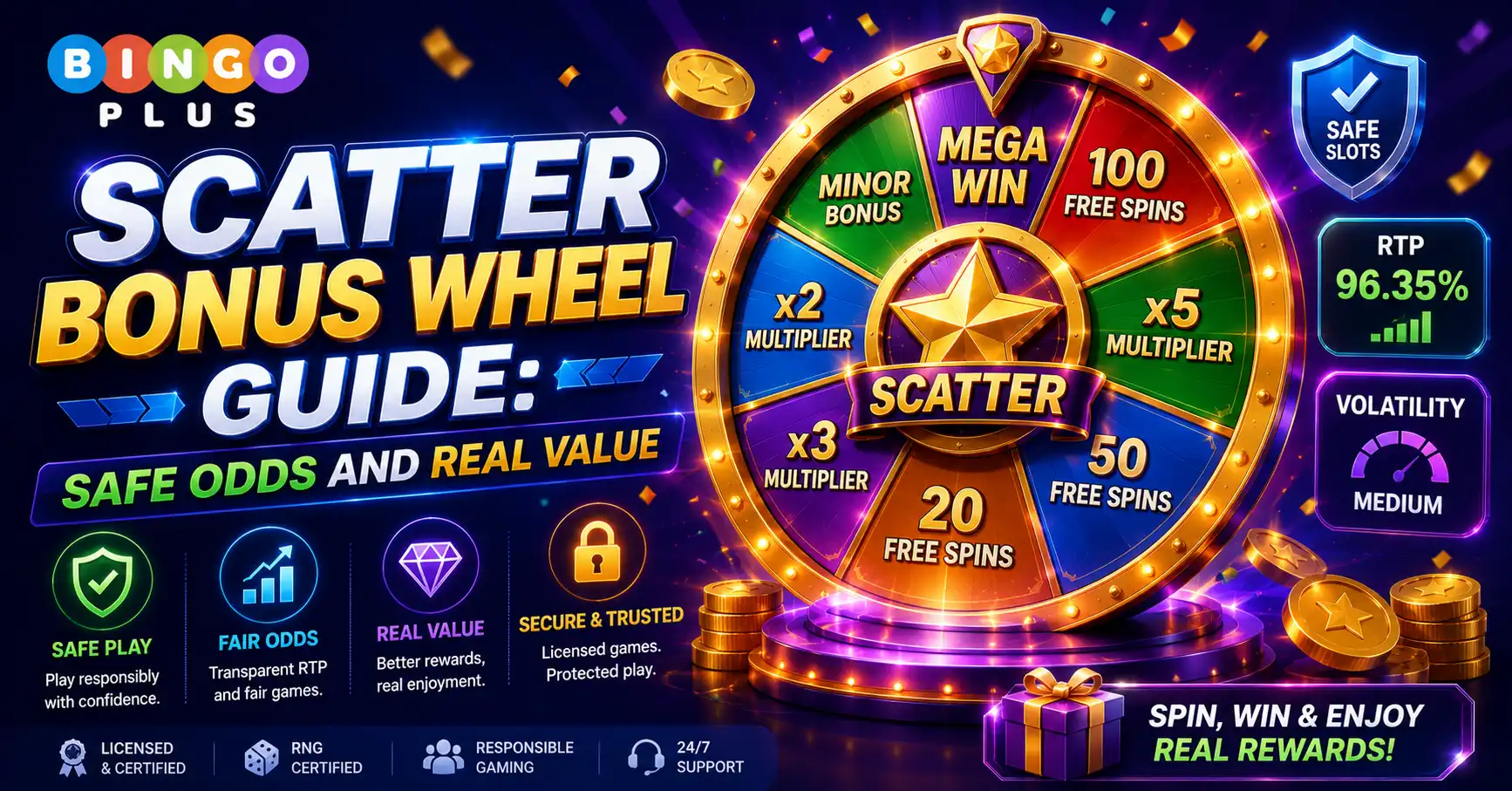
A scatter bonus wheel can award free spins, cash prizes, multipliers, jackpots, or access to a second bonus stage.
It can also mislead players.
A wheel may display several equal-sized prize segments even though the underlying outcomes are not equally probable. A platform may advertise a huge jackpot while withholding the actual trigger rules, maximum-win cap, wagering conditions, or withdrawal limits.
The risk becomes worse when a copied website uses a familiar brand and a fake regulatory logo.

Before I deposit on BingoPlus or assess any Philippine-facing platform, I apply three non-negotiable standards:
- The exact domain must appear in a current PAGCOR regulatory record.
- The game must disclose credible RTP, scatter, wheel, multiplier, and prize rules.
- The operator must publish clear KYC, wagering, withdrawal, and responsible-gaming terms.
- Click to spin for free and win the ultimate prize!
A wheel animation does not determine the result.
A large visible segment does not prove equal probability.
Bet responsibly, live a wonderful life. Gambling carries financial risk, no bonus outcome is guaranteed, and every player remains responsible for personal limits and losses.
What Is a Scatter Bonus Wheel?
A scatter bonus wheel is a secondary game feature activated after the required number of scatter symbols lands.
The wheel may award:
- Free spins
- Cash prizes
- Bet multipliers
- Win multipliers
- Mystery bonuses
- Jackpot levels
- Extra wheel spins
- Feature upgrades
- Sticky wilds
- Expanding reels
- Collectible symbols
- Entry into another bonus round
A common structure requires at least three scatter symbols.
Additional scatters may:
- Improve the starting multiplier
- Add more wheel spins
- Unlock stronger prize segments
- Upgrade a jackpot level
- Increase the minimum prize
- Open a second wheel
The exact mechanic depends on the game’s live paytable.
Scatter trigger versus wheel result
The scatter event and wheel event are separate mathematical stages.
The first stage determines whether the wheel activates:
[
P(\text{wheel access})=P(\text{qualifying scatter trigger})
]
The second stage determines the wheel award:
[
P(\text{specific prize})=
P(\text{wheel access})
\times
P(\text{prize}\mid\text{wheel access})
]
The symbol (\mid) means “given that.”
A jackpot may appear prominently on the wheel while remaining extremely unlikely after the feature triggers.
Core Entities Behind Bonus-Wheel Games
Our team evaluates scatter bonus wheel games through these technical entities:
- Scatter symbol
- Bonus trigger
- Weighted prize segment
- Random number generator
- Return to Player
- House edge
- Volatility
- Variance
- Conditional probability
- Feature RTP
- Multiplier weighting
- Retrigger probability
- Jackpot contribution
- Maximum-win cap
These terms reveal more than the wheel’s visual design.
They explain how frequently the feature appears, how prizes are weighted, and how much of the total theoretical return is concentrated inside the wheel.
Verify PAGCOR Legality Before Playing
Why regulatory verification comes first
Wheel mathematics cannot protect a deposit sent to a phishing site.
Fraudulent gaming pages can copy:
- PAGCOR logos
- BingoPlus branding
- Game-provider graphics
- Payment icons
- Bonus-wheel animations
- License certificates
- Jackpot counters
- Customer-support identities
For Philippine players, the Philippine Amusement and Gaming Corporation, or PAGCOR, is the primary official source for checking electronic gaming regulatory records.
PAGCOR’s Electronic Gaming Licensing Department publishes information covering regulatory frameworks, accredited gaming system administrators, registered brands, licensed casino domains, gaming affiliates, and support providers.
Check the official PAGCOR domain list
PAGCOR publishes the List of PAGCOR-Accredited Gaming System Administrators and Registered Brands and Domain Names/URLs.
The current document is dated June 30, 2026 and identifies approved administrators, brands, main domains, subdomains, and additional URLs. The list includes registered BingoPlus-related domains.
Players can use these official references:
- PAGCOR Electronic Gaming Licensing Department
- PAGCOR Registered Brands and Domain Names PDF
- PAGCOR Responsible Gaming Information
My domain-checking process is direct:
- Open the official PAGCOR regulatory website.
- Access the newest registered-brand and domain PDF.
- Search for BingoPlus.
- Confirm the listed gaming system administrator.
- Compare the complete address character by character.
- Verify the controlling root domain.
- Bookmark the confirmed address.
I do not rely on screenshots supplied by an advertiser, agent, or unofficial customer-service account.
Why a copied PAGCOR logo proves nothing
A regulatory logo displayed by a website is not independent evidence.
The operator controls its own page and can place any image in the footer.
Independent verification requires checking:
- The regulator’s own website
- The current domain record
- The exact root domain
- The registered brand
- The associated administrator
The official record should be treated as the primary reference.
Root domains and deceptive subdomains
Consider this address:
bingoplus.secure-wheel-example.com
The controlling root domain is:
secure-wheel-example.com
The word “bingoplus” is only a subdomain.
Other phishing techniques include:
- Adding an extra letter
- Removing one letter
- Replacing characters with similar symbols
- Adding a hyphen
- Changing the extension
- Using shortened links
- Adding words such as “official,” “VIP,” or “secure”
I never log in through an address received from an unknown message, unofficial group, or private agent.
Can a whitelist prevent phishing with 100% certainty?
No security method can provide a literal 100% guarantee.
Cross-checking PAGCOR’s official domain record materially reduces the risk of visiting an imitation site, but other threats remain possible:
- Malware
- Stolen login credentials
- Fake support accounts
- Compromised browser extensions
- One-time-password theft
- DNS manipulation
- Remote-access scams
- Shared-device sessions
My additional controls include:
- Use a bookmarked verified address.
- Confirm HTTPS is active.
- Never share passwords or one-time codes.
- Refuse screen-sharing requests.
- Do not install files from unknown agents.
- Avoid transfers to personal wallets.
- Log out on shared devices.
- Complete payments only inside the verified platform.
How a Scatter Bonus Wheel Actually Works
Stage 1: Scatter-trigger probability
The feature begins when the required scatter combination appears.
A simplified trigger probability is:
[
P(T)=P(\text{required scatter combination})
]
Suppose the wheel triggers once every 200 spins on average.
The simplified per-spin probability is:
[
P(T)=\frac{1}{200}=0.005
]
That equals:
[
0.5%
]
This is an average probability, not a countdown.
The wheel is not guaranteed to appear by spin 200.
Stage 2: Prize-segment probability
After the trigger, the game selects a prize outcome.
Suppose the wheel offers:
- 5× stake
- 10× stake
- 20× stake
- 50× stake
- 100× stake
- Mini jackpot
The game may visually present six segments.
That does not prove each outcome has a probability of:
[
\frac{1}{6}=16.67%
]
The actual probabilities can be weighted.
Stage 3: Final payout
The final expected wheel value depends on:
- Trigger probability
- Prize probability
- Prize amount
- Multiplier application
- Maximum-win cap
- Retrigger chance
- Feature cost
A simplified model is:
P(T)
\times
E(W)
]
Where:
- (P(T)) is the wheel-trigger probability
- (E(W)) is the expected wheel prize
The Wheel Animation Is Not the RNG
The visible wheel is usually an animation representing an outcome selected by the game system.
It should not be assumed that the wheel’s physical-looking movement determines the prize.
A legitimate digital game normally uses an RNG and approved mathematical configuration to select the result.
The following actions do not normally improve wheel odds:
- Pressing the stop button at a specific time
- Tapping faster
- Waiting before spinning
- Changing devices
- Switching internet connections
- Increasing the stake after losses
- Closing and reopening the game
The animation communicates the result.
It does not create skill-based control where the rules do not provide it.
Equal-Sized Segments May Have Unequal Odds
Visual size versus mathematical weight
A digital wheel can show eight equal visual sections while assigning different probability weights to them.
For example:
| Prize | Displayed Segments | Actual Probability |
|---|---|---|
| 2× | 1 | 35% |
| 3× | 1 | 25% |
| 5× | 1 | 18% |
| 10× | 1 | 12% |
| 20× | 1 | 6% |
| 50× | 1 | 3% |
| 100× | 1 | 0.9% |
| Jackpot | 1 | 0.1% |
Visually, every section may occupy one-eighth of the wheel.
Mathematically, the jackpot probability is only 0.1% after reaching the wheel.
Why weighted segments matter
Players often estimate odds by looking at segment size.
That method is reliable only when the rules confirm that all sections have equal probability.
In an RNG-controlled wheel, the software can select from a weighted outcome table before the pointer stops.
I look for:
- Published prize probabilities
- Game help documentation
- Provider rules
- Jackpot contribution information
- Certified mathematical data
- Mode-specific RTP
When exact probabilities are unavailable, I do not assume equal weighting.
Expected Value of a Bonus Wheel
Basic expected-prize formula
The expected wheel prize is:
[
E(W)=\sum_{i=1}^{n}p_iw_i
]
Where:
- (p_i) is the probability of prize (i)
- (w_i) is the prize value
Assume the following hypothetical distribution:
- 2× with 35% probability
- 3× with 25% probability
- 5× with 18% probability
- 10× with 12% probability
- 20× with 6% probability
- 50× with 3% probability
- 100× with 0.9% probability
- 1,000× jackpot with 0.1% probability
Then:
[
E(W)=
(0.35\times2)+
(0.25\times3)+
(0.18\times5)+
(0.12\times10)
]
[
+
(0.06\times20)+
(0.03\times50)+
(0.009\times100)+
(0.001\times1000)
]
[
E(W)=0.70+0.75+0.90+1.20+1.20+1.50+0.90+1.00
]
[
E(W)=8.15×
]
The headline jackpot is 1,000×.
The expected wheel award in this simplified example is 8.15× stake.
Include the trigger probability
Suppose the wheel triggers on 0.5% of base spins:
[
P(T)=0.005
]
Then:
0.005\times8.15
]
0.04075\ betting\ units
]
At a ₱10 stake:
[
₱10\times0.04075=₱0.4075
]
The wheel contributes an estimated ₱0.4075 per base spin under this simplified model.
That contribution is normally already included in the game’s total RTP.
RTP and House Edge
RTP is a long-run theoretical rate
Return to Player, or RTP, estimates the percentage of total wagering returned over a very large number of outcomes.
The house edge is:
[
House\ Edge=100%-RTP
]
For a slot with 96% RTP:
[
House\ Edge=100%-96%=4%
]
If cumulative wagering reaches ₱25,000:
[
Expected\ Loss=
₱25,000\times0.04
]
[
Expected\ Loss=₱1,000
]
This does not predict one session.
A player may finish far above or below the theoretical result because short-term outcomes are affected by variance.
Wheel RTP is part of total RTP
A scatter bonus wheel does not normally add extra return above the advertised RTP.
It receives a portion of the total theoretical return.
A simplified structure may be:
[
Total\ RTP=
Base\ Game\ RTP+
Scatter\ RTP+
Wheel\ RTP+
Other\ Feature\ RTP
]
For example:
- Base-game RTP: 67%
- Scatter payout RTP: 7%
- Bonus-wheel RTP: 18%
- Other-feature RTP: 4%
Then:
[
67%+7%+18%+4%=96%
]
The wheel’s 18% contribution is already included in the total 96%.
Feature dependency
A game is feature-dependent when a large share of theoretical return sits inside the wheel.
Compare two hypothetical 96% games.
Game A
- Base-game RTP: 80%
- Wheel RTP: 12%
- Other-feature RTP: 4%
Game B
- Base-game RTP: 58%
- Wheel RTP: 34%
- Other-feature RTP: 4%
Game B may produce:
- Weaker base-game wins
- Longer dry periods
- Greater dependence on the wheel
- Higher short-term bankroll risk
- Wider session outcomes
The total RTP is identical.
The payout distribution is not.
Volatility and Variance
Why wheel games can be highly volatile
A bonus wheel often concentrates value in a small number of rare prizes.
Most wheel outcomes may be modest.
A tiny percentage may deliver:
- Large multipliers
- Major jackpots
- Maximum free-spin packages
- Feature upgrades
- Second-level bonus access
This creates a wide outcome distribution.
Variance formula
Variance is:
[
Variance=E[(X-\mu)^2]
]
Where:
- (X) is an individual outcome
- (\mu) is the expected outcome
- (E) represents expected value
Standard deviation is:
[
Standard\ Deviation=\sqrt{Variance}
]
Players do not need to calculate the exact variance to understand its practical effect.
High variance means actual outcomes may differ sharply from the average.
Low-volatility wheel design
A lower-volatility wheel may use:
- Frequent wheel triggers
- Mostly small prizes
- Limited jackpot values
- Narrow multiplier ranges
- Modest maximum wins
High-volatility wheel design
A higher-volatility wheel may use:
- Rare triggers
- Many low-value wheel outcomes
- Very rare high multipliers
- Jackpot segments
- Secondary bonus stages
- Large maximum-win claims
Two games may have the same total RTP while offering very different bankroll experiences.
Combined Probability of a Jackpot Wheel Result
A jackpot requires both:
- Triggering the wheel
- Landing the jackpot result
The combined probability is:
[
P(J)=P(T)\times P(J\mid T)
]
Assume:
- Wheel trigger probability: 0.5%
- Jackpot probability after triggering: 0.1%
Convert the percentages:
[
0.5%=0.005
]
[
0.1%=0.001
]
Then:
[
P(J)=0.005\times0.001
]
[
P(J)=0.000005
]
As a percentage:
[
0.000005\times100=0.0005%
]
The average interval is approximately:
[
\frac{1}{0.000005}=200,000\ spins
]
This simplified model illustrates why a clearly visible jackpot segment can remain extremely rare.
The wheel’s appearance does not reveal the combined probability.
Fixed, Progressive, and Mystery Jackpots
Fixed jackpot
A fixed jackpot pays a predetermined amount or stake multiplier.
For example:
[
Jackpot=5,000\times Stake
]
At a ₱10 stake:
[
5,000\times₱10=₱50,000
]
Progressive jackpot
A progressive jackpot grows as eligible wagers contribute to the prize pool.
Part of each qualifying stake may fund:
- A local jackpot
- A network jackpot
- A provider-wide jackpot
- A platform-wide prize pool
Players should check:
- Minimum eligible stake
- Jackpot contribution rate
- Local or networked status
- Seed amount
- Reset amount
- Maximum payout
- Verification conditions
Mystery jackpot
A mystery jackpot may be selected randomly rather than through a visible wheel segment.
The display may show the current amount without revealing when it will trigger.
A mystery jackpot still forms part of the approved game mathematics.
It is not “due” because the displayed amount has grown.
Bonus-Wheel Multipliers
A wheel may award a multiplier rather than a direct cash prize.
Suppose the possible results are:
- 2×
- 3×
- 5×
- 10×
- 20×
The multiplier may apply to:
- Total stake
- Current spin win
- Free-spin winnings
- One symbol combination
- A fixed bonus value
- A future feature
Example
Assume:
- Base bonus win: ₱200
- Wheel result: 5×
Then:
[
Final\ Win=₱200\times5
]
[
Final\ Win=₱1,000
]
But if the multiplier applies only to a ₱20 qualifying symbol win:
[
₱20\times5=₱100
]
The paytable must define the multiplication base.
Multiple Wheel Spins and Retriggers
Some games award more than one wheel spin.
A second wheel may:
- Add another cash prize
- Multiply the first prize
- Upgrade the jackpot
- Add free spins
- Unlock a premium wheel
Additive model
If wheel prizes are added:
[
5×+10×=15×
]
Multiplicative model
If the second wheel multiplies the first:
[
5×\times10×=50×
]
The difference is substantial.
Never assume the more favorable treatment without checking the rules.
Expected wheel count
If the chance of earning another wheel spin is (r), a simplified expected-cycle formula is:
[
Expected\ Wheel\ Spins=\frac{1}{1-r}
]
Assume:
[
r=0.20
]
Then:
[
Expected\ Wheel\ Spins=
\frac{1}{0.80}
]
[
Expected\ Wheel\ Spins=1.25
]
This model assumes repeated extra spins are possible under similar conditions.
Actual games may impose caps or changing probabilities.
Can Bet Size Improve Wheel Odds?
In most fixed game configurations, increasing the stake changes the cash value of outcomes without improving the probability of triggering the wheel.
If the stake doubles:
- Cash wins double
- Cash losses double
- Cash variance increases
- Bankroll duration falls
- Trigger probability usually remains unchanged
A higher bet does not normally make the jackpot segment more likely.
Possible configuration exceptions
Some games offer:
- Ante bets
- Enhanced feature bets
- Jackpot-eligible stake levels
- Multiple RTP settings
- Bonus buys
- Premium wheel modes
An enhanced bet may increase wheel frequency while charging a higher amount.
The correct comparison is:
[
Value\ Efficiency=
\frac{Expected\ Feature\ Return}{Total\ Cost}
]
A higher trigger probability does not prove better value if the increased cost is greater than the additional expected return.
Bonus-Buy Wheel Features
Some games allow direct purchase of the scatter bonus or wheel feature.
Suppose:
- Base stake: ₱10
- Feature price: 100× stake
- Purchase cost: ₱1,000
- Bonus-mode RTP: 96.5%
The expected theoretical return is:
[
₱1,000\times0.965=₱965
]
The theoretical expected loss is:
[
₱1,000-₱965=₱35
]
That does not mean one wheel purchase should return close to ₱965.
One purchase may pay almost nothing.
Another may award a major multiplier or jackpot.
Bonus buys compress high variance into a single expensive event.
Practical Bankroll Strategy
Calculate available spins
Use:
[
Available\ Spins=
\frac{Session\ Bankroll}{Stake\ Per\ Spin}
]
With a ₱3,000 bankroll:
At ₱30 per spin:
[
\frac{₱3,000}{₱30}=100\ spins
]
At ₱10 per spin:
[
\frac{₱3,000}{₱10}=300\ spins
]
At ₱5 per spin:
[
\frac{₱3,000}{₱5}=600\ spins
]
More spins do not guarantee wheel access.
They provide more capacity to withstand normal losing sequences.
Stake percentage
Use:
[
Stake\ Percentage=
\frac{Stake}{Bankroll}\times100
]
For a ₱3,000 bankroll and a ₱30 stake:
[
Stake\ Percentage=1%
]
For a ₱5 stake:
[
Stake\ Percentage\approx0.167%
]
A 1% stake can exhaust a small bankroll quickly in a high-volatility bonus-wheel game.
My practical controls
Before playing, I set:
- A fixed entertainment budget
- A maximum stake
- A cash loss limit
- A session-time limit
- No stake escalation after losses
- No repeated bonus-buy chasing
- No borrowing
- No use of essential money
I do not chase a wheel because it has not triggered recently.
An average trigger interval is not a promise.
Bonus Wagering Requirements Exposed
Game value and promotional value are different
A mathematically competitive game can be attached to a poor promotion.
Bonus terms may impose:
- 10× or 30× rollover
- Deposit-plus-bonus wagering
- Reduced game contribution
- Maximum stake limits
- Maximum cash conversion
- Expiry deadlines
- Restricted payment methods
- KYC requirements
- Withdrawal limits
The promotion should be evaluated independently.
Basic rollover formula
Use:
[
Required\ Turnover=
Wagering\ Base\times Rollover
]
The wagering base may be:
- Bonus only
- Deposit plus bonus
- Free-spin winnings
- Wheel winnings
- Bonus plus winnings
- Fixed promotional credit
Example: 10× bonus-only rollover
Assume:
- Deposit: ₱1,000
- Bonus: ₱500
- Requirement: 10× bonus
Then:
[
Required\ Turnover=
₱500\times10
]
[
Required\ Turnover=₱5,000
]
Example: 10× deposit-plus-bonus rollover
Using the same amounts:
[
Required\ Turnover=
(₱1,000+₱500)\times10
]
[
Required\ Turnover=₱15,000
]
Both offers may advertise 10×.
The second requires three times more wagering.
Comparing 10× and 30× rollover
For a ₱500 bonus:
[
10×=₱5,000\ turnover
]
[
30×=₱15,000\ turnover
]
Assume the eligible game has 96% RTP.
The house edge is:
[
100%-96%=4%
]
The expected wagering cost is:
[
Expected\ Cost=
Turnover\times House\ Edge
]
At 10×:
[
₱5,000\times0.04=₱200
]
At 30×:
[
₱15,000\times0.04=₱600
]
The ₱500 bonus attached to 30× wagering has an estimated gaming cost of ₱600 before restrictions and volatility.
Calculate the bonus’s real mathematical value
Use:
[
Estimated\ Bonus\ Value=
Bonus-
Expected\ Wagering\ Cost-
Restriction\ Cost
]
Assume:
- Bonus value: ₱500
- Required turnover: ₱15,000
- House edge: 4%
- Estimated cap and restriction cost: ₱100
Then:
[
Expected\ Wagering\ Cost=
₱15,000\times0.04
]
[
Expected\ Wagering\ Cost=₱600
]
[
Estimated\ Bonus\ Value=
₱500-₱600-₱100
]
[
Estimated\ Bonus\ Value=-₱200
]
Under these assumptions, the promotion has negative estimated value.
Wheel-win conversion caps
Suppose promotional wheel spins produce ₱5,000, but the maximum convertible amount is ₱1,000.
The effective conversion rate is:
[
Conversion\ Rate=
\frac{₱1,000}{₱5,000}
]
[
Conversion\ Rate=20%
]
The wheel displayed a ₱5,000 result.
Only ₱1,000 enters the wagering or withdrawal process.
Game contribution can multiply the workload
Suppose the promotion requires ₱10,000 in qualifying turnover, but the wheel game contributes only 20%.
The actual betting volume required is:
[
Actual\ Betting\ Volume=
\frac{₱10,000}{0.20}
]
[
Actual\ Betting\ Volume=₱50,000
]
Always check the contribution table before accepting the promotion.
KYC Verification and Withdrawal Limits
KYC does not change wheel outcomes
Know Your Customer, or KYC verification, confirms identity, age, payment ownership, and account eligibility.
It does not alter:
- RNG outcomes
- Scatter frequency
- Wheel weighting
- RTP
- Volatility
- Jackpot probability
- Multiplier distribution
PAGCOR identified tighter KYC and identity-verification standards, mandatory self-exclusion tools, betting limits, and stronger advertising controls among its digital gaming regulatory measures in January 2026.
Common KYC requirements
A regulated operator may request:
- Government-issued identification
- Date-of-birth verification
- Mobile-number verification
- Selfie or facial matching
- Address information
- Payment-account ownership
- Source-of-funds evidence when required
I complete available verification before building a large balance.
Waiting until after a major wheel win can expose avoidable account mismatches.
Check withdrawal conditions before depositing
Review:
- Minimum withdrawal
- Daily withdrawal maximum
- Monthly withdrawal maximum
- Processing period
- Payment-channel restrictions
- Account-name matching
- Bonus turnover
- Conversion caps
- Maximum-win rules
- Manual-review conditions
A “fast withdrawal” claim means little without clear limits and eligibility rules.
Never pay an unofficial release fee
Treat separate payment requests as serious warning signs when they claim to cover:
- Withdrawal unlocking
- Tax clearance through a personal wallet
- Account synchronization
- RNG verification
- Jackpot activation
- VIP release
- Anti-fraud clearance
- Withdrawal insurance
Legitimate conditions should appear in the verified platform’s official terms and transaction flow.
Responsible Gaming Is Part of Platform Safety
PAGCOR states that gaming establishments must comply with its Responsible Gaming Code of Practice to minimize player harm, prevent gambling addiction, and prohibit underage gambling.
PAGCOR also provides exclusion procedures for players who believe their gambling is becoming harmful. Available self-exclusion periods include six months, one year, and five years.
Useful controls may include:
- Deposit limits
- Betting limits
- Session reminders
- Cooling-off periods
- Self-exclusion
- Account closure
- Access restrictions
- Player-support resources
A scatter bonus wheel is an entertainment mechanic.
It is not income, an investment, or a reliable method for recovering earlier losses.
My Scatter Bonus Wheel Evaluation Checklist
Before playing a wheel-based game on BingoPlus, I examine six areas.
1. Regulatory safety
- Exact domain appears in the current PAGCOR record
- Gaming system administrator is identifiable
- Official terms are accessible
- Responsible-gaming controls are available
2. Trigger mechanics
- Number of scatters required
- Trigger frequency
- Additional-scatter rewards
- Retrigger conditions
- Ante-bet options
- Bonus-buy availability
3. Wheel transparency
- Prize list
- Weighted or equal probabilities
- Direct cash or multiplier awards
- Extra-spin rules
- Jackpot qualification
- Maximum-win cap
4. Mathematical quality
- Published RTP
- House edge
- Wheel RTP contribution
- Expected wheel prize
- Conditional jackpot probability
- Volatility
- Variance
5. Bankroll exposure
- Stake as a percentage of bankroll
- Available spins
- Feature dependency
- Bonus-buy cost
- Loss limit
- Session duration
6. Promotion and withdrawal safety
- Wagering base
- Rollover multiple
- Game contribution
- Maximum stake
- Conversion cap
- KYC requirements
- Withdrawal limits
My priority order is fixed:
- Verified domain
- Withdrawal reliability
- Transparent wheel rules
- Suitable volatility
- Competitive RTP
- Promotional value
The largest wheel segment is not necessarily the most probable.
The highest jackpot is not necessarily the most relevant measure of value.
Frequently Asked Questions
Does KYC verification affect scatter bonus wheel results?
No. KYC does not change RTP, scatter frequency, wheel weighting, jackpot probability, or RNG results. It verifies identity, age, payment ownership, and withdrawal eligibility.
Is a digital bonus wheel technically fair?
A legitimate wheel should select outcomes through its approved RNG and mathematical configuration. Equal-looking segments may carry different probability weights, so visual size alone does not prove equal odds.
Why is my withdrawal pending after a bonus wheel win?
Common reasons include incomplete KYC, unfinished wagering requirements, promotional conversion caps, payment-account checks, withdrawal limits, or manual security review. Review the applicable terms and contact support only through the PAGCOR-verified official domain.