

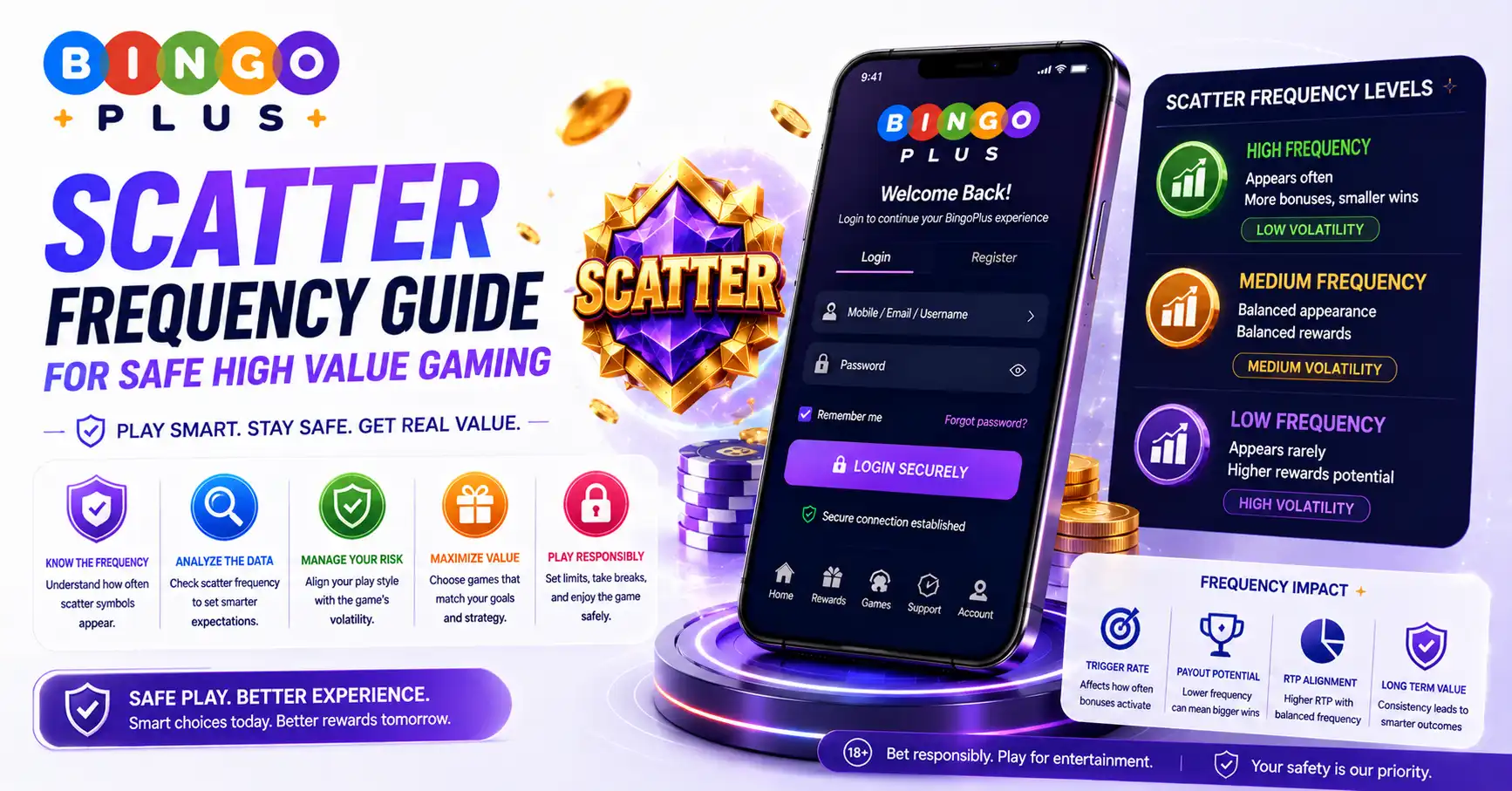
Players often assume that frequent scatter symbols mean frequent bonuses. That assumption can be expensive because scatter appearance frequency, qualifying trigger frequency, and profitable feature frequency are three different measurements.
The risk becomes worse on an unverified platform. A copied regulatory logo, altered game file, unclear withdrawal policy, or bonus with hidden rollover rules can matter far more than the advertised scatter rate.

Before I deposit on BingoPlus or evaluate another platform, I require three non-negotiable standards:
- The operator, brand, and exact domain must be independently verifiable.
- The game must disclose its RTP, scatter rules, paytable, volatility, and maximum win.
- The cashier must publish its KYC requirements, wagering conditions, and withdrawal limits.
- Click to spin for free and win the ultimate prize!
Scatter frequency can help compare games, but it cannot predict the next spin. Bet responsibly, live a wonderful life. Every wager carries financial risk, and the player remains responsible for all spending decisions.
What Does Scatter Frequency Mean?
Scatter frequency describes how often a scatter-related event occurs across a defined number of spins. The event must be clearly defined before the number becomes useful.
A provider might refer to:
- Any visible scatter symbol.
- Two or more scatters.
- Three qualifying scatters.
- A free-spin trigger.
- A jackpot-feature trigger.
- A scatter retrigger.
- A scatter payout of any size.
These events have very different probabilities. A game can display one or two scatters regularly while making the required three-symbol combination rare.
Core Entities Behind Scatter Frequency
Our team examines these technical entities when reviewing a scatter game:
- Random Number Generator
- Weighted reel strips
- Virtual reel stops
- Scatter symbol probability
- Trigger threshold
- Hit frequency
- Feature frequency
- Retrigger rate
- Return to Player
- Variance and volatility
Each entity answers a separate question. RTP estimates theoretical long-run return, while scatter frequency measures how often a defined scatter event occurs.
Verify the Platform Before Trusting Game Data
Mathematical analysis has no value if the platform is fraudulent. A fake website can copy a legitimate interface, licence image, promotional banner, and game screenshot within hours.
For Philippine-facing gaming services, the Philippine Amusement and Gaming Corporation, or PAGCOR, is the official national regulatory authority. PAGCOR regulates games of chance and licenses gaming operations within Philippine territory through its regulatory departments. PAGCOR Electronic Gaming Licensing Department
Use the Official PAGCOR Domain List
PAGCOR publishes an official list of accredited Gaming System Administrators, registered brands, and approved domain names. The current document is dated June 30, 2026 and contains BingoPlus-related brand and domain records. Official PAGCOR registered brands and domains PDF
My verification procedure is straightforward:
- Open the PDF through the official pagcor.ph website.
- Search for the operator or platform name.
- Identify the registered domains in the same record.
- Compare the full hostname with the website in the browser.
- Check every letter, dot, and domain extension.
- Repeat the check before installing an application.
The current list includes approved BingoPlus-related domains such as bingoplus.com and bingoplus.ph, along with associated URLs and subdomains. Players should use the latest PAGCOR document because approved records may change.
Recognize Phishing Patterns
A PAGCOR logo displayed in a footer is not proof of authorization. Fraudulent operators can copy logos and page designs without permission.
Common warning signs include:
- Misspelled brand names.
- Added hyphens or numbers.
- Unfamiliar domain extensions.
- Misleading subdomains.
- Shortened links in private messages.
- Unofficial Android installation files.
- Requests for passwords or one-time codes.
- Deposit instructions using unexplained personal accounts.
Matching the exact domain with the PAGCOR record is a strong phishing control. It cannot guarantee 100% prevention, since malicious software, compromised devices, or hijacked communication accounts can still expose users.
What Regulation Actually Provides
Regulatory registration creates an official framework for approved operations, game oversight, player protection, and responsible-gaming controls. It does not guarantee winnings or remove the mathematical house edge.
PAGCOR’s responsible-gaming guidance is designed to reduce gambling-related harm and prevent underage participation. Licensed operators may be required to provide safeguards such as account limits and self-exclusion. PAGCOR Responsible Gaming
Scatter Appearance Versus Trigger Frequency
A common mistake is treating every displayed scatter as evidence that a bonus is close. In most games, an incomplete scatter combination has no effect on the next spin.
Players should distinguish four measurements:
- Symbol frequency: How often any scatter appears.
- Combination frequency: How often a specified number appears.
- Trigger frequency: How often the required combination activates a feature.
- Value frequency: How often the feature returns more than its triggering cost.
A game can have a high symbol frequency and a low trigger frequency. This happens when individual scatters are common but the full combination is mathematically rare.
Near Misses Do Not Increase the Next Probability
Suppose two scatters land and the third stops just outside the visible area. That result may feel close, but it does not make the next spin more likely to trigger.
In an independent RNG model:P(Tn+1∣near miss at n)=P(Tn+1)
The probability of the next trigger remains defined by the game’s mathematical configuration. A near miss is not stored as progress unless the rules explicitly describe a persistent meter or collection mechanic.
How Weighted Reels Control Scatter Frequency
Digital slots commonly use virtual reel strips. Each reel can contain many virtual stopping positions, with symbols assigned different weights.
If a reel has N virtual stops and the scatter occupies S eligible positions, the simplified scatter probability is:p=NS
A reel with 100 virtual stops and five scatter positions has a simplified scatter probability of:p=1005=0.05
That equals 5% per qualifying reel stop under the simplified model.
Different Reels May Use Different Weights
Reel one might have a 5% scatter probability, while reel five has only 2%. This reduces the chance of completing a multi-reel combination even when scatters appear regularly on the earlier reels.
For independent reel probabilities p1,p2,…,pn, the probability of a specific scatter pattern is calculated by multiplying the required scatter and non-scatter probabilities:P(A)=i∈A∏pij∈/A∏(1−pj)
Visible reels do not disclose these virtual weights. Counting symbols on the screen cannot reveal the true trigger probability.
Calculating a Three-Scatter Trigger
Assume a hypothetical five-reel game has an independent 5% scatter probability on each reel. The probability of landing at least three scatters is:P(X≥3)=i=3∑5(i5)(0.05)i(0.95)5−i
Breaking it down:P(X=3)=10(0.05)3(0.95)2 P(X=4)=5(0.05)4(0.95) P(X=5)=(0.05)5
The total probability is approximately:P(X≥3)=0.001158
That equals 0.1158%, or an average of roughly one trigger per 863 spins.
Expected Frequency Is Not a Schedule
The expected number of spins between triggers is:E(N)=P(T)1
For a probability of 0.001158:E(N)≈863
This does not mean a feature must arrive every 863 spins. The game could trigger twice within 100 spins or remain inactive for several thousand.
Randomness produces clusters and droughts. An average is not a countdown.
Estimating Frequency From Personal Results
Players sometimes record their own spins to estimate feature frequency. This can be informative, but small samples produce unreliable conclusions.
The observed frequency is:p^=Total SpinsNumber of Triggers
If a player records 12 triggers across 10,000 spins:p^=10,00012=0.0012
The observed rate is 0.12%, or one trigger per 833 spins.
Why the Estimate Remains Uncertain
The approximate standard error is:SE=np^(1−p^)
Rare events require large samples. A personal record of 500 or 1,000 spins is usually too small to establish the game’s true long-run frequency.
Other problems include:
- Missing recorded spins.
- Mixing different game versions.
- Changing the number of active lines.
- Using normal spins and bonus purchases together.
- Counting retriggers as new base-game triggers.
- Changing stake levels where eligibility rules differ.
My rule is simple: personal observations can identify patterns worth investigating, but they cannot replace published mathematical data or certified test results.
Scatter Frequency and RTP Contribution
Scatter frequency alone does not reveal value. The average award produced by each trigger must also be considered.
A simplified scatter-feature RTP contribution is:RTPs=P(T)×E(F)
Where:
- P(T) is the trigger probability per spin.
- E(F) is the average feature return in bet units.
Suppose a feature triggers once every 800 spins:P(T)=8001=0.00125
If its average return is 40x the bet:RTPs=0.00125×40=0.05
The scatter feature contributes approximately 5 percentage points to total RTP under this simplified model.
The Same Frequency Can Produce Different Value
Consider two hypothetical games:
- Game A triggers once every 800 spins and averages 20x.
- Game B triggers once every 800 spins and averages 50x.
Their scatter frequencies are identical, but their feature contributions are different:RTPA=80020=2.5% RTPB=80050=6.25%
Frequency is therefore only half of the value equation.
A Frequent Feature Can Still Lose Money
Assume a free-spin feature triggers every 150 spins but returns an average of only 8x. Its simplified RTP contribution is:1508=5.33%
A less frequent feature triggering every 500 spins with a 35x average contributes:50035=7%
The second game has a lower trigger frequency but a higher feature contribution.
Scatter Frequency and Volatility
Scatter frequency is closely connected to volatility, but the relationship is not absolute. The size and distribution of feature awards also matter.
A game generally becomes more volatile when:
- Qualifying scatters appear less often.
- Larger awards are concentrated in rare features.
- Retriggers have low probability.
- Jackpot outcomes contribute to RTP.
- Multipliers have a wide range.
- Maximum wins are extremely high.
A frequent feature with wildly different possible outcomes can still be highly volatile. Some bonuses return less than the original triggering cost, while a tiny number produce thousands of times the stake.
Low-Frequency High-Value Distribution
Suppose a feature triggers once every 1,000 spins and produces:
- 60% chance of a 10x return.
- 25% chance of a 30x return.
- 10% chance of an 80x return.
- 4.9% chance of a 200x return.
- 0.1% chance of a 5,000x return.
The expected feature return is:EV=(0.60×10)+(0.25×30)+(0.10×80)+(0.049×200)+(0.001×5000) EV=36.3x
The feature’s simplified RTP contribution is:1,00036.3=3.63%
Most triggered features return 10x or 30x. The rare 5,000x event pulls the mathematical average upward, creating high variance.
Frequency Does Not Change the House Edge
The theoretical house edge is based on total RTP:House Edge=1−RTP
A game with 96% RTP has a theoretical house edge of:1−0.96=4%
No staking system can change a fixed RNG configuration. Increasing the stake after a dry period, waiting for a “hot” time, or changing spin speed does not improve the scatter probability.
Players can make better selection decisions:
- Choose the higher RTP version when alternatives exist.
- Read the complete scatter paytable.
- Check whether every stake qualifies for the feature.
- Avoid paying extra for cosmetic side bets.
- Compare average feature value, not only frequency.
- Reject games with hidden rules.
- Reduce bet size on highly volatile titles.
Choosing a 96% RTP version instead of a 94% version reduces the theoretical house edge from 6% to 4%. That is a real mathematical difference, although neither version guarantees profit.
A Practical BingoPlus Comparison Method
When comparing scatter games on BingoPlus, I use a structured review rather than relying on promotional graphics.
For each game, record:
- Published RTP
- Volatility category
- Scatter trigger threshold
- Estimated or disclosed feature frequency
- Average feature return, if available
- Retrigger conditions
- Minimum eligible stake
- Maximum win
- Progressive jackpot contribution
- Bonus-purchase price
- Game contribution during wagering
- Maximum promotional cashout
This creates a more useful comparison than simply ranking games by jackpot size.
Example Comparison
Assume three hypothetical titles:
| Measurement | Game A | Game B | Game C |
|---|---|---|---|
| RTP | 96.2% | 96.0% | 95.4% |
| Scatter trigger | 1 in 180 | 1 in 350 | 1 in 900 |
| Average feature | 12x | 28x | 80x |
| Volatility | Low | Medium | High |
| Maximum win | 500x | 5,000x | 20,000x |
Game A suits longer sessions but offers limited upside. Game C provides larger potential awards at the cost of longer feature droughts and greater bankroll risk.
Game B may provide the most balanced profile for a player seeking moderate frequency and meaningful feature value. The suitable choice still depends on budget and risk tolerance.
Bankroll Planning Around Feature Frequency
A player cannot force the next scatter, but bet size can control the cost of waiting for one.
The number of available betting units is:Betting Units=Bet SizeSession Bankroll
For a ₱2,000 bankroll:
- ₱100 per spin provides 20 units.
- ₱50 per spin provides 40 units.
- ₱20 per spin provides 100 units.
- ₱10 per spin provides 200 units.
- ₱5 per spin provides 400 units.
If the average trigger frequency is one in 350 spins, using only 40 betting units gives the player little chance of surviving a normal feature drought without recycled wins.
My Practical Limits
For scatter-focused games, I use these rules:
- Keep each spin below 0.5% to 1% of the session bankroll.
- Set the maximum loss before starting.
- Do not redeposit during the session.
- Ignore near-miss animations.
- Never raise stakes to recover losses.
- Treat a bonus purchase as a separate high-risk bet.
- Stop at the predetermined time or loss limit.
More betting units improve session survival. They do not alter the game’s RTP or trigger probability.
Wagering Requirements Can Destroy Bonus Value
A bonus may look attractive until its wagering requirement forces a player to generate thousands of pesos in turnover. Scatter frequency does not protect the balance from the house edge during that process.
Assume a ₱1,000 deposit receives a ₱500 bonus.
The 10x Bonus-Only Offer
If wagering applies only to the bonus:T=₱500×10 T=₱5,000
At 96% RTP, the simplified theoretical loss is:₱5,000×(1−0.96)=₱200
The simplified bonus value is:₱500−₱200=₱300
This calculation does not include volatility, cashout caps, or the possibility of exhausting the balance before completing rollover.
The 30x Deposit-Plus-Bonus Offer
If wagering applies to the deposit and bonus:T=(₱1,000+₱500)×30 T=₱45,000
At 96% RTP:₱45,000×0.04=₱1,800
The simplified bonus value becomes:₱500−₱1,800=−₱1,300
The second offer has negative theoretical value before any additional restrictions are applied.
Adjust for Game Contribution
If scatter games contribute only 25% toward a ₱5,000 rollover:Actual Play Required=0.25₱5,000 Actual Play Required=₱20,000
At 96% RTP, the expected theoretical loss becomes:₱20,000×0.04=₱800
A ₱500 bonus would then have a simplified value of −₱300.
Before accepting any promotion, verify:
- The rollover base.
- The multiplier.
- Eligible games.
- Game-contribution percentages.
- Maximum bet during wagering.
- Bonus expiry.
- Maximum cashout.
- Whether jackpot wins are excluded.
- Whether deposits and winnings can be withdrawn separately.
KYC Verification and Withdrawal Limits
KYC verification helps confirm identity, age, payment ownership, and compliance with account rules. A legitimate player may still experience delays when submitted details are incomplete or inconsistent.
Common KYC documents include:
- Government-issued identification.
- Facial verification.
- Registered mobile confirmation.
- Proof of address.
- Payment-method ownership.
- Source-of-funds evidence for larger transactions.
Where possible, complete verification before making a large deposit. Avoid using payment methods registered to another person.
Inspect Cashout Rules Before Depositing
My review always begins with the withdrawal page rather than the deposit page.
Check:
- Minimum withdrawal.
- Daily and monthly limits.
- Payment processing periods.
- KYC review time.
- Payment-channel restrictions.
- Maximum promotional cashout.
- Jackpot-payment procedures.
- Pending-withdrawal cancellation.
- Account-review conditions.
A scatter win does not automatically bypass active bonus conditions. The treatment of wins during wagering should be explained in the published terms.
Final Expert Assessment
Scatter frequency measures how often a defined event occurs; it does not measure profitability by itself. The real value depends on the trigger probability, average feature award, RTP contribution, volatility, and cost of reaching the event.
Start by verifying the exact platform domain through the latest PAGCOR record. Then compare game rules, scatter mathematics, bonus conditions, KYC requirements, and withdrawal limits.
Never treat an average frequency as a schedule. Use small stakes, maintain a fixed budget, and remember that random results cannot be forced by patience, timing, or betting patterns.
Frequently Asked Questions
Does KYC verification delay scatter game withdrawals?
KYC can delay a withdrawal when documents are incomplete or account details do not match. Completing identity and payment verification before requesting a large cashout may reduce avoidable processing delays.
Does a frequent scatter symbol prove that a game is fair?
No, scatter frequency alone does not prove fairness. Players should verify the platform domain, review the published rules, and look for information about the approved RNG and technical testing.
How long does a BingoPlus withdrawal take?
Processing depends on KYC status, payment channel, account review, and current withdrawal limits. Check the platform’s published cashier terms and use official support if the stated timeframe is exceeded.