



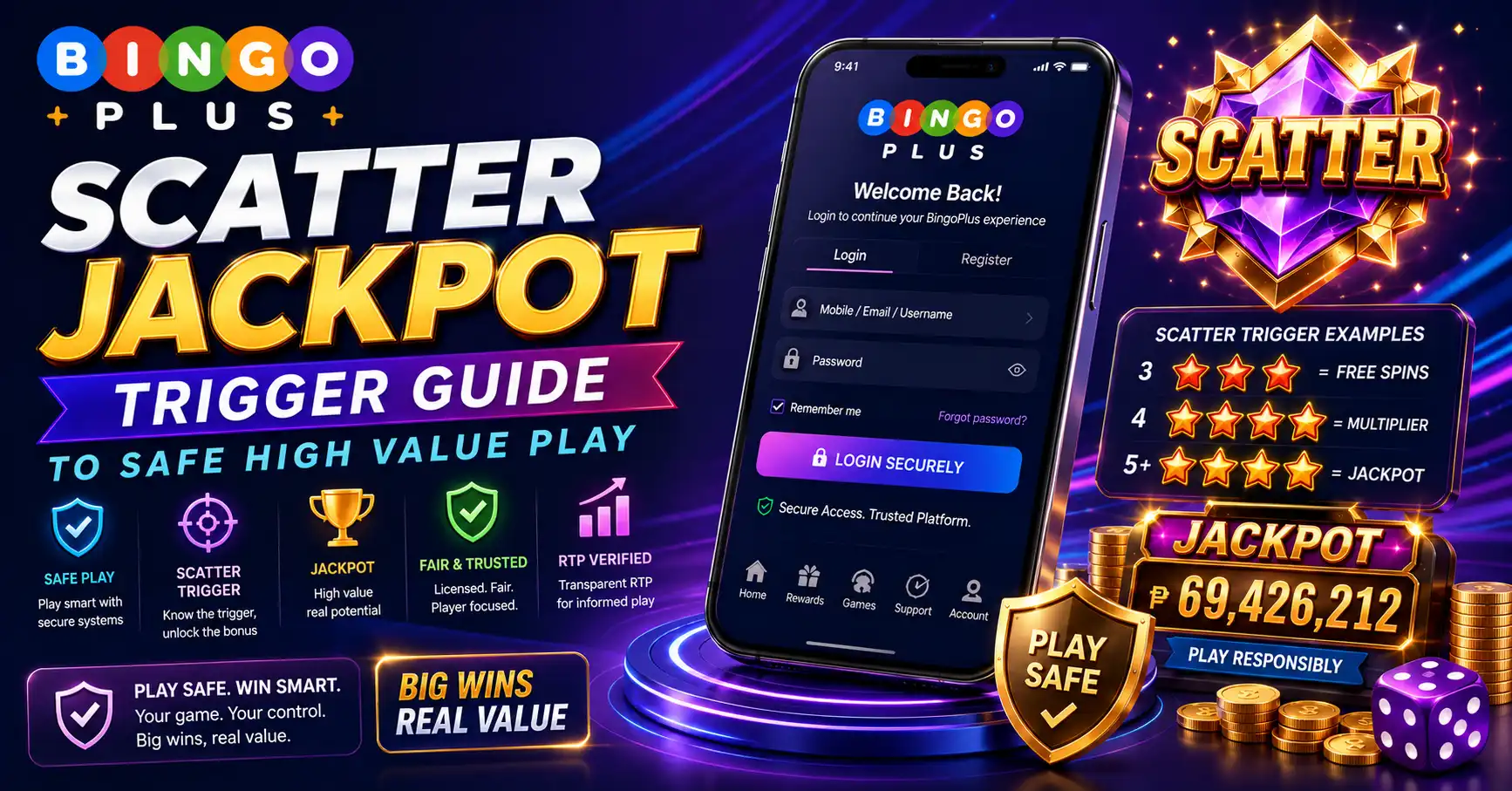
A scatter jackpot trigger can produce one of the most exciting moments in a digital slot, but the screen animation tells players almost nothing about the actual probability behind it. A flashy trigger may lead to a fixed prize, a jackpot selection round, or merely a chance to enter another random draw.
The bigger problem is platform risk. Players worry about fake domains, manipulated games, rejected withdrawals, and bonuses that appear generous until a 30x wagering requirement turns them into expensive commitments.

Before I deposit on any platform, including BingoPlus, I apply three non-negotiable standards:
- The operator, brand, and exact domain must be verifiable through an official regulator.
- The game must disclose RTP, rules, paytable conditions, and jackpot eligibility.
- The cashier must explain KYC verification, wagering rules, maximum cashout, and withdrawal limits before money is committed.
- Click to spin for free and win the ultimate prize!
No jackpot is guaranteed, and no staking pattern can force an RNG result. Bet responsibly, live a wonderful life. Gambling involves financial risk, and every wager remains the player’s responsibility.
What Is a Scatter Jackpot Trigger?
A scatter jackpot trigger is a game event in which a specified number or combination of scatter symbols activates a jackpot-related feature. Unlike ordinary paylines, scatters commonly count across eligible reels regardless of their exact horizontal position.
The trigger does not always award the jackpot immediately. Its function depends on the game’s paytable and mathematical design.
Common Trigger Structures
I normally separate scatter jackpot systems into four models:
- Direct trigger: Landing the required scatters awards a fixed or progressive jackpot.
- Feature-entry trigger: Scatters open a bonus round in which a jackpot may be won.
- Conditional draw: Scatters activate a random jackpot selection with several prize levels.
- Meter-assisted trigger: Scatter events fill a visible or hidden meter before jackpot eligibility begins.
This distinction matters. “Triggering the jackpot feature” and “winning the jackpot” are not automatically the same event.
Key Entities Behind the Feature
The technical language players should recognize includes:
- Scatter symbols
- Weighted reel strips
- Random Number Generator
- Hit frequency
- Progressive jackpot
- Fixed jackpot
- Trigger threshold
- RTP contribution
- Volatility
- Maximum exposure
These terms describe different parts of the model. A high trigger frequency, for example, does not prove that the top jackpot is frequently awarded.
PAGCOR Legality and Domain Verification
For Philippine-facing gaming services, the Philippine Amusement and Gaming Corporation, or PAGCOR, is the controlling official regulatory benchmark. PAGCOR states that it regulates games of chance and issues licences for gaming operations within Philippine territory through its relevant licensing departments. PAGCOR Electronic Gaming Licensing Department
A regulator’s logo in a website footer is not enough. Images can be copied in seconds, while a similar-looking domain can be registered specifically to capture passwords, one-time codes, or deposits.
Check the Current PAGCOR Registered Domain List
PAGCOR publishes an official list of accredited Gaming System Administrators, registered brands, and approved domain names. The current document is dated June 30, 2026, and includes registered BingoPlus brand and domain information. PAGCOR registered brands and domains PDF
My verification process is simple:
- Open the list directly from pagcor.ph.
- Search for the operator or brand name.
- Compare the listed domain character by character.
- Check the full hostname, not only the page logo.
- Reject links containing unexplained spelling changes or extra words.
- Repeat the check before using a new mirror or download domain.
The current PAGCOR document lists registered BingoPlus-related domains such as bingoplus.com, bingoplus.ph, and approved subdomains. Players should still consult the newest published version because approved URLs can change.
Why a Whitelist Reduces Phishing Risk
Cross-checking the exact domain against the regulator’s current list is one of the strongest phishing controls available to a player. It can expose lookalike addresses that rely on swapped letters, added hyphens, misleading subdomains, or unfamiliar domain extensions.
It does not provide a literal 100% guarantee. A user’s device, DNS connection, browser session, or communication account could still be compromised.
Use the whitelist together with these checks:
- Type the known address directly instead of following unsolicited messages.
- Confirm that the browser shows a secure HTTPS connection.
- Never share a password or one-time verification code.
- Avoid remote-screen-access requests from alleged support agents.
- Do not install an APK received through an unknown chat group.
- Stop if a deposit request sends money to an unexplained personal account.
What PAGCOR Oversight Does and Does Not Prove
Regulatory registration indicates that an operator and its approved domains are subject to an official framework. PAGCOR regulations are intended to support game integrity, player protection, lawful operations, and responsible gaming.
Registration does not mean every player will win. It also does not convert a high-volatility jackpot into a low-risk product.
A licence should therefore be treated as the first screening layer, followed by:
- Published game rules.
- Independent technical certification where stated.
- Clear KYC procedures.
- Transparent cashier terms.
- Accessible dispute channels.
- Responsible-gaming tools.
- Consistent domain verification.
PAGCOR also requires licensed operators to support safeguards such as self-exclusion and betting limits, according to its responsible-gaming guidance. PAGCOR Responsible Gaming
Scatter Jackpot Trigger Mathematics
I never evaluate a scatter jackpot from its animation alone. The useful information is found in the probability model, reel weighting, jackpot conditions, and the portion of RTP assigned to rare awards.
Weighted Reels Change the Real Probability
A digital reel may display many possible stopping positions. The scatter symbol can appear on some stops more frequently than others, and each reel may use a different weighting.
If a reel has N virtual stops and the scatter occupies S eligible stops, its simplified scatter probability is:p=NS
The visible symbol count on the screen does not reveal N or S. This is why counting displayed symbols cannot determine the true trigger probability.
Probability of Three or More Scatters
Suppose a five-reel game has the same independent scatter probability p on every reel. The probability of landing at least three scatters is:P(X≥3)=i=3∑5(i5)pi(1−p)5−i
If p=0.02, the probability becomes approximately:P(X≥3)=0.00007762
That equals about 0.007762%, or roughly one trigger per 12,883 spins in the long-run mathematical model.
This is only a hypothetical illustration. Real games may use unequal reel probabilities, multiple symbol positions, reel dependencies, expanding scatters, or separate random feature selection.
Trigger Probability Is Not Jackpot Probability
Assume the three-scatter event opens a jackpot selection, but the top jackpot is chosen only once per 100 feature entries.
The top-jackpot probability per spin is:P(J)=P(T)×P(J∣T)
Using the earlier hypothetical trigger probability:P(J)=0.00007762×0.01=0.0000007762
The theoretical top-jackpot frequency would therefore be about one in 1.29 million spins, not one in 12,883.
This gap is where marketing language can mislead inexperienced players. A frequent feature animation may still contain a very rare top-prize outcome.
Expected Spins Between Triggers
If the trigger probability per spin is pt, the long-run expected number of spins between triggers is:E(N)=pt1
A trigger probability of 0.1% produces an expectation of 1,000 spins. It does not mean the feature must appear within 1,000 spins.
Random outcomes can cluster or remain absent for long periods. The expected value is an average across a very large sample, not a countdown.
RTP, House Edge, and Jackpot Contribution
Return to Player represents the theoretical percentage of total wagers returned to players across the game’s full mathematical cycle. It includes many winning and losing outcomes over an enormous number of rounds.
The theoretical house edge is:House Edge=1−RTP
For a game with 96% RTP, the theoretical house edge is 4%.
Total RTP Can Contain Several Components
A scatter jackpot game may divide its theoretical return into:
- Base-game line wins.
- Scatter payments.
- Free-spin features.
- Bonus rounds.
- Minor jackpot awards.
- Major or progressive jackpots.
Suppose a game advertises 96% RTP, but 1.5 percentage points come from extremely rare jackpot outcomes. A short-session player may experience a return pattern that feels much lower because most ordinary play is supported by the remaining RTP components.
This does not mean the published RTP is necessarily false. It means RTP distribution matters as much as the headline percentage.
Jackpot Expected Value
A simplified jackpot contribution can be estimated as:EVJ=P(J)×AJ
Where:
- P(J) is the probability of winning the jackpot per spin.
- AJ is the average jackpot award measured in bet units.
If the probability is not disclosed, a player cannot independently calculate the exact jackpot EV. In that situation, published RTP and certified game information become more useful than visual impressions.
Volatility and Bankroll Exposure
Volatility describes how unevenly returns are distributed. Jackpot games are often medium-to-high volatility because a meaningful portion of their return may depend on rare outcomes.
High volatility creates:
- Longer losing sequences.
- Larger short-term balance swings.
- A greater chance of exhausting a small bankroll.
- Occasional large wins.
- Results that can differ sharply from theoretical RTP.
Changing the bet size does not alter the RNG unless the rules explicitly state that jackpot eligibility or prize scaling changes at certain stakes.
My Practical Bankroll Method
There is no strategy that lowers the mathematical house edge of a fixed-RTP slot. Bankroll rules only control exposure.
I use the following risk limits when testing a game:
- Keep each spin below 0.5% to 1% of the session bankroll.
- Set a loss limit before the first spin.
- Set a time limit and use an alarm.
- Never increase stakes to recover losses.
- Confirm whether the jackpot requires a minimum or maximum bet.
- Leave when the planned budget is spent.
If a ₱2,000 session bankroll uses ₱20 spins, only 100 full bets are available before wins are recycled. A ₱5 stake provides 400 initial bet units and better short-term survival, but it does not improve expected return.
How to Compare Scatter Jackpot Games on BingoPlus
When assessing a scatter jackpot title on BingoPlus or another regulated platform, I use the paytable before I use the spin button.
My comparison checklist includes:
- Published RTP: Prefer clearly disclosed information.
- Volatility rating: Match it to the available bankroll.
- Trigger requirement: Check the number and location of scatters.
- Jackpot path: Determine whether the trigger awards or merely unlocks a chance.
- Bet eligibility: Confirm whether every stake qualifies.
- Progressive contribution: Check whether part of each bet funds the pool.
- Maximum win: Read the cap in bet units and currency.
- Feature purchase: Compare the cost with its stated theoretical RTP.
- Withdrawal rules: Review limits before depositing.
- KYC requirements: Prepare legitimate documents in advance.
A game with a larger displayed jackpot is not automatically the better option. A smaller fixed jackpot with clearer odds may offer more understandable value than a huge progressive award with undisclosed hit frequency.
The Bonus Rollover Trap
Bonuses change the financial equation because the displayed credit may not be immediately withdrawable. The most important terms are the rollover base, multiplier, game contribution, maximum bet, expiry period, and maximum cashout.
Bonus-Only Versus Deposit-Plus-Bonus Rollover
Assume a player deposits ₱1,000 and receives a ₱500 bonus.
With a 10x bonus-only rollover:T=₱500×10=₱5,000
With a 30x deposit-plus-bonus rollover:T=(₱1,000+₱500)×30=₱45,000
The second offer requires nine times more turnover despite presenting the same ₱500 headline bonus.
Adjusting for Game Contribution
If scatter jackpot slots contribute only 50% toward wagering, the actual betting volume needed to clear a ₱5,000 requirement is:Actual Play=0.50₱5,000=₱10,000
At a 10% contribution rate, the same nominal requirement needs ₱50,000 in real play.
This is why I reject any promotion that does not clearly state contribution percentages.
Estimating Theoretical Rollover Cost
A simplified expected loss calculation is:Expected Loss=T×(1−RTP)
For ₱5,000 of turnover at 96% RTP:₱5,000×0.04=₱200
For ₱45,000 of turnover at the same RTP:₱45,000×0.04=₱1,800
A rough bonus-value estimate is:Estimated Bonus Value=B−Expected Loss
The ₱500 bonus with ₱5,000 turnover has a simplified theoretical value of ₱300 before considering volatility, cashout caps, excluded games, expiry, and the chance of losing the balance before completion.
The ₱500 bonus with ₱45,000 turnover produces a simplified value of negative ₱1,300 under the same assumptions. That is not an attractive offer.
KYC Verification and Withdrawal Limits
KYC verification is designed to confirm identity, age, account ownership, and payment-source consistency. It also supports anti-money-laundering controls and helps prevent duplicate or fraudulent accounts.
A regulated platform may request:
- A government-issued identification document.
- A clear facial verification image.
- A registered mobile number.
- Proof of address.
- Confirmation of payment-method ownership.
- Additional information for unusual transactions.
The name on the payment method should match the verified account where required. Using another person’s wallet can create withdrawal delays even when the game balance is legitimate.
Read Withdrawal Terms Before Depositing
I check these cashier rules before accepting any offer:
- Minimum withdrawal.
- Daily and monthly withdrawal limits.
- Processing time.
- KYC review time.
- Payment-channel limits.
- Pending-withdrawal cancellation rules.
- Maximum promotional cashout.
- Dormant-account fees.
- Conditions affecting jackpot withdrawals.
A platform should not invent a new wagering requirement after a legitimate jackpot win. Any relevant restriction should already appear in the published rules accepted by the player.
Final Expert Verdict
A scatter jackpot trigger should be evaluated as a probability event, not a promise. The key questions are how often the trigger occurs, whether it directly pays a jackpot, how much RTP is assigned to rare prizes, and whether the bankroll can withstand the game’s variance.
For BingoPlus or any Philippine-facing platform, start by matching the exact brand and domain against the latest PAGCOR list. Then inspect the paytable, bonus formula, KYC process, and withdrawal rules before depositing.
A licence supports accountability; it does not eliminate the house edge. Play only with discretionary money, use firm limits, and treat every jackpot as a rare outcome rather than an expected source of income.
Frequently Asked Questions
Does KYC verification affect a scatter jackpot withdrawal?
Yes, KYC may be required before withdrawal. The operator can verify identity, age, payment ownership, and account compliance, but the requested documents and review process should follow published platform terms.
Can an operator change a scatter jackpot result?
A properly regulated RNG game should determine outcomes according to its approved mathematical model. Players should use a PAGCOR-registered domain, read the paytable, and check for stated technical certification rather than relying only on visual animations.
How long does a scatter jackpot withdrawal take?
The processing time depends on KYC status, payment channel, withdrawal limits, and account review. Check the cashier’s published timeframe and contact official support if a completed request exceeds that period without a documented reason.