




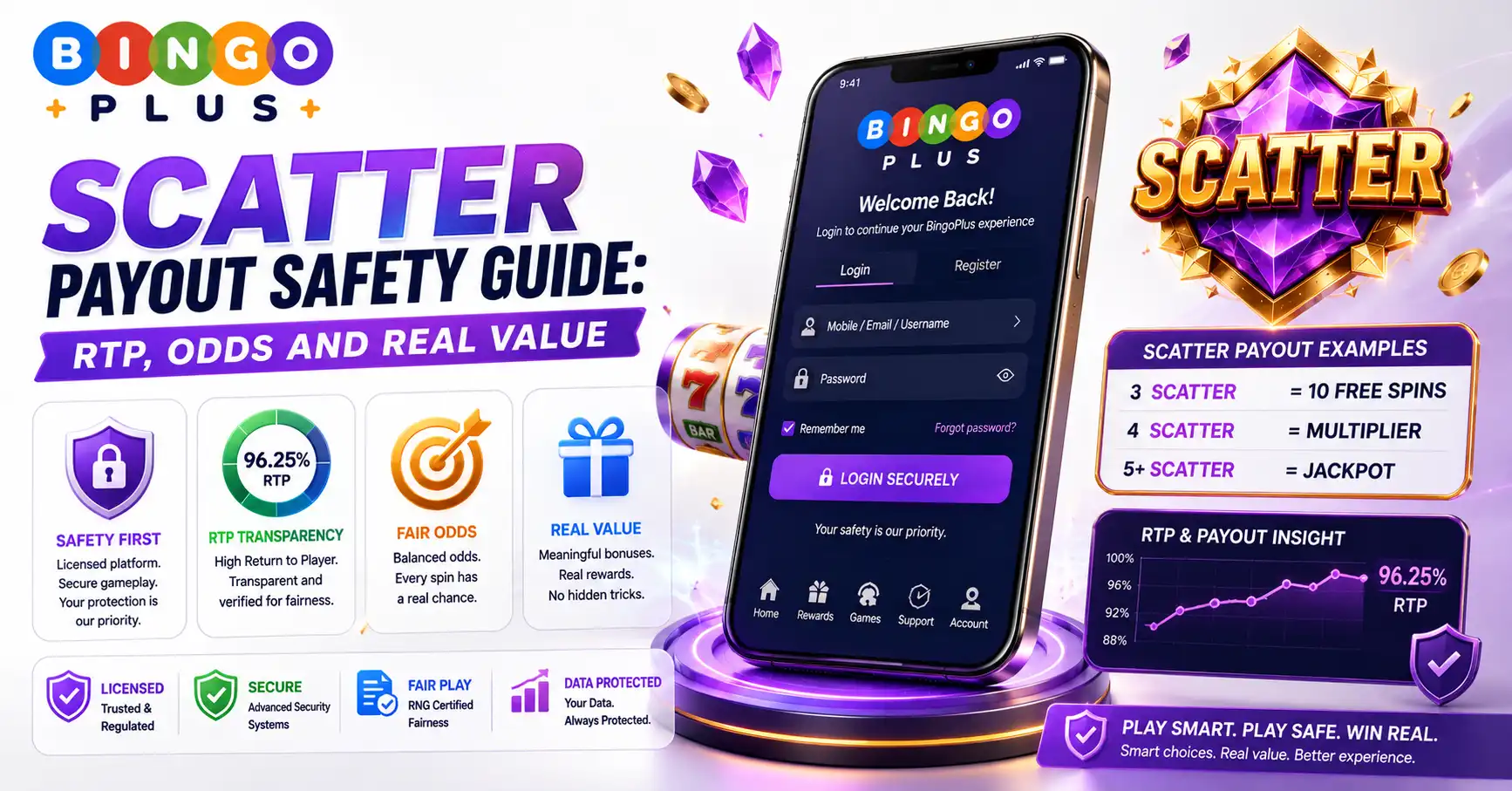
A large advertised scatter payout can look convincing until the player asks three harder questions: how rarely does it occur, what portion of the game’s RTP supports it, and can the resulting balance actually be withdrawn?
Those questions matter because an impressive multiplier cannot protect a player from an impersonation site, hidden wagering conditions, a low maximum cash-out, or a game whose volatility does not fit the available bankroll.

I use three non-negotiable standards before assessing any platform or scatter-based game:
- The operator and exact domain must be verifiable through PAGCOR.
- The game must disclose its paytable, RTP, feature rules, and payout limits.
- The promotion must state its wagering, KYC, and withdrawal conditions before deposit.
- Click to spin for free and win the ultimate prize!
Bet responsibly, live a wonderful life. Every wager carries financial risk, short-term losses can exceed the theoretical house edge, and each player remains responsible for personal decisions and spending limits.
What Is a Scatter Payout?
A scatter payout is a prize created when a required number of scatter symbols appear in eligible positions during a game round.
Unlike ordinary symbols, scatters often do not need to align on a fixed payline. Depending on the game, they may pay anywhere on the reels or activate a separate feature.
A scatter can produce:
- A direct cash payout
- Free spins
- A bonus round
- A fixed multiplier
- A progressive multiplier
- A respin sequence
- A pick-and-win feature
- A jackpot qualification
- A collected-symbol reward
The presence of a scatter symbol does not always guarantee a payout.
Some games require at least three scatters, while others use collection meters, reel-specific rules, or feature symbols that appear only during selected modes.
The Core Entities Behind Scatter Payouts
When our team reviews a scatter game, we separate the visual theme from the actual mathematical structure.
The following entities determine the real payout profile.
Scatter Symbol
The scatter symbol is the qualifying symbol used to produce a direct prize or activate a feature.
Its value can depend on:
- Number of scatters
- Reels on which they appear
- Stake size
- Active game mode
- Multiplier state
- Whether the feature is bought or naturally triggered
Trigger Threshold
The trigger threshold is the minimum number of scatters needed to produce a result.
A hypothetical paytable may state:
- Three scatters: 5x stake
- Four scatters: 20x stake
- Five scatters: 100x stake
Another game may replace direct cash payouts with free-spin awards.
Paytable
The paytable explains symbol values, trigger requirements, multipliers, bonus rules, maximum wins, and feature limitations.
I never rely on the lobby description alone.
The paytable is where the actual contract between the game model and the player is displayed.
Reel Strip and Symbol Weighting
Digital reels may use virtual positions and weighted symbols.
Two symbols that appear visually identical can have very different underlying frequencies.
The game may place:
- More scatter opportunities on the middle reels
- Fewer qualifying scatters on the first or final reel
- Different symbol weights during bonus rounds
- Restricted scatter positions in the base game
This is why a simple visual count cannot reveal true trigger probability.
Random Number Generator
The random number generator, or RNG, selects outcomes according to the configured game mathematics.
A near-miss does not make a payout more likely on the next spin.
Previous losses also do not create a debt that the RNG must repay.
Return to Player
RTP represents the theoretical percentage of total wagers returned across a very large number of rounds.
It is not a promise for one session, one account, or one player.
Volatility and Variance
Volatility describes the size and frequency pattern of returns.
Variance is the statistical dispersion of outcomes around the expected result.
A high-volatility game may deliver large scatter payouts, but it may also produce long losing sequences.
Maximum-Win Cap
The maximum-win cap limits how much one game round or feature can pay.
A game may advertise a large multiplier while also applying a fixed monetary ceiling.
Players should check both figures.
PAGCOR Verification Comes Before Payout Analysis
No payout model matters when a user enters credentials or transfers money through an unauthorized domain.
The Philippine Amusement and Gaming Corporation is the Philippine government regulator responsible for relevant domestic gaming oversight. PAGCOR’s regulatory structure includes electronic gaming licensing, platform evaluation, accredited administrators, registered brands, and approved domain records.
Check the Current Registered-Domain List
PAGCOR publishes a List of PAGCOR-Accredited Gaming System Administrators and Registered Brands and Domain Names/URLs.
The current document found during this review is dated June 30, 2026 and identifies registered administrators, brands, main domains, subdomains, and additional URLs.
Official references:
- PAGCOR Official Website
- PAGCOR Electronic Gaming Licensing Department
- PAGCOR Registered Brands and Domain Names PDF
For BingoPlus, the player should compare the exact address being used with the relevant entries in PAGCOR’s current document rather than trusting a logo, advertisement, social-media profile, or search-result title.
Why a Logo Is Not Proof
PAGCOR has repeatedly warned the public about fake sites using its logo or fabricated licensing material.
Its warnings explain that unauthorized sites may expose users to personal-data and financial risks.
Cross-checking the domain against the official list substantially reduces phishing exposure, but it cannot provide a literal 100% guarantee.
A complete check should also cover:
- Exact spelling
- HTTPS connection
- Redirect behavior
- Registered main domain or subdomain
- Current PAGCOR publication date
- Official support channels
- Payment-recipient consistency
- Absence of unexpected file downloads
My Anti-Phishing Checklist
Before opening BingoPlus or submitting a payment, I verify:
- The complete domain, character by character
- Whether it appears in the current PAGCOR list
- Whether the browser remains on the same registered domain
- Whether privacy and support pages work
- Whether an APK came from an approved source
- Whether anyone is requesting an OTP or password
- Whether the payment route matches platform instructions
- Whether urgency is being used to force a deposit
A copied interface can be built quickly.
A verified domain and consistent operational trail are harder to fake.
How Scatter Payout Mathematics Works
The size of a scatter payout is only one part of its value.
The complete model involves:
- Trigger probability
- Award size
- Retrigger probability
- Feature RTP allocation
- Bet cost
- Volatility
- Maximum-win limits
- Promotional restrictions
Calculating a Direct Scatter Payout
For a direct multiplier award, the basic calculation is:Scatter Payout=Stake×Scatter Multiplier
Assume:
- Stake: ₱20
- Four-scatter award: 25x
The direct payout is:₱20×25=₱500
The displayed return may include the stake or may represent profit plus stake, depending on the game rules.
Always check how the paytable defines “win.”
Calculating Payout From Free Spins
When scatters award free spins, the final value is variable.
A simplified estimate is:E(Feature Payout)=Number of Free Spins×E(Return Per Free Spin)
Assume:
- 12 free spins
- Average theoretical return per free spin: 4.5x stake
- Base stake: ₱10
Estimated average feature payout:12×4.5×₱10=₱540
This does not mean every feature returns ₱540.
A high-variance bonus may return zero in one activation and hundreds of times the stake in another.
Scatter Trigger Probability
Suppose a simplified five-reel game gives each reel an independent 5% probability of showing a qualifying scatter.
The probability of receiving at least three scatters is:P(X≥3)=k=3∑5(k5)(0.05)k(0.95)5−k
The result is approximately:P(X≥3)≈0.001158
That equals about:0.1158%
The estimated average frequency is approximately:1÷0.001158≈864
Under this simplified assumption, a qualifying trigger would occur about once per 864 spins on average.
That is not a schedule.
A player could trigger twice within 50 spins or go more than 2,000 spins without a feature.
Why Real Trigger Rates Are More Complex
Real games rarely use one identical probability across every reel.
A more accurate general formula is:P(qualifying outcome)=∑P(specific scatter combinations)
The calculation may need to account for:
- Different reel-strip lengths
- Different scatter counts per reel
- Blocked scatter positions
- Variable reel heights
- Cascading symbols
- Expanding grids
- Mystery symbols
- Bonus-specific reel sets
- Ante-bet modes
Without the provider’s probability model, an external reviewer can estimate behavior but cannot reconstruct every exact outcome weight.
Expected Scatter Value
The expected value contributed by the scatter feature can be represented as:EVscatter=P(trigger)×E(payout when triggered)
Assume:
- Trigger rate: 1 in 250 spins
- Average payout after a trigger: 80x
- Stake: ₱10
The expected scatter contribution per spin is:2501×80×₱10=₱3.20
That ₱3.20 is a long-run mathematical contribution, not a payment added to each round.
The rest of the game’s RTP may come from base-game wins, wild combinations, respins, or other features.
RTP and House Edge
If a game has 96% RTP, the theoretical house edge is:100%−96%=4%
For ₱20,000 in total wagering:₱20,000×0.96=₱19,200
The long-run theoretical loss is:₱20,000−₱19,200=₱800
Short-term results can differ sharply because RTP is measured across extensive play.
A player can lose the whole session bankroll long before the observed result approaches the theoretical percentage.
RTP Allocation to Scatter Features
A game’s RTP can be distributed across several components.
For example:
- Base combinations: 48%
- Wild-related wins: 14%
- Scatter feature: 28%
- Other bonus mechanics: 6%
- Total RTP: 96%
This hypothetical structure means the scatter system contributes 28 percentage points to the long-run RTP.
It does not mean every scatter trigger returns 28% of the player’s money.
Hit Frequency Versus Payout Frequency
Hit frequency measures how often any winning result occurs.
Scatter payout frequency measures how often a scatter condition produces a payout or feature.
A title could have:
- Overall hit frequency: 31%
- Three-scatter frequency: 1 in 170
- Four-scatter frequency: 1 in 2,400
- Five-scatter frequency: 1 in 45,000
A high overall hit frequency can coexist with rare premium scatter payouts.
Small wins may create frequent activity while the main feature remains difficult to trigger.
Payout Curves and Scatter Counts
Scatter payout tables often rise non-linearly.
A hypothetical structure might be:
| Scatter Count | Award |
|---|---|
| 3 | 5x |
| 4 | 25x |
| 5 | 150x |
The five-scatter payout is not simply three times the three-scatter payout.
It is larger because the probability of landing all five scatters is usually much lower.
Expected Value by Scatter Count
Each outcome should be assessed separately:EVk=P(X=k)×Awardk
The total direct-scatter value is:EVtotal=EV3+EV4+EV5
A large top award may contribute less to RTP than a smaller but more frequent three-scatter prize.
Multiplier Mechanics
A scatter feature may apply:
- Fixed multipliers
- Random multipliers
- Progressive multipliers
- Multipliers that increase after cascades
- Multipliers limited to selected wins
- Multipliers capped at a maximum value
Suppose a free-spin feature returns ₱800 before a 3x multiplier.
The adjusted payout is:₱800×3=₱2,400
However, the rules may apply the multiplier only to:
- Line wins
- Scatter wins
- Cascade wins
- One selected symbol
- Wins below the maximum cap
The paytable should state the scope clearly.
Retriggers and Their Mathematical Value
A retrigger adds more rounds after the initial feature begins.
A simple expected-spin model is:E(Total Spins)=Initial Spins+E(Retriggered Spins)
Suppose:
- Initial free spins: 10
- Probability of one six-spin retrigger: 20%
- Multiple retriggers ignored for simplicity
Expected additional spins:0.20×6=1.2
Expected total:10+1.2=11.2
The advertised award is ten spins, but the theoretical average becomes 11.2 under this simplified structure.
Maximum Win and Payout Truncation
A maximum-win cap can reduce the upper tail of a payout distribution.
Assume:
- Calculated feature result: ₱600,000
- Game cap: ₱500,000
Final payable amount:min(₱600,000,₱500,000)=₱500,000
The extra ₱100,000 is removed by the cap.
This rule matters most in games with expanding multipliers, cluster chains, or theoretically open-ended cascades.
Volatility Changes the Practical Experience
Two games can share the same 96% RTP and still behave very differently.
Lower-Volatility Model
- More frequent payouts
- Smaller average wins
- Fewer severe drawdowns
- Lower dependence on rare features
- More stable session duration
Higher-Volatility Model
- Longer losing sequences
- Larger premium payouts
- Stronger dependence on scatters
- Higher bankroll pressure
- Greater chance of session ruin
RTP measures the long-run return level.
Volatility describes the route taken toward that level.
Bankroll Strategy for Scatter Games
No staking method changes the house edge of a fixed-RTP game.
Bankroll rules can only control exposure.
Percentage-Based Stake Sizing
A conservative base-stake formula is:Stake=Session Bankroll×Risk Percentage
Assume:
- Session bankroll: ₱3,000
- Risk per spin: 0.25%
Stake:₱3,000×0.0025=₱7.50
The player could use the nearest permitted stake below that amount.
Coverage Estimate
At a ₱5 stake with a ₱3,000 bankroll:₱3,000÷₱5=600
The bankroll covers 600 full-cost spins before wins are considered.
This does not guarantee a scatter trigger.
It simply prevents the stake from consuming the bankroll too quickly.
Practical Session Rules
My review framework uses:
- Fixed starting bankroll
- Maximum stake percentage
- Predetermined stop-loss
- Predetermined win target
- Session time limit
- No deposit extension
- No stake increase after losses
- No attempt to “recover” the session
These controls do not improve expected return.
They limit the financial damage of variance and emotional decisions.
Natural Trigger Versus Bonus Buy
A bonus buy allows direct access to a scatter feature for a fixed price.
Assume:
- Base stake: ₱10
- Bonus-buy cost: 100x
- Purchase price: ₱1,000
- Average feature return: ₱960
Estimated RTP:₱960÷₱1,000=96%
Estimated house edge:100%−96%=4%
Buying the feature does not create a guaranteed payout.
It compresses the variance into a larger single transaction.
Bonus-Buy Bankroll Risk
A ₱5,000 bankroll can support:
- 500 spins at ₱10 each, or
- Five bonus purchases at ₱1,000 each
Five poor bonus results can end the session quickly.
The apparent convenience carries much higher round-level exposure.
BingoPlus Scatter Payout Review Framework
When assessing scatter games through BingoPlus, I apply three layers of checks.
Platform Checks
- Verify the exact domain through PAGCOR
- Confirm age and account eligibility
- Complete KYC early
- Review payment ownership requirements
- Check withdrawal limits
- Read current promotional terms
- Locate responsible-gaming controls
Game Checks
- Confirm provider identity
- Open the full paytable
- Record displayed RTP
- Identify volatility
- Check scatter trigger conditions
- Review multiplier rules
- Confirm maximum-win limits
- Examine retrigger conditions
- Compare natural and purchased feature modes
Transaction Checks
- Use a payment method in the account holder’s name
- Confirm deposit minimums
- Confirm withdrawal minimums
- Review daily and monthly limits
- Check processing estimates
- Save transaction records
- Avoid third-party payment instructions
PAGCOR maintains regulatory resources and publishes lists relevant to approved gaming operations and registered domains. Players should use the latest official document rather than an archived screenshot or copied list.
The Wagering Requirement Trap
A promotional balance is not equivalent to withdrawable cash.
Its real value depends on the required turnover and the mathematical cost of completing it.
10x Versus 30x Rollover
Assume:
- Deposit: ₱1,000
- Bonus: ₱500
10x Bonus-Only Requirement
₱500×10=₱5,000
Required turnover: ₱5,000
30x Bonus-Only Requirement
₱500×30=₱15,000
Required turnover: ₱15,000
30x Deposit-Plus-Bonus Requirement
(₱1,000+₱500)×30=₱45,000
Required turnover: ₱45,000
The phrase “30x wagering” is incomplete unless the player knows what amount receives the multiplier.
Estimating the Mathematical Cost of Rollover
Use:Expected Wagering Cost=Required Turnover×Effective House Edge
Assume eligible games average 96% RTP.
Effective house edge:100%−96%=4%
Cost of 10x Bonus Rollover
₱5,000×0.04=₱200
Cost of 30x Bonus Rollover
₱15,000×0.04=₱600
Cost of 30x Deposit-Plus-Bonus Rollover
₱45,000×0.04=₱1,800
A ₱500 reward tied to ₱45,000 of expected turnover can carry a theoretical wagering cost far above the headline bonus amount.
Real Bonus Value Formula
I use this simplified calculation:Estimated Real Bonus Value=Bonus−Expected Wagering Cost−Other Expected Restrictions
For the ₱500 bonus with ₱15,000 turnover:₱500−₱600=−₱100
The simplified expected value is negative ₱100 before other restrictions.
Those restrictions may include:
- Maximum cash-out
- Reduced game contribution
- Maximum eligible stake
- Expiry deadlines
- Excluded titles
- Payment fees
- Withdrawal limits
- KYC delays
Game Contribution Rates
A game may count only partially toward rollover.
Example:
- Standard slots: 100%
- Selected high-RTP titles: 50%
- Electronic table games: 20%
- Live games: 10%
- Restricted games: 0%
Suppose the remaining requirement is ₱10,000 and the selected game contributes 20%.
Actual wagering needed:₱10,000÷0.20=₱50,000
The player must place ₱50,000 in real wagers to generate ₱10,000 of qualifying turnover.
Effective House Edge With Contribution Rates
A low contribution rate can make a seemingly attractive promotion expensive.
A practical adjustment is:Effective Cost Per Qualifying Peso=Contribution RateHouse Edge
For a game with:
- House edge: 4%
- Contribution: 20%
0.04÷0.20=0.20
The effective expected cost is 20 centavos per ₱1 of qualifying turnover.
This simplified metric makes weak contribution terms easier to compare.
Maximum Bet Restrictions
Promotions often cap the permitted stake during rollover.
Exceeding the cap may cause:
- Bonus cancellation
- Winnings removal
- Manual review
- Delayed withdrawal
- Account restrictions
I record the maximum stake before placing the first qualifying wager.
One accidental oversized bet can compromise the full promotion.
Maximum Cash-Out
Assume:
- Bonus-generated balance: ₱12,000
- Maximum promotional cash-out: ₱4,000
The player may satisfy the rollover and still be limited to:min(₱12,000,₱4,000)=₱4,000
A cash-out cap changes the upper value of the promotion.
It should be included in the decision before deposit.
KYC Verification and Payout Processing
KYC verification confirms the account holder’s identity, age, and control over the payment method.
It may require:
- Government-issued identification
- Full legal name
- Date of birth
- Mobile-number verification
- Address information
- Selfie or liveness check
- Payment-method ownership evidence
KYC does not alter the RNG or scatter probability.
It can affect whether a withdrawal proceeds without additional review.
Common KYC Problems
Frequent issues include:
- Nickname used instead of legal name
- Expired identification
- Blurred document images
- Inconsistent birth dates
- Payment method owned by another person
- Duplicate accounts
- Unsupported document format
I recommend completing verification before building a large balance.
Discovering an identity mismatch during withdrawal is avoidable.
Withdrawal Limits
Before accepting a promotion or chasing a large scatter payout, check:
- Minimum withdrawal
- Maximum withdrawal per transaction
- Daily limit
- Weekly limit
- Monthly limit
- Bonus-specific cash-out limit
- Processing period
- Payment-channel restrictions
- Pending-withdrawal rules
- Manual-review conditions
A ₱100,000 payout may need to be withdrawn across several transactions when daily limits apply.
That is operationally different from receiving the full amount immediately.
Technical Fairness: What Players Can and Cannot Verify
Players cannot independently inspect every line of a proprietary RNG implementation.
They can still evaluate several meaningful signals:
- Provider identity
- Published RTP
- Complete paytable
- Consistent rules
- Regulatory context
- Approved game status where published
- Maximum-win disclosure
- Stable transaction records
- No result changes after settlement
PAGCOR’s Electronic Gaming Licensing Department publishes regulatory materials and maintains resources related to registered platforms and approved electronic games.
A short losing session is not proof of manipulation.
It may simply reflect normal variance.
Warning Signs Our Team Rejects
I would not deposit when I see:
- A domain absent from the applicable PAGCOR list
- A fabricated or unverifiable certificate
- No accessible paytable
- No displayed terms
- Guaranteed scatter claims
- Guaranteed withdrawal promises
- Pressure to send an OTP
- Payment to a random personal account
- An APK distributed through an unknown mirror
- Changing rollover terms
- An undisclosed maximum cash-out
- Support available only through an unverified private profile
PAGCOR advises the public to use its official website when verifying legitimate gaming activity and has warned against unauthorized sites.
Responsible Scatter Payout Strategy
No strategy can force an RNG-based scatter.
A disciplined approach can reduce preventable losses.
My practical rules are:
- Treat the stake as entertainment spending
- Set the loss limit before opening the game
- Use a small percentage of the bankroll per spin
- Do not raise stakes to recover losses
- Never borrow money to continue
- Stop when the time limit expires
- Read all bonus terms before opting in
- Withdraw only through verified channels
- Use exclusion or limit tools when control weakens
PAGCOR states that responsible-gaming measures are intended to minimize player and community harm, prevent addiction, and prohibit underage gambling.
Frequently Asked Questions
Does KYC change my scatter payout?
No. KYC does not change the game’s configured scatter probability or calculated payout. It verifies account ownership and may be required before the operator processes a withdrawal.
Are scatter payouts generated fairly by an RNG?
A properly implemented game uses an RNG and predefined mathematical rules to determine scatter outcomes. Check the provider, paytable, displayed RTP, payout cap, platform status, and relevant regulatory information rather than judging fairness from a short session.
How long does a scatter payout withdrawal take?
Timing depends on KYC status, payment method, withdrawal limits, account review, and bonus conditions. Completing a game feature or wagering requirement does not bypass identity checks, cash-out caps, or security reviews.
Final Assessment
A scatter payout should never be judged by the largest advertised multiplier alone.
The more reliable assessment combines:
- PAGCOR domain verification
- Paytable analysis
- Trigger probability
- RTP allocation
- House edge
- Volatility
- Retrigger value
- Maximum-win limits
- Wagering requirements
- KYC readiness
- Withdrawal limits
For BingoPlus or any comparable platform, the first step is verifying the exact operating domain through the current PAGCOR publication.
The next step is mathematical: calculate what the feature can pay, how rarely it may occur, what completing a promotion is expected to cost, and whether the resulting balance can be withdrawn under the stated rules.
A scatter can produce a large result.
It cannot remove the house edge, eliminate variance, or guarantee profit.