



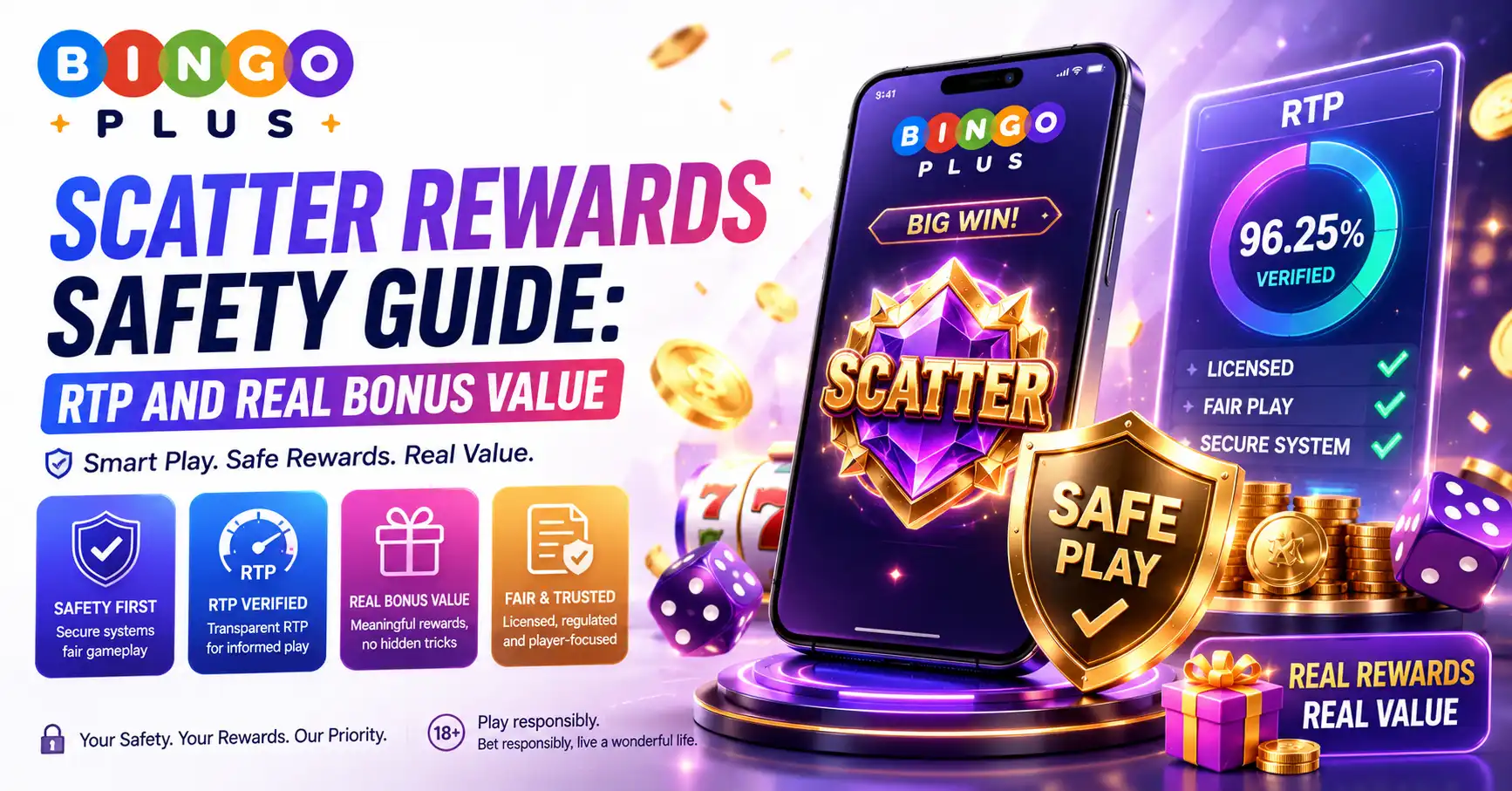
Scatter rewards attract attention because they can unlock free spins, bonus rounds, multipliers, respins, or direct cash prizes without requiring a normal payline combination.
The problem is that many players judge these features by animation quality or advertised maximum wins. That tells you almost nothing about the real mathematical value.

The larger risks are more serious:
- Depositing through a copied website
- Playing a game with undisclosed rules
- Accepting a reward with restrictive wagering terms
- Completing KYC only after requesting a withdrawal
- Discovering low withdrawal limits too late
- Confusing theoretical RTP with guaranteed short-term returns
- Click to spin for free and win the ultimate prize!
My evaluation process starts with three non-negotiable standards:
- The operator and domain must be verifiable through PAGCOR.
- The game must disclose RTP, volatility, paytable rules, and trigger conditions.
- The reward must have transparent wagering and withdrawal terms.
Bet responsibly, live a wonderful life. Gambling involves financial risk, and every player remains responsible for deposits, wagers, and losses.
What Are Scatter Rewards?
Scatter rewards are prizes or feature activations generated when a required number of scatter symbols appear during a game round.
Unlike standard symbols, scatters often do not need to land on one fixed payline. Their value may depend on the total number displayed across eligible reels or positions.
Common scatter outcomes include:
- Free spins
- Bonus games
- Instant multipliers
- Respin sequences
- Pick-and-win rounds
- Expanding symbol features
- Progressive reward meters
- Direct cash awards
The word “reward” can be misleading. A triggered feature does not automatically mean the player has gained a profitable advantage.
Its real value depends on the trigger probability, average bonus payout, base-game cost, volatility, and any attached promotional conditions.
The Core Entities Behind Scatter Reward Analysis
When our team reviews a scatter-based title, we focus on several technical entities rather than promotional language.
Scatter Symbol
A scatter symbol activates a payout or feature based on its count, location, or collection progress.
Some scatters pay anywhere. Others must appear on specified reels.
Trigger Threshold
The trigger threshold is the minimum number of qualifying scatters needed to activate a reward.
A common structure may look like this:
- Three scatters: 8 free spins
- Four scatters: 12 free spins
- Five scatters: 20 free spins
A higher scatter count may produce a larger reward, but it is usually much less frequent.
Free Spins
Free spins are rounds funded by the game rather than separate cash deductions from the visible balance.
They still have mathematical value because they are already included in the game’s long-run RTP model.
Multiplier
A multiplier increases an eligible win by a fixed or variable factor.
For example:
- 2x doubles the eligible payout
- 5x multiplies it by five
- A progressive multiplier may rise after each win or cascade
Retrigger
A retrigger awards additional bonus rounds after the original feature has started.
Retrigger potential can materially affect the average feature value and volatility.
Bonus Buy
A bonus buy allows the player to pay a stated multiple of the base stake for direct feature entry.
It changes the cost structure but does not remove the house advantage.
Paytable
The paytable defines symbol values, scatter conditions, multipliers, maximum wins, and feature rules.
I do not assess a scatter game until I have reviewed the paytable and information screen.
Random Number Generator
The random number generator, or RNG, determines game outcomes according to the configured mathematical model.
A visually dramatic near-miss does not prove that the next round is more likely to trigger.
Verify PAGCOR Status Before Evaluating Rewards
Reward mathematics becomes irrelevant when the player is using an impersonation site.
PAGCOR states that it regulates games of chance and licenses gaming operations within Philippine territory through its regulatory departments. Its Electronic Gaming Licensing Department covers locally regulated categories including electronic casino games, electronic bingo, sports betting, specialty games, online poker, and numeric games.
Use the Official PAGCOR Domain List
Players should compare the operator name and exact domain against PAGCOR’s current List of PAGCOR-Accredited Gaming System Administrators and Registered Brands and Domain Names/URLs.
The official list dated June 30, 2026 identifies accredited administrators, brands, main domains, subdomains, and additional URLs. It includes BingoPlus under AB Leisure Exponent, Inc. and lists registered addresses associated with the brand, including bingoplus.ph, bingoplus.com, and other specified URLs.
Use these official references:
Cross-checking the exact domain substantially reduces phishing risk, but no single check provides a 100% guarantee.
PAGCOR has warned that fake gaming websites may use its logo without authorization to appear connected with licensed operations. A copied logo is therefore not proof of legitimacy.
My Domain Verification Checklist
Before opening BingoPlus or entering account credentials, I check:
- Exact domain spelling
- HTTPS connection
- PAGCOR-listed domain status
- No unexpected redirect to an unrelated host
- Consistent privacy and support pages
- No request to share one-time passwords
- No unofficial APK prompt
- No payment request to unlock an account
A difference of one character can lead to a completely different website.
Bookmarks are safer than repeatedly following links from private messages or social media comments.
How Scatter Reward Mathematics Works
A scatter feature is governed by probability, not timing, player loyalty, or recent losses.
The two questions that matter are:
- How often does the feature trigger?
- What is the average value when it triggers?
Trigger Probability
Assume a simplified five-reel game where each reel independently has probability p of displaying at least one qualifying scatter.
The approximate probability of receiving at least three scatters is:P(X≥3)=k=3∑5(k5)pk(1−p)5−k
Suppose the scatter probability per reel is 5%, or 0.05.
The approximate three-or-more-scatter probability becomes:P(X≥3)≈0.001158
That is roughly one trigger in every:1÷0.001158≈864
This example is educational, not a prediction for a specific title.
Real slot mathematics may use weighted reel strips, different scatter frequencies by reel, variable reel heights, or correlated feature mechanics. The game provider’s internal probability table may therefore differ from a simple independent-reel model.
Hit Frequency Is Not Scatter Frequency
Hit frequency measures how often any qualifying win occurs.
Scatter frequency measures how often the scatter condition occurs.
A game might have:
- Hit frequency: 30%
- Scatter feature frequency: once every 180 spins
- Average feature value: 65 times the base bet
These numbers describe different parts of the model.
A high hit frequency can still produce frequent low-value wins while the scatter feature remains rare.
RTP and Scatter Rewards
RTP, or return to player, is the theoretical percentage of total wagers returned to players over a very large sample.
A game with 96% RTP has a theoretical house edge of:100%−96%=4%
For every ₱10,000 wagered across the long run, the theoretical return is:₱10,000×0.96=₱9,600
The theoretical expected loss is:₱10,000−₱9,600=₱400
This does not mean every player receives ₱9,600 back.
One session may finish above the starting balance. Another may lose far more than 4% because short-term results are dominated by variance.
RTP Allocation Matters
A game’s total RTP can be divided across:
- Base-game line wins
- Scatter payouts
- Free-spin features
- Multipliers
- Jackpots
- Bonus rounds
- Retriggers
Suppose a game has 96% total RTP, with 30 percentage points attributed to its bonus feature.
That does not mean the player receives 30% whenever the feature triggers. It means the bonus component contributes that amount to the long-run game model across all qualifying wagers.
Volatility and Variance
Volatility describes how unevenly returns are distributed.
Low-Volatility Scatter Games
These usually offer:
- More frequent small wins
- Lower average bonus peaks
- Smaller balance swings
- Longer play duration for the same bankroll
High-Volatility Scatter Games
These often feature:
- Long non-trigger periods
- Larger potential bonus outcomes
- Higher retrigger dependence
- Sharp balance drawdowns
- Greater risk of bankroll exhaustion
A maximum win figure is not a useful measure without its probability.
A title advertising 10,000x maximum potential may reach that result so rarely that it has little relevance to an ordinary session.
Calculating the Expected Value of a Scatter Feature
A simplified expected-value model is:EVscatter=P(trigger)×E(feature payout)
Assume:
- Trigger probability per spin: 1/200
- Average feature payout: 70x bet
- Stake per spin: ₱10
The expected scatter contribution per spin is:2001×70×₱10=₱3.50
That does not mean the player earns ₱3.50 on every spin.
It means the scatter feature contributes an average theoretical value of ₱3.50 per ₱10 spin across a sufficiently large sample, before accounting for the remaining base-game mathematics.
Compare Feature Value, Not Free-Spin Count
Twenty free spins are not automatically better than ten.
The real value depends on:
- Reel configuration
- Active multiplier
- Symbol upgrades
- Wild frequency
- Retrigger probability
- Bet level applied
- Maximum-win cap
- Average payout per spin
Consider two hypothetical features:
Feature A
- 20 free spins
- Average return per free spin: 1.8x
- Estimated feature value: 36x
Feature B
- 10 free spins
- Average return per free spin: 5x
- Estimated feature value: 50x
Feature B offers fewer rounds but higher expected value in this simplified comparison.
A Practical Bankroll Framework
My rule is to size the stake around volatility, not around the advertised jackpot.
For a high-volatility scatter game, a conservative session model might use:
- Bankroll: ₱2,000
- Base stake: ₱5
- Starting coverage: 400 spins
- Stop-loss: ₱600
- Win target: ₱400
- Hard session limit: 45 minutes
This structure does not improve the game’s RTP.
It controls exposure and reduces the chance that one emotional decision consumes the entire bankroll.
Do Not Chase the Trigger
After 300 losing spins, the next spin is not automatically “due.”
Under independent RNG operation:
- Previous losses do not create credit
- Near-misses do not increase trigger probability
- Increasing the stake does not force a feature
- Changing speed does not alter the configured RTP
- Leaving and returning does not reset the mathematical model in the player’s favor
The correct decision is based on remaining bankroll and predetermined limits.
Bonus Wagering Requirements: The Hidden Cost
Promotional rewards often look attractive because the headline value is immediate.
The true cost appears in the wagering requirement, also called rollover or playthrough.
Basic Rollover Formula
Assume:
- Deposit: ₱1,000
- Bonus: ₱500
- Wagering requirement: 20x bonus
Required turnover:₱500×20=₱10,000
If the rule applies to deposit plus bonus:(₱1,000+₱500)×20=₱30,000
That single wording difference triples the required turnover.
Comparing 10x and 30x Rollover
Assume a ₱500 bonus.
At 10x Bonus Wagering
₱500×10=₱5,000
At 30x Bonus Wagering
₱500×30=₱15,000
Now assume the eligible games average 96% RTP, creating a theoretical house edge of 4%.
Expected mathematical cost at 10x:₱5,000×0.04=₱200
Expected mathematical cost at 30x:₱15,000×0.04=₱600
A ₱500 bonus with 30x turnover has an approximate expected wagering cost of ₱600 under this simplified model.
Its headline value is therefore not its real value.
A Practical Bonus Value Formula
I use this simplified estimate:Estimated Bonus Value=Bonus Amount−(Required Turnover×House Edge)−Other Expected Costs
For a ₱500 bonus with ₱15,000 turnover and a 4% house edge:₱500−(₱15,000×0.04)=−₱100
The estimated mathematical value is negative ₱100 before considering:
- Contribution rates
- Maximum bet restrictions
- Withdrawal caps
- Expiry periods
- Excluded games
- Volatility
- Account verification delays
This is why I compare the terms before accepting any promotion.
Game Contribution Can Change Everything
Not every game may contribute 100% toward wagering.
A promotion might apply:
- Slots: 100%
- Electronic table games: 20%
- Live games: 10%
- Certain titles: 0%
If a player wagers ₱10,000 on a game with a 20% contribution rate, only:₱10,000×0.20=₱2,000
counts toward the requirement.
The player may need five times more actual turnover than expected.
Maximum Bet Rules
Promotions may impose a maximum eligible bet while the bonus is active.
Exceeding it can lead to:
- Bonus cancellation
- Removal of associated winnings
- Account review
- Delayed withdrawal
I record the maximum allowed stake before beginning any rollover.
Relying on memory during a long session is an avoidable error.
Withdrawal Limits and Caps
A reward can have a withdrawal cap separate from the platform’s normal limits.
Suppose:
- Bonus winnings: ₱8,000
- Promotional withdrawal cap: ₱3,000
Even after completing the required turnover, the maximum cashable amount may remain ₱3,000.
Players should inspect:
- Minimum withdrawal
- Daily withdrawal limit
- Monthly withdrawal limit
- Bonus-specific maximum cash-out
- Processing time
- KYC status requirements
- Supported payment methods
- Potential account-review conditions
KYC Verification Before Withdrawal
KYC verification confirms the account holder’s identity and helps platforms enforce age, payment, and account-ownership controls.
Typical requests may include:
- Government-issued identification
- Full legal name
- Date of birth
- Mobile-number confirmation
- Address information
- Payment-method ownership
- Selfie or liveness verification
My advice is simple: complete KYC before depositing a large amount or accepting a complicated reward.
Waiting until withdrawal can expose name mismatches, expired documents, duplicate accounts, or unsupported payment ownership at the worst possible time.
Evaluating Scatter Rewards on BingoPlus
When reviewing scatter rewards available through BingoPlus, I use the same framework applied to any regulated platform.
Platform-Level Checks
- Confirm the current domain through PAGCOR
- Complete KYC early
- Review deposit and withdrawal limits
- Check promotional expiry
- Confirm eligible payment methods
- Read bonus-specific terms
Game-Level Checks
- Open the paytable
- Record the displayed RTP
- Identify volatility
- Confirm the scatter threshold
- Review free-spin or reward mechanics
- Check the maximum-win cap
- Note whether bonus buying is available
- Understand retrigger rules
Session-Level Controls
- Set a fixed bankroll
- Use a percentage-based stake
- Establish a stop-loss
- Set a time limit
- Avoid chasing missed triggers
- Record deposits and withdrawals
- Stop when the limit is reached
Red Flags I Would Not Ignore
I would leave a platform or promotion when I see:
- A domain missing from the applicable PAGCOR list
- A copied PAGCOR logo with no verifiable registration
- Missing bonus terms
- Undisclosed wagering requirements
- Changing withdrawal conditions
- Requests for passwords or OTPs
- Guaranteed-win claims
- Pressure to deposit immediately
- Unexplained account fees
- Support provided only through an unverified private account
Legitimate scatter rewards are governed by published rules and mathematical probability.
They are not guaranteed income.
FAQ
Does KYC affect Scatter Rewards or withdrawals?
KYC normally does not change the game’s scatter probability, but incomplete verification can delay or restrict withdrawal processing. Complete identity and payment-method checks before relying on bonus winnings as withdrawable funds.
Are scatter symbols controlled by an RNG?
In properly implemented digital games, scatter outcomes are generated through the game’s configured RNG and mathematical model. Review the displayed RTP, paytable, provider information, feature rules, and regulatory context rather than judging fairness from short-term results.
How long does a Scatter Rewards withdrawal take?
The timing depends on KYC status, payment method, platform review, withdrawal limits, and promotional conditions. Completing rollover does not override identity checks, maximum cash-out rules, or account-security reviews.
Final Assessment
Scatter rewards should be evaluated as mathematical components, not as guaranteed prizes.
A responsible review combines:
- PAGCOR domain verification
- RTP and house-edge analysis
- Trigger-frequency estimates
- Volatility assessment
- Expected feature value
- Wagering requirement calculations
- KYC readiness
- Withdrawal-limit checks
The safest player is not the one who predicts the next scatter.
It is the one who verifies the platform, reads the full terms, understands the mathematics, controls the bankroll, and accepts that every wager carries risk.