


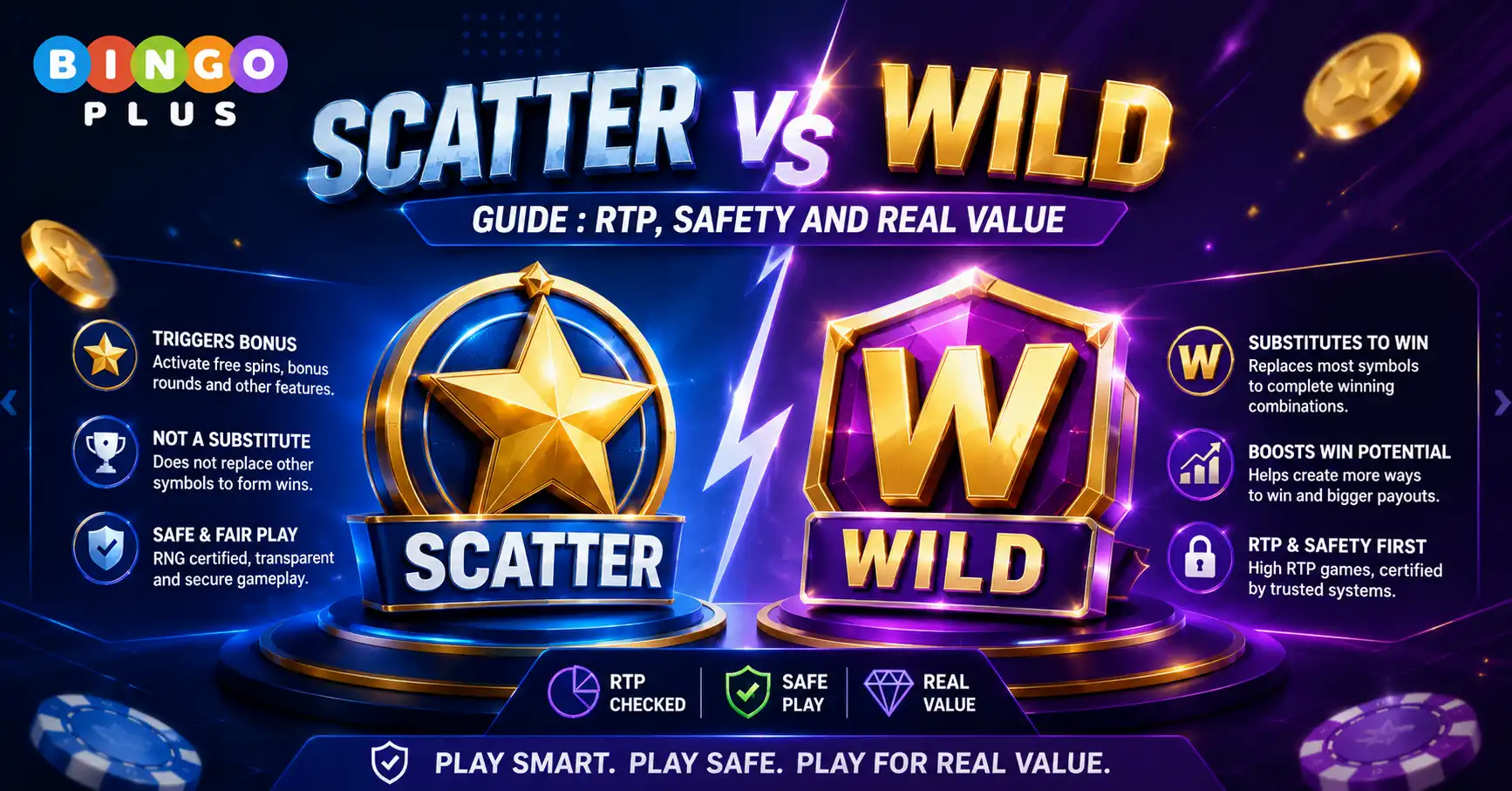
Players often treat Scatter vs Wild as a simple symbol comparison. One triggers free spins, while the other replaces missing symbols.
That explanation is technically correct but financially incomplete.
The real difference lies in how each symbol contributes to RTP, hit frequency, volatility, bonus probability, payout concentration, and bankroll risk. A dramatic scatter animation may lead to no feature, while one strategically positioned wild can complete several winning lines at once.
Platform risk matters just as much as game mathematics. Fake domains, copied login pages, undisclosed bonus terms, delayed KYC checks, and withdrawal restrictions can turn an ordinary slot session into a serious financial problem.

Before I play any scatter-heavy or wild-heavy slot, I apply three non-negotiable standards:
- The operator and exact domain must be verifiable through PAGCOR
- The game must disclose its RTP, symbol rules, and payout limits
- The platform must publish clear wagering, KYC, and withdrawal conditions
- Click to spin for free and win the ultimate prize!
These checks cannot guarantee a winning result. They help remove avoidable operational risk and expose weak promotional value before money is deposited.
Bet responsibly, live a wonderful life. Slot outcomes are uncertain, losses remain possible, and all wagering should be limited to money that can be lost without affecting essential expenses.
Scatter vs Wild: The Core Difference
A scatter symbol usually pays or activates a feature based on how many scatter icons appear anywhere on the reels or grid.
A wild symbol normally substitutes for other symbols to help complete a winning payline, cluster, or ways-based combination.
The basic comparison is:
| Feature | Scatter Symbol | Wild Symbol |
|---|---|---|
| Main function | Triggers bonuses or pays independently | Substitutes for standard symbols |
| Position requirement | Often anywhere on the grid | Usually part of a valid winning pattern |
| Common reward | Free spins, bonus rounds, multipliers | Completed paylines, clusters, or ways |
| Substitution ability | Usually does not substitute | Commonly substitutes for most symbols |
| Bonus role | Often starts the feature | Often improves wins inside the feature |
| Typical frequency | Relatively limited | Varies from rare to frequent |
| Mathematical effect | Concentrates RTP in bonus events | Raises combination probability |
Some games combine both functions.
A symbol may act as:
- A wild scatter
- A multiplier wild
- A sticky wild
- An expanding wild
- A walking wild
- A stacked wild
- A scatter-paying wild
The game information screen determines the actual rule. The icon alone does not.
Core Scatter and Wild Entities
My team checks these technical entities when evaluating the symbol structure:
- Scatter Trigger
- Wild Substitution
- Free Spins
- Retrigger Probability
- Hit Frequency
- Return to Player
- Volatility
- Random Number Generator
Other relevant mechanics include:
- Cascading reels
- Cluster pays
- Ways-to-win systems
- Sticky wilds
- Expanding wilds
- Multiplier wilds
- Locked wilds
- Mystery symbols
- Bonus buys
- Maximum-win caps
Each mechanic changes the payout distribution. None removes the built-in house edge.
PAGCOR Licensing and Domain Verification
For Philippine-facing gaming services, the main official regulatory reference is the Philippine Amusement and Gaming Corporation, or PAGCOR.
PAGCOR’s Electronic Gaming Licensing Department publishes regulatory materials, approved gaming system administrators, registered brands, domain records, operational requirements, and responsible-gaming guidance.
PAGCOR is a primary Philippine gaming authority. It should not be described as the regulator for every Asian jurisdiction, because authorization and player-protection rules differ across countries.
Check the Official Registered-Domain List
PAGCOR publishes the List of PAGCOR-Accredited Gaming System Administrators and Registered Brands and Domain Names/URLs.
The current document available during this review is dated June 30, 2026. It identifies accredited administrators, game offerings, main brands, sub-brands, registered domains, subdomains, and additional approved URLs.
Players can verify platform information through:
- PAGCOR Official Website
- PAGCOR Electronic Gaming Licensing Department
- PAGCOR Registered Brands and Domains PDF
An earlier PAGCOR service-provider document dated March 18, 2025 included AB Leisure Exponent, Inc., the Bingo Plus brand, and associated registered domains. The newer official list should be checked first because approved domain records may change.
My BingoPlus Domain Check
Before entering a password, OTP, or payment detail, I use this process:
- Open pagcor.ph manually.
- Find the electronic gaming regulatory section.
- Open the newest registered-domain document.
- Search for the operator, administrator, or brand.
- Compare the entire domain character by character.
- Confirm the website uses HTTPS.
- Inspect every redirect before signing in.
- Reject links sent by unknown agents.
- Bookmark the verified address.
Cross-checking the exact domain is one of the strongest defenses against phishing.
It does not provide absolute protection. A malicious advertisement, compromised device, stolen social account, deceptive browser extension, or fake support representative can still create risk.
Phishing Warning Signs
I leave a platform immediately when I see:
- Misspelled domain names
- Extra hyphens or unusual domain extensions
- A PAGCOR logo without matching official records
- Requests for passwords through chat
- Requests for one-time passwords
- APK downloads from unknown hosts
- Guaranteed-win claims
- Payments to changing personal accounts
- A fee demanded to release winnings
- Pressure to deposit before verification
- No visible KYC or withdrawal policy
PAGCOR has warned the public that unauthorized gaming sites may misuse its logo and imitate legitimate services. The agency advises users to consult its official list of authorized gaming entities and websites.
A regulatory logo is not proof by itself.
The operator, brand, and exact domain must match current official records.
How Scatter Symbols Work
A scatter usually pays independently of a standard payline.
In many slots, three or more scatters can trigger:
- Free spins
- Bonus games
- Pick-and-win features
- Hold-and-win rounds
- Expanding grids
- Multiplier modes
- Jackpot selections
The symbol may appear anywhere, but some games impose additional rules.
A trigger might require:
- Three scatters on separate reels
- Three scatters anywhere on the grid
- A minimum scatter value
- Scatters appearing in consecutive cascades
- Collected scatters across several spins
- A special scatter on the final reel
The paytable must be checked before assuming how the feature works.
Scatter Pays
Some scatters award an immediate cash value even when they do not trigger free spins.
A hypothetical paytable might show:
- Three scatters: 2x total stake
- Four scatters: 10x total stake
- Five scatters: 50x total stake
If the total stake is ₱20 and five scatters pay 50x:
₱20 × 50 = ₱1,000
This payment may be separate from the value of the triggered feature.
Scatter Retriggers
A retrigger awards additional spins during an active free-spin round.
For example:
- Initial feature: 10 free spins
- Three bonus scatters: 5 extra spins
- Four bonus scatters: 8 extra spins
- Five bonus scatters: 12 extra spins
Retriggers can materially increase feature value.
Their mathematical contribution is already included in the game’s theoretical RTP.
How Wild Symbols Work
A wild usually replaces standard paying symbols to complete a valid combination.
Suppose a payline shows:
A – A – Wild – A – A
If the wild substitutes for the A symbol, the result may be evaluated as five matching A symbols.
Wilds usually do not replace:
- Scatter symbols
- Bonus symbols
- Jackpot symbols
- Special collector icons
Exceptions exist, so the rules matter.
Why Wild Position Matters
A wild on the first, second, or third reel may be more valuable than a wild on the final reel, depending on the payline structure.
In a left-to-right slot, early reels participate in more potential winning combinations.
A wild in a central grid position may also contribute to several:
- Paylines
- Clusters
- Adjacent groups
- Ways-based combinations
This makes wild value positional rather than purely numerical.
Wild Types
Common variations include:
- Standard Wild: substitutes for ordinary symbols
- Expanding Wild: expands across a reel or column
- Sticky Wild: stays in place for multiple spins
- Walking Wild: moves across the reels
- Stacked Wild: occupies several connected positions
- Multiplier Wild: multiplies wins that include it
- Random Wild: appears through a random feature
- Locked Wild: remains fixed during respins
- Wild Reel: converts an entire reel into wild symbols
Two games may both advertise wild symbols while offering completely different mathematical value.
Scatter vs Wild Probability
A scatter usually creates a lower-frequency, higher-impact event.
A standard wild may appear more often and improve ordinary combinations without triggering a separate feature.
That produces a common pattern:
- Scatter: lower frequency, larger feature impact
- Wild: higher combination value, more regular contribution
- Scatter plus wild: concentrated bonus value with enhanced winning potential
The actual probabilities depend on the game’s hidden mathematical configuration.
Why Visible Symbols Do Not Reveal the Odds
Players often count scatter or wild positions and assume every visible symbol has an equal probability.
That assumption is unreliable.
A digital slot may use:
- Virtual reel strips
- Unequal symbol weighting
- Reel-specific probabilities
- State-dependent feature logic
- Different base and bonus configurations
- Random modifier tables
- Jurisdiction-specific RTP settings
A premium wild may occupy one visible position while having a much lower virtual probability than a low-value symbol.
The artwork does not reveal the weighting.
A Simplified Scatter Probability Example
Assume a five-reel slot where each reel has an independent 4% chance of displaying a qualifying scatter.
The probability of exactly three scatter reels is:
P(3) = C(5,3) × 0.04³ × 0.96²
Where:
C(5,3) = 10
The calculation becomes:
10 × 0.000064 × 0.9216 = 0.0005898
Converted to a percentage:
0.0005898 × 100 = 0.05898%
That is approximately one exact three-scatter result in:
1 ÷ 0.0005898 ≈ 1,695 spins
This is only an educational example.
It is not the actual trigger probability for a named BingoPlus game, because real slots may use different reel weights, multiple scatter positions, cascading mechanics, or correlated feature logic.
A Simplified Wild Probability Example
Assume a five-reel game where a specific payline needs five matching symbols.
Suppose the probability of an A symbol on each reel is 10%, and a wild appears with 3% probability and substitutes for A.
The effective matching probability per reel becomes approximately:
10% + 3% = 13%
Without wild substitution:
0.10⁵ = 0.00001
That equals:
0.001%, or approximately one in 100,000 outcomes for that simplified line.
With wild substitution:
0.13⁵ = 0.00003713
That equals:
0.003713%, or approximately one in 26,932 outcomes.
The simplified wild raises the probability of completing the line by more than three times.
Real slot mathematics is more complex because reels are not always identically weighted, multiple paylines interact, and wild combinations may have different paytable values.
Scatter vs Wild RTP Contribution
Return to Player, or RTP, estimates the proportion of total stakes returned over the complete long-term game model.
The formula is:
RTP = Total Amount Returned ÷ Total Amount Wagered × 100
The simplified house edge is:
House Edge = 100% − RTP
For a game with 96% RTP:
House Edge = 100% − 96% = 4%
This does not mean every ₱100 session returns ₱96.
It means that across the model’s massive statistical cycle, the expected return is approximately 96% of total stakes.
Hypothetical RTP Distribution
A 96% slot might allocate theoretical return like this:
- Standard symbol wins: 50%
- Wild-assisted wins: 18%
- Scatter feature wins: 24%
- Other modifiers: 4%
Total:
50% + 18% + 24% + 4% = 96% RTP
This example shows why a player can experience a poor session without a scatter trigger.
If a large portion of RTP sits inside the bonus feature, missing that feature leaves the observed session return far below the advertised percentage.
Wilds Do Not Raise the Published RTP During Play
A game with many wilds may feel generous.
Those wilds do not dynamically raise RTP after the game starts. Their expected contribution is already included in the published model.
The same applies to:
- Scatter triggers
- Retriggers
- Expanding wilds
- Sticky wilds
- Cascades
- Bonus multipliers
- Random modifiers
The visual frequency of a feature does not create additional value outside the mathematical design.
PAGCOR Technical Standards and Bonus Mathematics
PAGCOR’s technical standards state that a game’s player return, including bonuses over the full game cycle, must conform to the stated theoretical RTP. The standards also indicate that a game must not adjust bonus likelihood based on previous awards or player activity in ways prohibited by the technical requirements.
This point matters when comparing Scatter vs Wild.
A scatter bonus is not separate from RTP.
Wild-assisted wins are not separate from RTP.
Both are components of the same theoretical payout model.
Older PAGCOR technical materials also describe bonus awards as part of the game cycle and require their contributions to be included in the program payout percentage.
Volatility: Which Symbol Creates More Risk?
Neither scatter nor wild automatically determines volatility.
The complete payout model matters.
A scatter-heavy game may be highly volatile when:
- Bonus triggers are rare
- Bonus multipliers are wide
- Base-game wins are small
- Maximum wins are concentrated in free spins
- Retriggers are uncommon
A wild-heavy game may also be highly volatile when:
- Wilds appear in rare stacks
- Multiplier wilds have wide values
- Premium combinations are difficult
- Base wins remain infrequent
- Wild reels are tied to rare random features
Lower-Volatility Structure
A lower-volatility slot may offer:
- Frequent standard wilds
- Regular small line wins
- Modest scatter features
- Lower maximum multipliers
- More stable bankroll movement
Higher-Volatility Structure
A higher-volatility slot may offer:
- Rare scatter triggers
- Expanding wild reels
- Progressive multipliers
- Large maximum wins
- Long losing sequences
RTP tells me the expected long-run return.
Volatility tells me how aggressively the game may move the bankroll before that long-run average becomes meaningful.
Scatter vs Wild in Free Spins
The strongest interaction often occurs after a scatter activates free spins and wilds enhance the bonus rounds.
A feature may include:
- Sticky wilds
- Expanding wilds
- Random wild placement
- Increasing wild multipliers
- Wild reels
- Collected wilds
- Locked wilds during respins
This creates a two-stage model:
- Scatter symbols provide access
- Wild symbols influence payout size
A game may have a relatively frequent scatter trigger but weak wild mechanics.
Another may trigger less often while offering more valuable persistent wilds.
The second game can have a higher average bonus payout but greater volatility.
Multiplier Wild Mathematics
Assume a free-spin win has a base value of ₱50.
One 3x multiplier wild produces:
₱50 × 3 = ₱150
Two multiplier wilds may be added or multiplied, depending on the rules.
Additive Method
If two wilds carry 3x and 4x values:
3 + 4 = 7x
The result is:
₱50 × 7 = ₱350
Multiplicative Method
If the game multiplies them:
3 × 4 = 12x
The result is:
₱50 × 12 = ₱600
The difference is substantial.
I never assume how multiplier wilds combine. The paytable must state whether values are:
- Added
- Multiplied
- Applied separately
- Capped
- Reset after each spin
- Retained throughout the feature
Can Players Influence Scatter or Wild Outcomes?
No reliable betting pattern can force a scatter or wild outcome in a legitimate random slot.
I reject claims based on:
- Raising the stake after two scatters
- Playing after a long losing sequence
- Switching from manual to autoplay
- Changing devices
- Restarting the game
- Spinning at a specific time
- Waiting for a wild-heavy cycle
- Following another player’s results
Unless the rules disclose a persistent meter or saved progression feature, past outcomes do not make a future scatter or wild more likely.
A near miss is not evidence that the feature is due.
Practical Game-Selection Tactics
A player cannot remove the house edge, but poor product selection can increase exposure unnecessarily.
I compare:
- Published RTP
- Volatility
- Scatter trigger structure
- Wild frequency
- Bonus contribution
- Maximum win
- Minimum stake
- Bonus-buy cost
- Feature restrictions
Prefer Transparent RTP
Some providers offer several RTP versions of the same game.
A title may exist at:
- 96% RTP
- 94% RTP
- 92% RTP
The artwork and game name may be identical.
At ₱20,000 total wagering:
- 96% RTP implies ₱800 theoretical loss
- 94% RTP implies ₱1,200 theoretical loss
- 92% RTP implies ₱1,600 theoretical loss
Use:
Expected Loss = Total Wagering × House Edge
The difference becomes meaningful as turnover increases.
Match Volatility to the Budget
For a limited bankroll, a game placing most value inside a rare scatter feature can create a high probability of ending the session before the bonus appears.
A more balanced game may offer:
- Regular wild-assisted wins
- Moderate scatter frequency
- Smaller bonus peaks
- Lower drawdown risk
That does not guarantee a better result.
It gives the bankroll more opportunities to survive ordinary variance.
Bankroll Management for Scatter and Wild Slots
Bankroll management cannot improve RTP.
It limits the amount and speed of financial exposure.
Set a Fixed Session Limit
Use only disposable entertainment funds.
Never use:
- Rent money
- Loan proceeds
- Emergency savings
- Medical funds
- School funds
- Credit advances
- Money reserved for family obligations
Stop when the predetermined limit is reached.
Calculate Stake Size
I generally treat wagers above 1% of the session bankroll as aggressive for a volatile slot.
With a ₱2,000 budget:
- 0.25% stake: ₱5
- 0.5% stake: ₱10
- 1% stake: ₱20
- 2% stake: ₱40
Ignoring temporary returns:
Maximum Base Spins = Bankroll ÷ Stake
At ₱10 per spin:
₱2,000 ÷ ₱10 = 200 spins
At ₱40 per spin:
₱2,000 ÷ ₱40 = 50 spins
The higher stake does not make scatters or wilds more favorable unless the paytable explicitly changes with the stake.
It only increases financial exposure per outcome.
Do Not Chase the Scatter
A plan to stop only after free spins appear is not a valid loss limit.
The feature may trigger immediately.
It may also fail to appear before the entire bankroll is lost.
Use:
- A fixed spending limit
- A fixed time limit
- A predetermined stop-loss
- No redeposit after the limit
Do not use a feature trigger as the stopping condition.
Bonus Wagering Requirements
Promotions tied to Scatter vs Wild games can carry wagering conditions that outweigh the headline reward.
Assume a platform awards a ₱1,000 bonus.
At 10x Rollover
₱1,000 × 10 = ₱10,000 required turnover
At 30x Rollover
₱1,000 × 30 = ₱30,000 required turnover
The 30x condition requires three times as much betting.
Bonus-Only Rollover
Use:
Required Turnover = Bonus × Wagering Multiple
For a ₱1,000 bonus at 30x:
₱1,000 × 30 = ₱30,000
Deposit-Plus-Bonus Rollover
Use:
Required Turnover = (Deposit + Bonus) × Wagering Multiple
For a ₱1,000 deposit and ₱1,000 bonus at 30x:
(₱1,000 + ₱1,000) × 30 = ₱60,000
The wording doubles the requirement.
Never evaluate a rollover number without identifying its calculation base.
Calculate the Real Bonus Value
Use:
Expected Rollover Cost = Required Turnover × House Edge
Assume:
- Bonus: ₱1,000
- Required turnover: ₱30,000
- Eligible slot RTP: 96%
- House edge: 4%
Expected cost:
₱30,000 × 0.04 = ₱1,200
Now use:
Estimated Bonus Value = Bonus Amount − Expected Rollover Cost
Therefore:
₱1,000 − ₱1,200 = −₱200
The simplified expected value is negative before considering:
- Maximum cashout
- Expiry
- Maximum-bet rules
- Restricted games
- Reduced contribution
- Withdrawal fees
- KYC delays
- Payment restrictions
A large bonus percentage does not automatically create good value.
Game Contribution Rates
The selected Scatter vs Wild slot may not contribute 100% toward wagering.
Use:
Actual Betting Needed = Required Credited Turnover ÷ Contribution Rate
For a ₱20,000 credited requirement:
At 100% contribution:
₱20,000 ÷ 1.00 = ₱20,000 actual betting
At 50% contribution:
₱20,000 ÷ 0.50 = ₱40,000 actual betting
At 20% contribution:
₱20,000 ÷ 0.20 = ₱100,000 actual betting
A low contribution rate can make a promotion mathematically impractical.
KYC Verification
Know Your Customer verification confirms identity, age, payment ownership, and account legitimacy.
A regulated platform may request:
- Government-issued identification
- Selfie or facial verification
- Mobile-number verification
- Proof of payment ownership
- Date of birth
- Proof of address
- Source-of-funds information in certain cases
Complete KYC before depositing a large amount whenever possible.
The legal name should match across:
- Gaming account
- Identification document
- Bank account
- E-wallet
- Withdrawal destination
A name mismatch can delay or prevent payment processing.
Protect the Account
I use these controls:
- Create a unique password
- Enable available two-factor authentication
- Never share an OTP
- Avoid public Wi-Fi for payments
- Use only verified applications
- Review transaction history
- Log out on shared devices
- Reject remote-access requests
A legitimate support representative should never need your full password or one-time authentication code.
Withdrawal Limits and Bonus Restrictions
Before depositing, verify:
- Minimum withdrawal
- Daily withdrawal limit
- Monthly withdrawal limit
- Processing timeframe
- Pending-withdrawal rules
- KYC status
- Payment-channel availability
- Maximum promotional cashout
- Withdrawal fees
- Account-name requirements
A large scatter or wild-assisted win may still be restricted by promotion terms.
For example:
- Final promotional balance: ₱10,000
- Maximum cashout: ₱2,000
The player may be allowed to withdraw only ₱2,000.
The remaining promotional balance may be removed according to the published terms.
How I Evaluate Scatter vs Wild Games on BingoPlus
I divide the review into three layers.
Regulatory Layer
I verify:
- Current PAGCOR records
- Accredited gaming administrator
- Approved brand
- Exact BingoPlus domain
- Secure connection
- Responsible-gaming information
PAGCOR states that licensed and PAGCOR-operated entities must adopt responsible-gaming rules designed to reduce player harm, prevent gambling addiction, and prohibit underage gambling.
Mathematical Layer
I inspect:
- RTP version
- House edge
- Volatility
- Scatter requirements
- Wild substitution rules
- Retrigger structure
- Multiplier behavior
- Maximum win
Promotional Layer
I calculate:
- Bonus amount
- Rollover base
- Wagering multiple
- Required turnover
- Contribution rate
- Expected rollover cost
- Maximum bet
- Cashout limit
Licensing verifies regulatory authorization.
It does not guarantee that every game or promotion offers suitable value for every player.
Scatter vs Wild Safety Checklist
Before playing, confirm:
- The exact domain matches current PAGCOR records
- Scatter trigger conditions are visible
- Wild substitution rules are explained
- RTP is displayed
- Volatility suits the session budget
- Retrigger mechanics are clear
- Multiplier wild rules are published
- The maximum win is stated
- Bonus-buy costs are acceptable
- Wagering requirements are calculated
- Game contribution is disclosed
- Maximum bonus bets are clear
- KYC can be completed
- Withdrawal limits are acceptable
- No borrowed or essential money is being used
Scatter and wild symbols serve different mathematical purposes.
The scatter usually controls access to high-impact features. The wild usually improves the probability or value of winning combinations.
Neither is inherently more profitable.
I prefer transparent rules, a verified platform, acceptable RTP, manageable volatility, clear promotion terms, and realistic withdrawal conditions over dramatic graphics or oversized maximum-win claims.
Frequently Asked Questions
Do I need KYC to withdraw Scatter vs Wild slot winnings?
Usually, yes. Regulated platforms commonly require identity, age, and payment-ownership verification before processing withdrawals, especially when bonus funds are involved.
Are scatter and wild outcomes technically random?
They should be generated through the game’s RNG and predefined mathematical model on a properly regulated platform. Scatter and wild probabilities may be differently weighted, so visible symbol counts do not reveal the true odds.
Why was my Scatter vs Wild withdrawal rejected?
Common reasons include incomplete KYC, unfinished wagering, a maximum-bet violation, an expired promotion, a payment-name mismatch, or a cashout limit. Request the exact written reason and compare it with the published terms.