


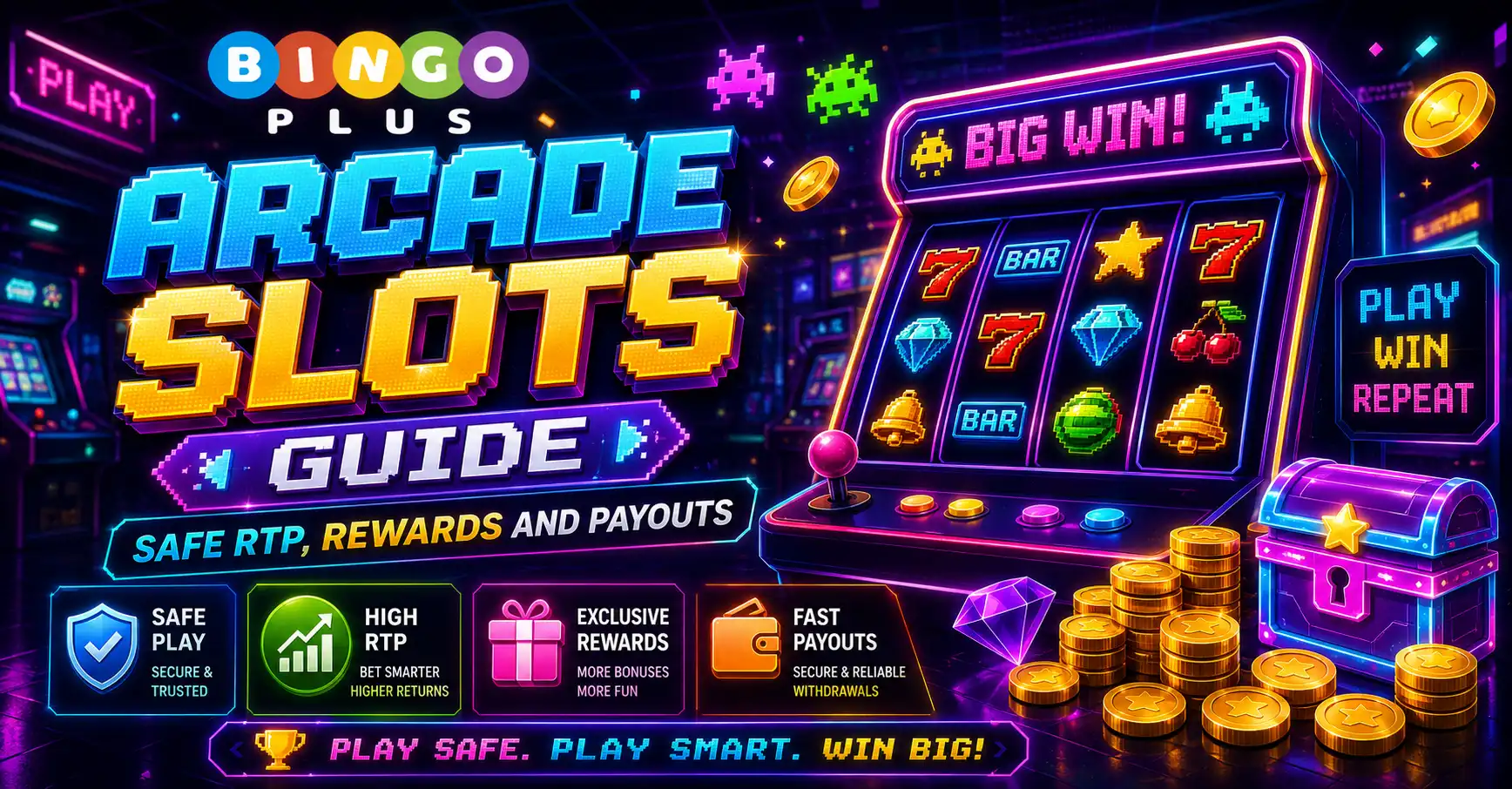
Arcade Slots feel more interactive than conventional reel games. Players may shoot targets, collect coins, destroy symbols, catch fish, fill meters, or activate rapid bonus rounds instead of simply pressing Spin.
That interaction can create a false sense of control.
The animation may respond to a player’s taps, but the underlying payout model can still depend on RNG, symbol weighting, hit probability, RTP, volatility, and a built-in house advantage. The greater danger is using these games through an unverified domain that hides its operator, withdrawal rules, or bonus restrictions.

After more than ten years reviewing gaming products, I apply three non-negotiable standards:
- Regulatory verification: Match the operator, platform brand, and exact domain against PAGCOR’s official records.
- Mathematical transparency: Check RTP, RNG rules, volatility, hit frequency, credit cost, payout table, and maximum win.
- Payment clarity: Read KYC requirements, withdrawal limits, bonus contribution, account-name rules, and processing times before depositing.
- Click to spin for free and win the ultimate prize!
PAGCOR’s Electronic Gaming Licensing Department regulates games of chance and licenses gaming operations within Philippine territory. Its regulatory resources include current lists of accredited Gaming System Administrators, registered brands, domains, subdomains, and additional URLs.
Bet responsibly, live a wonderful life. Arcade Slots involve financial risk, no animation or target guarantees a payout, and every player remains responsible for their own spending decisions.
What Are Arcade Slots?
Arcade Slots combine slot-style wagering mathematics with interactive arcade presentation.
Instead of relying only on conventional spinning reels, these games may use:
- Shooting mechanics
- Fishing targets
- Coin collection
- Symbol destruction
- Prize wheels
- Moving characters
- Falling objects
- Meter-filling systems
- Instant multiplier rounds
- Boss battles
- Hold-and-win grids
- Cascading clusters
The player may appear to aim, select, tap, or time an action.
That does not automatically mean skill controls the result.
In many games, the visible action is the presentation layer while the payout is governed by a predefined mathematical model.
Core Arcade Slots Entities
The most important technical concepts are:
- RTP
- RNG
- House Edge
- Volatility
- Hit Frequency
- Credit Cost
- Target Multiplier
- Payout Table
- Maximum Win
- Round Speed
- Bonus Meter
- Wagering Contribution
Understanding these terms is more useful than judging a game by graphics or sound effects.
Arcade Slots vs Traditional Video Slots
Traditional video slots usually use reels, symbols, paylines, or ways-to-win systems.
Arcade Slots may replace or disguise those structures with interactive elements.
| Feature | Traditional Video Slots | Arcade Slots |
|---|---|---|
| Main interaction | Spin reels | Tap, shoot, collect, or target |
| Outcome display | Symbols and paylines | Animated targets or events |
| Round speed | Moderate to fast | Often very fast |
| Cost visibility | Stake per spin | Stake per shot, tap, or round |
| Mathematical base | RNG and paytable | RNG, probability table, or target weighting |
| Player perception | Mostly chance-based | Can appear skill-based |
| Main risk | Repeated spins | Hidden cumulative credit use |
The most important difference is behavioral.
A player clearly sees one ₱20 slot spin. In a shooting or fishing-style game, the player may spend ₱20 repeatedly within seconds without noticing how quickly the total turnover grows.
Main Types of Arcade Slots
Fishing Arcade Slots
Fishing-style games allow users to shoot at moving targets.
Each shot consumes credits. Different fish or boss targets may offer different payout multiples.
Important variables include:
- Cost per shot
- Target payout
- Target resistance or probability
- Weapon strength
- Special ammunition
- Boss multipliers
- Bonus events
- Maximum payout
A large target may advertise a high multiplier.
That does not mean the next shot has a strong probability of capturing it.
Shooting Arcade Slots
Shooting games may use:
- Monsters
- Animals
- Spaceships
- Treasure objects
- Moving targets
- Boss characters
The player selects a target and fires.
The risk is rapid credit consumption. A ₱10 shot repeated ten times in five seconds creates ₱100 of turnover.
Coin and Collecting Games
These games may use:
- Falling coins
- Prize meters
- Collection symbols
- Locked values
- Hold-and-win grids
- Progressive jackpots
They often resemble slots mathematically, even when the display looks like an arcade machine.
Crash and Multiplier Arcade Games
Some arcade-style products display a rising multiplier.
The player must exit before the round ends.
Core variables include:
- Cashout target
- Crash probability
- Auto-cashout setting
- House edge
- Maximum multiplier
- Round history
Past multipliers do not reliably predict the next round.
Mines and Tile Games
Mines-style games ask the player to select safe tiles while avoiding hidden hazards.
Each successful choice increases the available payout.
Risk rises when:
- More mines are selected
- More tiles are opened
- Cashout is delayed
- Stakes increase after losses
The ability to select a tile does not mean the player can identify where the mines are located.
Why Arcade Interaction Can Be Misleading
Arcade interfaces create three psychological effects.
Illusion of Control
The player believes better timing or aim changes the result.
In some genuinely skill-based products, performance may matter. In many real-money arcade games, however, the payout remains controlled by game mathematics.
Hidden Turnover
Small repeated actions feel cheaper than one large wager.
A player may remember using ₱10 shots but overlook that 300 shots created ₱3,000 in turnover.
Near-Miss Pressure
A target may appear almost captured, a meter may look almost full, or a boss may seem close to defeat.
Unless the published rules confirm persistent progress, the visual state may not mean the next action has better value.
PAGCOR Licensing and Official Domain Verification
A game provider supplies software.
The platform controls:
- Account registration
- Deposits
- Bonus balances
- KYC
- Withdrawal approval
- Payment processing
- Customer support
- Responsible gaming tools
That is why I verify the platform before evaluating its arcade library.
PAGCOR’s regulatory portal publishes information for electronic gaming, licensed casinos, service providers, and other regulated sectors. The current Gaming System Administrator list is organized by administrator, game offering, brand, main domain, subdomain, and additional URL.
What a PAGCOR Domain Match Can Establish
A matching record can help confirm:
- The accredited administrator
- The registered brand
- The main domain
- Approved subdomains
- Additional registered URLs
- The associated gaming offering
This is one of the strongest practical checks for a Philippine-facing platform.
It does not guarantee winnings or remove the need to read payment terms.
Domain Verification Cannot Guarantee 100% Protection
No single security step can honestly prevent every phishing attempt.
Cross-checking an exact domain against PAGCOR’s official list can materially reduce exposure to:
- Misspelled domains
- Fake mirror websites
- Copied login pages
- Fabricated platform identities
- Unregistered promotional pages
- Unofficial app-download routes
The Gaming System Administrator framework also requires the registration of a main brand and main domain, reinforcing why the exact URL matters.
Combine the regulatory check with:
- HTTPS verification
- Secure-device use
- Official support channels
- Strong passwords
- Refusal to share OTPs
- Careful payment-recipient review
Domain and Platform Red Flags
I stop immediately when I see:
- No identifiable operator
- No exact regulatory-domain match
- Misspelled brand URLs
- Random APK download links
- Personal payment instructions
- Requests for OTP or password
- No withdrawal policy
- No KYC page
- Guaranteed-win language
- No game provider name
- No round history
- Support available only through private chat
A familiar game graphic is not proof of a legitimate platform.
PAGCOR vs International Licensing
Arcade Slots may also appear on platforms claiming oversight from:
- Malta Gaming Authority
- UK Gambling Commission
- Gibraltar authorities
- Isle of Man authorities
- Curaçao licensing structures
These regulatory systems serve different markets.
For Philippine-facing activity, I first verify the platform through PAGCOR’s relevant operator and domain records. An overseas license may establish status in another jurisdiction, but it does not automatically confirm Philippine authorization.
My review order is:
- Verify the local operator and domain.
- Identify the game provider.
- Read the mathematical rules.
- Inspect deposit and withdrawal terms.
- Calculate bankroll and bonus exposure.
Arcade Slots Mathematics
Arcade Slots may look different from reel games, but the underlying commercial mathematics usually revolves around:
- Total wagered credits
- Expected payout
- House advantage
- Target probability
- Outcome weighting
- Volatility
- Maximum exposure
- Round frequency
The most important starting point is RTP.
What RTP Means
RTP, or Return to Player, is the theoretical percentage of total stakes returned across a very large number of rounds.
Assume an Arcade Slot has:
- RTP: 96%
- House Edge: 4%
- Total theoretical turnover: ₱100,000
The model implies:
- Theoretical player return: ₱96,000
- Theoretical operator advantage: ₱4,000
This does not mean a player wagering ₱1,000 receives exactly ₱960.
One session may return:
- ₱0
- ₱600
- ₱1,100
- ₱3,000
- A rare large payout
RTP describes long-run mathematical structure.
It does not predict a short session.
House Edge Formula
The basic formula is:
House Edge = 100% − RTP
Examples:
- 97% RTP = 3% House Edge
- 96% RTP = 4% House Edge
- 94% RTP = 6% House Edge
Over ₱50,000 of turnover:
At 96% RTP
Expected theoretical loss = ₱50,000 × 4% = ₱2,000
At 94% RTP
Expected theoretical loss = ₱50,000 × 6% = ₱3,000
A two-point RTP difference adds ₱1,000 of theoretical cost over the same turnover.
What RNG Means
RNG stands for Random Number Generator.
In RNG-based Arcade Slots, the system selects outcomes according to the game’s configured probabilities.
This means:
- A missed target does not make the next one due.
- A boss that survived many shots does not necessarily have to pay soon.
- A full-looking screen does not guarantee a bonus.
- Previous rounds do not produce a reliable pattern.
- Higher weapon power does not automatically improve value unless the rules state how it changes cost and payout.
The visible action may influence presentation.
The payout must still be evaluated through the rules and mathematics.
Hit Frequency
Hit Frequency measures how often any winning result may occur.
A game may have:
- High hit frequency with small returns
- Low hit frequency with larger returns
- Frequent visual events that do not produce net profit
- Rare bonus events with high multipliers
A “hit” does not always mean a profitable round.
Example:
- Stake: ₱20
- Payout: ₱8
- Winning animation appears
- Net result: -₱12
Players should distinguish between:
- Any payout
- Stake recovery
- Net profit
Volatility and Variance
Volatility describes how sharply results may move.
Low Volatility
Typical behavior:
- Frequent small payouts
- Lower maximum multipliers
- Longer perceived sessions
- Smaller short-term swings
Medium Volatility
Typical behavior:
- Balanced payout frequency
- Moderate bonus potential
- Noticeable but manageable swings
High Volatility
Typical behavior:
- Long losing sequences
- Rare large payouts
- Heavy bonus dependence
- Rapid bankroll decline
Extreme Volatility
Typical behavior:
- Very rare major wins
- Fast credit consumption
- Large target multipliers
- Severe short-session variance
An Arcade Slot can have a respectable RTP and still destroy a small bankroll quickly when volatility is high.
Specific Fishing Arcade Example
Consider a hypothetical fishing-style Arcade Slot:
- RTP: 96%
- Volatility: High
- Minimum shot: ₱5
- Maximum shot: ₱100
- Small target payout: 2x to 5x
- Medium target payout: 10x to 50x
- Boss payout: Up to 1,000x
- Special weapon cost: 20x standard shot
- Maximum round payout: ₱100,000
A player may focus on the 1,000x boss.
The more useful question is how much credit is consumed while pursuing it.
Credit Consumption Example
Assume:
- Cost per shot: ₱20
- Shots per minute: 30
- Session length: 20 minutes
Total turnover:
₱20 × 30 × 20 = ₱12,000
The player may feel that each action costs only ₱20.
The actual session generates ₱12,000 of betting volume.
At a 4% theoretical house edge:
₱12,000 × 4% = ₱480 expected long-term cost
The short-term result may vary far more widely because of high volatility.
Cost Per Minute Formula
For fast Arcade Slots, I use:
Cost per Minute = Stake per Action × Actions per Minute
Example:
- Stake: ₱10
- Actions per minute: 40
₱10 × 40 = ₱400 per minute
For a 15-minute session:
₱400 × 15 = ₱6,000 turnover
This calculation exposes a major risk that standard bankroll screens may hide.
Net Result Per Target
A target payout should be judged against all credits spent.
Example:
- Total shots fired: 20
- Cost per shot: ₱10
- Total cost: ₱200
- Target payout: ₱150
The target was captured.
The net result is still:
₱150 − ₱200 = -₱50
A successful animation does not always mean a profitable sequence.
Weapon Strength and Stake Scaling
Some arcade games allow users to increase weapon power.
A stronger weapon may:
- Increase the cost per shot
- Increase potential payout
- Change the visual effect
- Target larger objects
- Speed up credit consumption
Do not assume stronger firepower improves expected value.
Check whether:
- RTP remains constant
- Payout scales proportionally
- Target probability changes
- Special weapons have separate costs
- Maximum exposure increases
If cost doubles but expected value remains unchanged, the stronger weapon simply increases variance and session speed.
Boss Targets and Large Multipliers
Boss targets attract attention because they may advertise:
- 100x
- 500x
- 1,000x
- Progressive prizes
- Random jackpot values
These values do not reveal:
- Capture probability
- Average shots required
- Expected net result
- Maximum credit consumption
- Whether multiple players share the target
- Whether the payout scales with individual contribution
Read the game rules carefully.
A large payout can still represent poor value when its probability is extremely low.
Shared-Screen Arcade Games
Some fishing or shooting games allow several users to target the same object.
Check:
- Who receives the payout
- Whether contribution is tracked
- Whether the final shot determines the winner
- Whether damage is persistent
- Whether targets are shared across players
- How disconnections are handled
Never assume your previous shots create ownership of a target unless the rules explicitly state it.
Bankroll Allocation for Arcade Slots
Because these games are fast, I use stricter stake limits.
Assume a session bankroll of ₱2,000.
Conservative Action Cost
- Stake per action: ₱5
- Maximum raw actions: 400
- Better for longer observation
Moderate Action Cost
- Stake per action: ₱10
- Maximum raw actions: 200
- Faster bankroll movement
Aggressive Action Cost
- Stake per action: ₱25
- Maximum raw actions: 80
- High risk
Extreme Action Cost
- Stake per action: ₱100
- Maximum raw actions: 20
- Bankroll can disappear within minutes
Returns will change the exact action count.
The comparison shows how quickly stake size controls survival.
A Practical Arcade Slots Strategy
No staking method removes the house edge.
The goal is to control exposure.
My framework is:
- Verify the platform first.
- Check the actual RTP.
- Identify volatility.
- Calculate cost per action.
- Estimate actions per minute.
- Set a fixed session duration.
- Set a hard loss limit.
- Avoid increasing weapon power after losses.
- Do not chase one boss or meter.
- Stop after reaching the budget limit.
- Never redeposit immediately to recover losses.
Example Session Rule
Bankroll: ₱2,000
Maximum planned turnover: ₱4,000
Stake per action: ₱10
Maximum actions:
₱4,000 ÷ ₱10 = 400 actions
At 20 actions per minute, the planned session lasts:
400 ÷ 20 = 20 minutes
This structure does not produce profit.
It gives the player a measurable limit.
Bonus Meters and Persistence
Arcade games may show:
- Energy bars
- Collection meters
- Boss-health bars
- Prize gauges
- Treasure progress
- Mission counters
Before chasing a meter, check:
- Does progress persist after leaving?
- Does it belong to the individual player?
- Does it reset after a round?
- Is the meter shared?
- Does a full meter guarantee a prize?
- Can the prize value vary?
Visual progress without published persistence rules can encourage irrational continuation.
Arcade Slots Bonus Mechanisms
Platforms may offer:
- Deposit matches
- Cashback
- Free credits
- Mission rewards
- Reload bonuses
- Loss rebates
- Daily tasks
- Tournament prizes
The value depends on:
- Wagering Requirements
- Eligible games
- Contribution percentage
- Maximum action stake
- Expiry
- Withdrawal cap
- KYC rules
Fast turnover does not automatically make a bonus easy to clear.
What Is a Wagering Requirement?
A Wagering Requirement is the total betting volume required before promotional funds or related winnings become withdrawable.
Example:
- Deposit: ₱1,000
- Bonus: ₱1,000
- Wagering rule: 30x deposit plus bonus
Required turnover:
(₱1,000 + ₱1,000) × 30 = ₱60,000
The ₱1,000 bonus creates a ₱60,000 turnover condition.
10x vs 30x Rollover
10x Bonus-Only Offer
- Bonus: ₱1,000
- Rollover: 10x
- Required turnover: ₱10,000
30x Bonus-Only Offer
- Bonus: ₱1,000
- Rollover: 30x
- Required turnover: ₱30,000
30x Deposit-Plus-Bonus Offer
- Deposit: ₱1,000
- Bonus: ₱1,000
- Rollover: 30x
- Required turnover: ₱60,000
The wording of the calculation base matters more than the promotional headline.
Arcade Game Contribution Trap
Arcade Slots may contribute less than standard slots.
Example:
- Required promotional turnover: ₱30,000
- Arcade contribution: 20%
Actual betting volume needed:
₱30,000 ÷ 20% = ₱150,000
If the game contributes 0%, none of the activity reduces the requirement.
Before accepting a bonus, check:
- Arcade eligibility
- Provider exclusions
- Contribution percentage
- Maximum action stake
- Special-weapon restrictions
- Jackpot exclusions
Real Bonus Value Formula
Use:
Real Bonus Value = Bonus Amount − Expected Wagering Loss − Restriction Cost
Assume:
- Bonus: ₱1,000
- Required turnover: ₱30,000
- Eligible game RTP: 96%
- House edge: 4%
Expected theoretical loss:
₱30,000 × 4% = ₱1,200
Simplified value:
₱1,000 − ₱1,200 = -₱200
The promotion is mathematically weak before considering:
- Low contribution
- Expiry pressure
- Withdrawal cap
- Maximum-stake rules
- KYC delays
- Provider restrictions
Better Bonus Example
Assume:
- Bonus: ₱500
- Requirement: 5x bonus only
- Required turnover: ₱2,500
- Game RTP: 96%
- Expected theoretical loss: ₱100
Simplified value:
₱500 − ₱100 = ₱400
A smaller offer can have better real value.
Maximum Stake Rules
Promotions may set a maximum wager per round or action.
This is difficult in Arcade Slots because a player may use:
- Standard shot
- Rapid fire
- Enhanced weapon
- Special ammunition
- Multi-shot mode
Check how the operator defines one wager.
Example:
- Maximum promotional action: ₱50
- Special weapon costs ₱500
- Platform treats the weapon activation as one ₱500 wager
- Promotional winnings may be voided
Do not rely on assumptions.
Read the exact rule.
Cashback Mathematics
Cashback can be based on:
- Net loss
- Total turnover
- Eligible losses
- Real-money play
- Bonus-adjusted loss
Example:
- Net eligible loss: ₱2,000
- Cashback rate: 5%
Cashback:
₱2,000 × 5% = ₱100
Now check whether the ₱100 is:
- Withdrawable cash
- Bonus credit
- Subject to rollover
- Limited by a cap
- Available only after KYC
A cashback label does not explain its real value.
KYC Verification
KYC Verification helps the platform confirm:
- Legal identity
- Age eligibility
- Payment ownership
- Duplicate-account risk
- Fraud exposure
- Bonus abuse
- Anti-money laundering compliance
Common requirements include:
- Government-issued ID
- Selfie or liveness check
- Proof of address
- Bank or e-wallet ownership evidence
- Mobile-number verification
Use consistent legal information across:
- Gaming account
- Identification
- Deposit method
- Withdrawal destination
Identity mismatches can trigger manual review.
Withdrawal Limits
Before playing, check:
- Minimum withdrawal
- Maximum daily withdrawal
- Monthly withdrawal cap
- Processing time
- KYC requirement
- Payment-method limits
- Maximum game payout
- Bonus withdrawal cap
- Large-win review
- Failed-payment procedure
The game provider calculates the result.
The operator approves and processes the withdrawal.
Round History and Technical Disputes
A trustworthy platform should preserve:
- Round ID
- Stake or credit cost
- Target selected
- Starting balance
- Final payout
- Completion status
- Timestamp
- Provider name
If the connection drops:
- Stop firing or tapping.
- Check the balance.
- Open game history.
- Save the round ID.
- Contact official platform support.
The result may already have been processed even if the animation froze.
Mobile Arcade Slots Safety
Arcade games can consume credits rapidly on mobile.
A safe interface should provide:
- Clear stake display
- Touch-safe controls
- Confirmation for expensive actions
- Visible balance
- Session history
- Weapon-cost labels
- Responsive layout
- Reliable reconnection
Before activating rapid fire or a stronger weapon:
- Confirm the cost per action.
- Check the remaining balance.
- Review the multiplier.
- Confirm bonus eligibility.
- Estimate total exposure.
How I Compare Arcade Slots Platforms
1. Regulatory Status
I verify:
- PAGCOR-accredited administrator
- Registered brand
- Main domain
- Subdomain
- Additional URL
- Relevant gaming category
PAGCOR’s current list dated June 30, 2026 provides these fields for accredited Gaming System Administrators.
2. Game Transparency
I check:
- Provider identity
- RTP
- RNG explanation
- Volatility
- Credit cost
- Payout table
- Maximum win
- Round history
3. Interaction Rules
I check:
- Target mechanics
- Weapon scaling
- Shared-screen rules
- Meter persistence
- Special-item costs
- Boss payout rules
4. Promotion Fairness
I check:
- Wagering multiple
- Arcade contribution
- Maximum action cost
- Provider exclusions
- Expiry
- Withdrawal cap
5. Payment Reliability
I check:
- KYC timing
- Withdrawal processing
- Account-name matching
- Daily limits
- Support quality
- Failed-payment handling
A visually entertaining game cannot compensate for an unverified platform or weak cashout policy.
Common Arcade Slots Mistakes
Mistake 1: Believing Aim Guarantees Control
Interactive visuals do not automatically make the outcome skill-based.
Read the rules.
Mistake 2: Ignoring Cost Per Minute
Small repeated actions can create heavy turnover.
Mistake 3: Chasing a Boss Target
Past shots may not create better future value.
Mistake 4: Increasing Weapon Power After Losses
Higher power may simply increase stake and variance.
Mistake 5: Confusing a Target Capture With Profit
Total payout must be compared with all credits spent.
Mistake 6: Trusting a PAGCOR Logo
Verify the exact domain through official records.
Mistake 7: Ignoring Bonus Contribution
Arcade play may contribute only a small percentage toward wagering.
Mistake 8: Skipping KYC Rules
Identity and payment-name mismatches can delay withdrawals.
My Arcade Slots Safety Checklist
Before playing, I check:
- Is the administrator accredited?
- Is the exact domain registered?
- Is the operator identifiable?
- Is the game provider shown?
- Is RTP displayed?
- Is the RNG model explained?
- Is volatility stated?
- Is the cost per action clear?
- Is the payout table complete?
- Are target rules explained?
- Are weapon costs visible?
- Are shared-screen rules published?
- Is round history available?
- Are bonus contribution rates shown?
- Is the maximum promotional stake clear?
- Are KYC requirements published?
- Are withdrawal limits visible?
- Are responsible gaming controls available?
If the platform, mathematics, or withdrawal path is unclear, I do not deposit.
FAQ: Arcade Slots Fairness, KYC and Withdrawals
Are Arcade Slots based on skill or RNG?
Many real-money Arcade Slots use RNG or weighted probability models despite interactive shooting, fishing, or collecting mechanics. Check the game rules and provider information before assuming skill controls the payout.
How can I complete KYC faster?
Use your legal name, upload a clear government ID, complete any liveness check, and ensure the deposit and withdrawal accounts match your verified identity.
Why can an Arcade Slots withdrawal be delayed?
Common causes include incomplete KYC, payment-name mismatches, unresolved bonus wagering, withdrawal-limit reviews, unclear round records, or additional checks on unusually large payouts.