





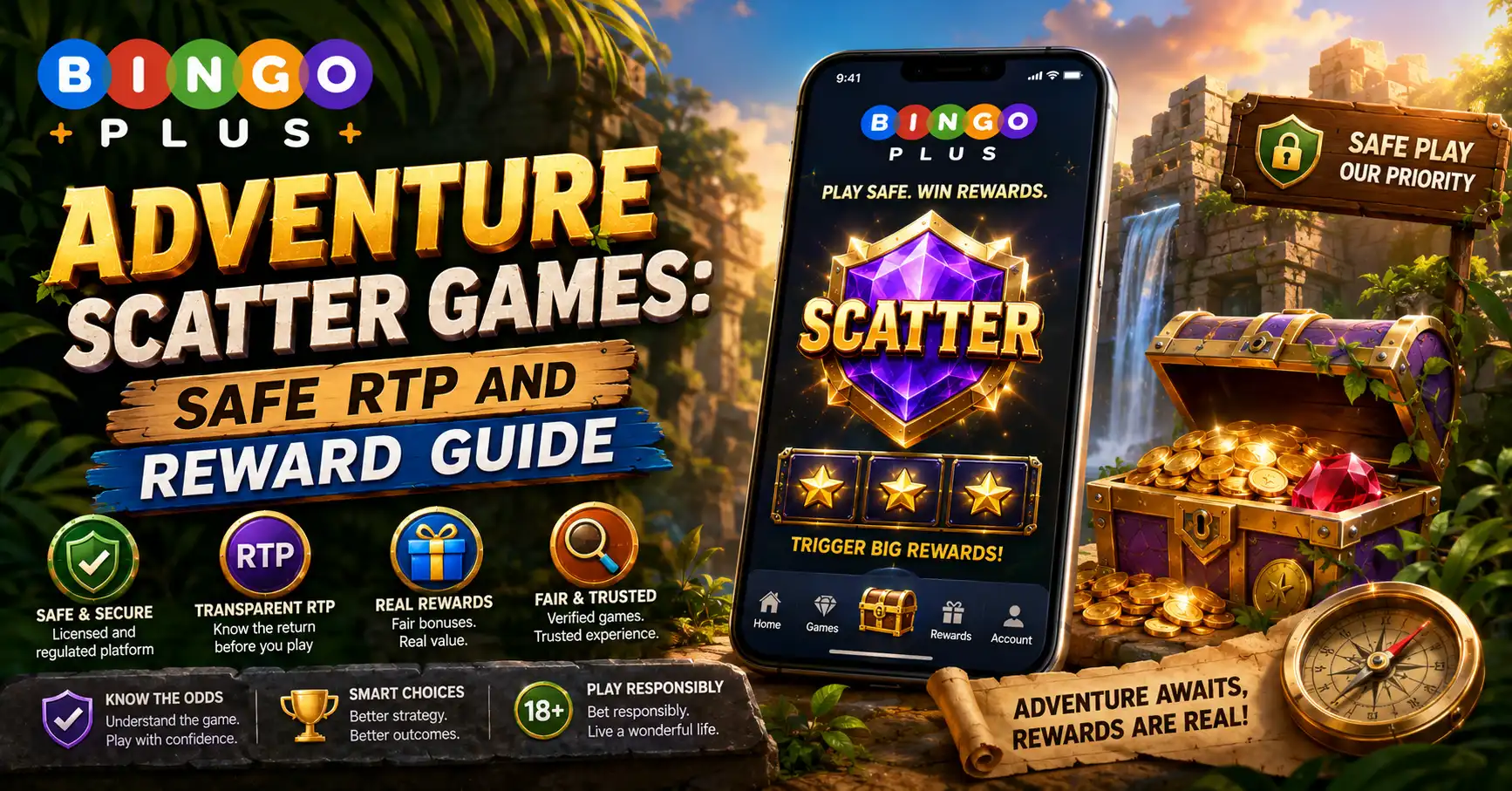
Adventure Scatter Games are designed to make every bonus feel like a discovery. Ancient temples open, maps reveal hidden paths, treasure symbols unlock free spins, and expanding reels create the impression that a major payout may be one spin away.
That visual energy can hide the questions that actually protect a player’s money.
Is the platform operating through a verifiable domain? Does the game publish its RTP, volatility, trigger rules, and maximum win? Can bonus-derived winnings be withdrawn after KYC verification, wagering requirements, and cash-out limits are applied?

My three non-negotiable standards are:
- Verify the operator and exact domain through current PAGCOR records.
- Read the game’s paytable, RTP, volatility, scatter rules, and payout cap.
- Calculate the real cost of wagering requirements before accepting a bonus.
- Click to spin for free and win the ultimate prize!
Bet responsibly, live a wonderful life. Adventure-themed games remain games of chance, every wager involves financial risk, and players are responsible for setting and respecting personal limits.
What Are Adventure Scatter Games?
Adventure Scatter Games are digital casino games that combine exploration-based themes with scatter-triggered reward mechanics.
The adventure layer may use:
- Treasure hunts
- Lost cities
- Jungle expeditions
- Mythical kingdoms
- Archaeological discoveries
- Ocean voyages
- Mountain quests
- Space exploration
- Fantasy missions
The scatter system drives the mathematical feature beneath the story.
Landing a required number of qualifying symbols may unlock:
- Free spins
- Bonus maps
- Pick-and-win stages
- Expanding reels
- Multiplier trails
- Respin sequences
- Symbol upgrades
- Progressive reward meters
- Jackpot opportunities
The story does not improve the odds.
A treasure-chest animation may make the feature feel more valuable, but its real value still depends on probability, average payout, volatility, and the cost of reaching it.
Core Entities Behind Adventure Scatter Games
When I review an adventure title, I separate the narrative layer from the game engine.
These are the entities that determine how the game actually performs.
Scatter Symbol
A scatter symbol awards a direct payout or activates a feature when enough qualifying symbols appear.
Unlike standard line symbols, scatters may pay regardless of exact payline position.
The paytable should explain:
- Required scatter count
- Eligible reel positions
- Direct payout value
- Free-spin allocation
- Retrigger rules
- Multiplier conditions
Trigger Threshold
The trigger threshold is the minimum number of scatters required to activate a reward.
A hypothetical adventure game may use:
- Three maps: 8 free spins
- Four maps: 12 free spins
- Five maps: 20 free spins
More scatters usually produce a larger feature, but the higher-count outcome is generally much less frequent.
Free-Spin Feature
A free-spin feature provides a fixed or variable number of rounds without deducting a new base stake for each spin.
Adventure games often modify the reels during these rounds through:
- Expanding wilds
- Growing multipliers
- Collected artifacts
- Locked symbols
- Additional reel rows
- Progressive stages
- Enhanced scatter frequency
A high free-spin count is not automatically a high-value feature.
The value depends on the mathematical configuration inside those spins.
Retrigger
A retrigger adds more rounds after the bonus has started.
Some games allow unlimited retriggers, while others impose:
- One-retrigger limits
- Maximum free-spin caps
- Reduced scatter frequency
- Different trigger thresholds inside the feature
Retrigger potential can materially increase feature volatility.
Wild Symbol
A wild symbol substitutes for selected regular symbols.
Adventure titles may use:
- Expanding wilds
- Walking wilds
- Sticky wilds
- Multiplier wilds
- Random wild transformations
Wilds and scatters are not interchangeable unless the rules explicitly state otherwise.
Bonus Map or Progress Meter
A bonus map tracks progress through multiple reward stages.
Players may collect keys, gems, relics, or compass symbols to unlock:
- Higher multipliers
- Additional spins
- New reel sets
- Enhanced symbols
- Final-stage prizes
These progress systems can be persistent within one feature or reset after every paid round.
Random Number Generator
The random number generator, or RNG, selects outcomes according to the configured probability model.
The RNG does not recognize that a player has nearly completed a treasure map or recently suffered a losing run.
Unless the rules disclose a persistent collection mechanic, previous spins do not make the next scatter more likely.
Maximum-Win Cap
The maximum-win cap limits the total payout from one round or feature.
A game may advertise 10,000x potential, but the terms may also impose:
- A fixed monetary cap
- A maximum multiplier
- Automatic feature termination
- A provider-wide payout ceiling
I check the multiplier limit and the cash limit separately.
PAGCOR Verification Before Game Comparison
Game mathematics offers no protection if a player sends funds through an impersonation domain.
The Philippine Amusement and Gaming Corporation, or PAGCOR, regulates games of chance and issues licenses for covered gaming operations within Philippine territory through its regulatory departments.
Verify the Current Registered Domain
PAGCOR publishes a formal list of accredited gaming system administrators, registered brands, and approved domain names or URLs.
The current document available during this review is dated June 30, 2026. It includes administrator names, game offerings, main brands, sub-brands, main domains, subdomains, and additional registered URLs.
Official verification sources:
- PAGCOR Official Website
- PAGCOR Electronic Gaming Licensing Department
- Registered Brands and Domain Names PDF
For BingoPlus, I compare the complete address in the browser with the relevant entry in PAGCOR’s latest published document.
I do not rely on:
- A PAGCOR logo
- A copied certificate
- A social media advertisement
- A private-message link
- A search-result title
- A screenshot of an old domain list
Why Domain Matching Is Necessary
PAGCOR has warned that unauthorized websites may use its logo or fabricated licensing claims to mislead the public. It advises users to consult the agency’s official website when checking legitimate operations.
Cross-checking the official PDF is one of the strongest available anti-phishing steps, but it does not literally provide a 100% guarantee.
A complete verification process should also check:
- Exact domain spelling
- HTTPS connection
- Redirect destination
- Current PDF publication date
- Registered subdomains
- Working privacy information
- Verified support channels
- Consistent payment instructions
My Anti-Phishing Procedure
Before entering a BingoPlus password or depositing, I:
- Type or open the verified domain directly.
- Compare it character by character with the current PAGCOR list.
- Confirm that no unrelated redirect occurs.
- Check that account, privacy, and support pages function normally.
- Reject any request for a password or one-time code through chat.
- Avoid APK files from mirrors, groups, and shortened links.
- Confirm that payment instructions originate inside the verified platform.
A cloned page may reproduce the brand design perfectly.
The domain and transaction path matter more than appearance.
How Adventure Scatter Mathematics Works
Adventure graphics may differ widely, but the mathematical framework usually follows the same core structure:
- Base stake
- Scatter probability
- Trigger threshold
- Feature payout distribution
- Retrigger probability
- RTP allocation
- Volatility
- Maximum-win cap
Direct Scatter Payout Formula
When scatters award a direct multiplier, the basic formula is:Scatter Payout=Stake×Scatter Multiplier
Assume:
- Stake: ₱10
- Three-scatter award: 5x
- Four-scatter award: 25x
- Five-scatter award: 100x
The payouts would be:
- Three scatters: ₱50
- Four scatters: ₱250
- Five scatters: ₱1,000
The game rules should state whether the returned amount includes the original stake.
Trigger Probability
Consider a simplified five-reel model in which every reel independently has a 6% probability of showing a qualifying scatter.
The probability of receiving at least three scatters is:P(X≥3)=k=3∑5(k5)pk(1−p)5−k
Using p=0.06:P(X≥3)≈0.001970
That equals approximately:0.197%
The estimated average frequency is:1÷0.001970≈508
Under this simplified model, a qualifying trigger occurs about once every 508 spins on average.
That does not mean the feature is scheduled for the 508th spin.
The player may trigger it twice in 100 rounds or fail to trigger it across 1,500 rounds.
Why Real Games Are More Complex
Real adventure scatter games may use different symbol weights on each reel.
A provider may configure:
- More scatters on central reels
- Fewer scatters on the first reel
- Restricted scatter positions
- Different reel-strip lengths
- Bonus-only scatter sets
- Expanding reel grids
- Cascading mechanics
- Mystery-symbol transformations
- Ante-bet modes
The exact trigger probability may therefore require proprietary reel and weighting data.
A basic binomial model is useful for education, but it should not be presented as the exact rate of a named game unless the provider publishes matching data.
Return to Player
RTP is the theoretical percentage of total wagers returned over a very large sample.
If an adventure scatter title has 96% RTP, its theoretical house edge is:100%−96%=4%
For ₱25,000 in total wagering:₱25,000×0.96=₱24,000
The theoretical long-run loss is:₱25,000−₱24,000=₱1,000
This calculation does not predict one session.
A player can lose significantly more or finish above the starting balance because short-term variance dominates individual results.
RTP Allocation
The total RTP may be divided across several systems.
A hypothetical adventure game could allocate:
- Base symbol wins: 42%
- Wild mechanics: 16%
- Scatter feature: 30%
- Map progression feature: 8%
- Total RTP: 96%
The scatter feature’s 30% contribution means it returns 30 percentage points of long-run wager volume within the mathematical model.
It does not mean each feature pays 30% of the player’s current balance.
House Edge Cannot Be Removed by Strategy
For a fixed 96% RTP game:House Edge=4%
No pattern of increasing, decreasing, or alternating stakes changes that built-in expectation.
A staking system can change:
- Session duration
- Balance swings
- Risk of ruin
- Size of individual outcomes
It cannot change the underlying game RTP.
Hit Frequency Versus Scatter Frequency
Hit frequency measures how often any paying outcome appears.
Scatter frequency measures how often a scatter condition is completed.
A hypothetical title may have:
- Overall hit frequency: 32%
- Three-scatter trigger: 1 in 180
- Four-scatter trigger: 1 in 2,800
- Five-scatter trigger: 1 in 60,000
Frequent small wins can make the game feel active even when the premium feature remains rare.
I compare both figures whenever they are disclosed.
Volatility and Variance
Two adventure titles can share the same RTP but produce very different player experiences.
Lower-Volatility Adventure Game
Typical characteristics:
- Frequent small payouts
- Lower average feature peaks
- Shorter losing sequences
- Lower dependence on rare scatters
- Slower balance swings
Higher-Volatility Adventure Game
Typical characteristics:
- Long dry periods
- Larger bonus potential
- Strong reliance on retriggers
- Sharper bankroll drawdowns
- Higher risk of session ruin
A player seeking longer entertainment should not choose a game only because it advertises a high maximum multiplier.
That multiplier may come with an extremely thin payout tail.
Expected Value of the Scatter Feature
A simplified scatter expected-value formula is:EVscatter=P(trigger)×E(feature payout)
Assume:
- Feature probability: 1 in 200
- Average feature return: 60x stake
- Stake: ₱10
Then:EVscatter=2001×60×₱10 EVscatter=₱3
The scatter feature contributes a theoretical ₱3 per spin in this simplified example.
It does not pay ₱3 on each round.
Most spins contribute nothing from the scatter feature, while occasional triggers produce the feature’s actual returns.
Adventure Feature Expected Value
Suppose the game awards:
- 10 free spins
- Average return of 4x stake per free spin
- Base stake of ₱10
The estimated feature value is:10×4×₱10=₱400
Now add a 25% probability of receiving five extra spins.
Expected additional spins:0.25×5=1.25
Expected total spins:10+1.25=11.25
Estimated adjusted feature value:11.25×4×₱10=₱450
This simplified model shows why retriggers matter even when they do not happen in every bonus.
Progressive Adventure Maps
Some Adventure Scatter Games divide the feature into stages.
A player may collect artifacts to advance from:
- Base camp
- Forest stage
- Temple stage
- Treasure chamber
- Final reward stage
The feature value depends on the probability of reaching each level.
A simplified expected-value formula is:EV=i=1∑nP(reach stage i)×E(stage reward i)
Assume:
| Stage | Probability of Reaching | Average Reward |
|---|---|---|
| Forest | 100% | 10x |
| Temple | 45% | 30x |
| Vault | 15% | 100x |
Expected value:(1.00×10)+(0.45×30)+(0.15×100) EV=10+13.5+15=38.5x
The rare vault stage contributes heavily to the headline potential, but most features will not reach it.
Multipliers and Reward Paths
Adventure games often increase multipliers as the player advances.
For example:
- Stage 1: 1x
- Stage 2: 2x
- Stage 3: 3x
- Final stage: 5x
A payout of ₱600 at the final stage could become:₱600×5=₱3,000
However, the paytable may apply the multiplier only to:
- Regular symbol wins
- Cascade wins
- One selected symbol
- Wins after the stage is reached
- Wins below the maximum cap
The phrase “up to 5x” does not explain which wins qualify.
Cascades and Expedition Chains
Some adventure titles remove winning symbols and allow new symbols to fall into the empty positions.
This is commonly called a cascade, tumble, or avalanche mechanic.
The round continues until no new win appears.
A growing multiplier may use:Mn=M0+d(n−1)
Where:
- M0 is the starting multiplier
- d is the increase per cascade
- n is the cascade number
If the multiplier starts at 1x and increases by 1x per cascade:
- Cascade 1: 1x
- Cascade 2: 2x
- Cascade 3: 3x
- Cascade 4: 4x
The larger multipliers occur only when the chain survives long enough.
Maximum-Win Truncation
Assume:
- Calculated feature win: ₱750,000
- Provider maximum: ₱500,000
The payable amount is:min(₱750,000,₱500,000)=₱500,000
The cap removes the remaining ₱250,000 from the payable result.
Players comparing adventure games should therefore review:
- Maximum multiplier
- Maximum monetary payout
- Automatic feature-stop rule
- Jackpot exclusions
- Stake-dependent limits
Practical Bankroll Allocation
No bankroll system creates positive expectation in a negative-expectation game.
It can reduce the probability of losing the session fund too quickly.
Percentage Stake Formula
I use:Base Stake=Session Bankroll×Risk Percentage
Assume:
- Session bankroll: ₱2,500
- Risk per spin: 0.2%
₱2,500×0.002=₱5
The base stake is ₱5.
Spin Coverage
At a ₱5 stake:₱2,500÷₱5=500
The bankroll covers 500 full-stake rounds before considering any returns.
This is not enough to guarantee a scatter.
It simply provides more variance tolerance than staking ₱25 per round.
My Practical Limits
For a high-volatility adventure game, I establish:
- Fixed session bankroll
- Stake below 0.5% of bankroll
- Hard stop-loss
- Separate win target
- Maximum session time
- No redeposit during the session
- No stake increase after a near-miss
- No attempt to recover losses
A visually dramatic “almost-trigger” is not a mathematical reason to continue.
Natural Scatter Versus Bonus Purchase
Some games allow direct purchase of the adventure feature.
Assume:
- Base stake: ₱10
- Feature cost: 100x
- Purchase price: ₱1,000
- Average feature return: ₱960
Estimated feature-buy RTP:₱960÷₱1,000=96%
Estimated house edge:100%−96%=4%
The bonus purchase does not remove the house edge.
It concentrates the risk into one larger transaction.
Risk Comparison
A ₱5,000 bankroll can fund:
- 500 rounds at ₱10, or
- Five feature purchases at ₱1,000
Five weak bonus outcomes can end the bankroll rapidly.
I treat feature buying as a high-exposure mode, not a shortcut to profit.
Comparing Adventure Scatter Games on BingoPlus
When I assess Adventure Scatter Games on BingoPlus, I use three evaluation layers.
Platform Safety
Check:
- Current PAGCOR-listed domain
- Secure account access
- KYC requirements
- Deposit ownership rules
- Withdrawal limits
- Support channels
- Responsible-gaming tools
Game Mathematics
Check:
- Provider name
- Displayed RTP
- Volatility level
- Scatter threshold
- Triggered feature
- Retrigger mechanics
- Multiplier rules
- Maximum win
- Bonus-buy cost
- Paytable completeness
Commercial Terms
Check:
- Promotional eligibility
- Wagering multiplier
- Eligible games
- Contribution rates
- Maximum bet
- Bonus expiry
- Maximum cash-out
- Withdrawal restrictions
A visually superior game is not automatically the better commercial choice.
The better choice is the one with transparent mathematics, manageable volatility, and clear transaction rules.
The Wagering Requirement Trap
A bonus amount is not the same as withdrawable value.
The true cost depends on:
- Rollover multiplier
- Calculation base
- Eligible-game RTP
- Contribution rate
- Maximum bet
- Cash-out cap
- Expiry period
10x Versus 30x Rollover
Assume:
- Deposit: ₱1,000
- Bonus: ₱500
10x Bonus-Only Rollover
₱500×10=₱5,000
Required turnover: ₱5,000
30x Bonus-Only Rollover
₱500×30=₱15,000
Required turnover: ₱15,000
30x Deposit-Plus-Bonus Rollover
(₱1,000+₱500)×30=₱45,000
Required turnover: ₱45,000
The wording changes the exposure dramatically.
“30x wagering” is meaningless unless the terms define whether it applies to the bonus, deposit, or both.
Expected Wagering Cost
Use:Expected Cost=Required Turnover×House Edge
Assume the eligible Adventure Scatter Games average 96% RTP.
House edge:100%−96%=4%
Cost at 10x Bonus Rollover
₱5,000×0.04=₱200
Cost at 30x Bonus Rollover
₱15,000×0.04=₱600
Cost at 30x Deposit-Plus-Bonus Rollover
₱45,000×0.04=₱1,800
A ₱500 headline bonus tied to ₱45,000 of turnover may carry a theoretical wagering cost of ₱1,800.
Real Bonus Value Formula
My simplified formula is:Estimated Bonus Value=Bonus Amount−Expected Wagering Cost−Expected Additional Costs
For the ₱500 bonus with ₱15,000 turnover:₱500−(₱15,000×0.04) ₱500−₱600=−₱100
The estimated mathematical value is negative ₱100 before accounting for other restrictions.
Contribution Rates
Some games contribute less than 100% toward the wagering requirement.
Example:
- Standard slots: 100%
- Selected adventure titles: 50%
- Electronic table games: 20%
- Live products: 10%
- Excluded games: 0%
If an adventure title contributes 50% and the remaining qualifying turnover is ₱10,000:₱10,000÷0.50=₱20,000
The player must place ₱20,000 in real wagers.
Effective Cost With Reduced Contribution
Assume:
- Game house edge: 4%
- Actual wagering: ₱20,000
Expected cost:₱20,000×0.04=₱800
A reduced contribution rate can erase the practical value of a promotion.
Maximum Bet During Rollover
Promotions may restrict the largest permitted wager.
Exceeding the limit may result in:
- Bonus removal
- Winnings cancellation
- Account review
- Withdrawal delay
- Promotion disqualification
I record the maximum eligible stake before the first round.
An accidental oversized spin can invalidate hours of qualifying play.
Maximum Cash-Out
Assume:
- Bonus-derived balance: ₱10,000
- Promotional cash-out cap: ₱3,000
The withdrawable amount may be:min(₱10,000,₱3,000)=₱3,000
The remaining balance may be removed after withdrawal.
A large in-game number has limited commercial value when the promotional cap is low.
KYC Verification
KYC verification confirms identity, age, account ownership, and payment-method control.
Typical requirements include:
- Government-issued ID
- Legal name
- Date of birth
- Registered mobile number
- Address information
- Selfie or liveness check
- Payment ownership evidence
KYC does not change the scatter frequency or RTP.
It can determine whether a withdrawal is approved, delayed, or referred for further review.
KYC Problems I See Repeatedly
Common issues include:
- Account nickname not matching legal ID
- Expired identification
- Cropped document image
- Blurred photograph
- Incorrect birth date
- Third-party payment account
- Duplicate registration
- Unverified phone number
Complete KYC before placing substantial deposits.
A verification mismatch is easier to resolve before a large win is waiting for withdrawal.
Withdrawal Limits
Before playing for a high-value scatter result, check:
- Minimum withdrawal
- Maximum per transaction
- Daily limit
- Weekly limit
- Monthly limit
- Bonus-specific cap
- Payment-method availability
- Estimated processing period
- Pending-withdrawal rules
- Manual-review triggers
A balance of ₱100,000 may need several withdrawals if the daily limit is ₱20,000.
That affects access to funds even when the game payout itself was valid.
Technical Fairness
Players normally cannot inspect proprietary RNG code directly.
They can still assess several useful indicators:
- Named game provider
- Published paytable
- Displayed RTP
- Consistent settlement
- Defined maximum win
- Platform regulatory status
- Clear bonus rules
- Stable transaction records
A losing streak is not proof that the game was manipulated.
High variance can produce severe short-term losses within a properly configured mathematical model.
Red Flags I Reject Immediately
I do not deposit when I see:
- A domain missing from the current applicable PAGCOR list
- A PAGCOR logo with no verifiable domain record
- Fabricated licensing language
- Missing paytable
- Hidden RTP
- Guaranteed-win claims
- Unpublished rollover conditions
- Unexplained withdrawal fees
- Requests for passwords or OTPs
- Payments routed through random contacts
- APK files from unofficial mirrors
- Changing cash-out rules
PAGCOR warns that unauthorized gaming exposes users to risks including scams, identity theft, and financial fraud.
Responsible Play Controls
PAGCOR states that its Responsible Gaming Code of Practice is intended to reduce harm, prevent gambling addiction, and prohibit underage gambling across covered establishments.
My practical controls are:
- Treat every deposit as entertainment spending
- Never use borrowed money
- Set a session loss limit
- Set a time limit
- Avoid chasing map stages or scatter triggers
- Stop after reaching the predefined limit
- Review account history
- Use deposit limits or exclusion tools when needed
The story may encourage one more expedition.
The bankroll plan should decide whether the session continues.
Frequently Asked Questions
Does KYC affect Adventure Scatter Game results?
No. KYC does not alter the RNG, scatter frequency, RTP, or calculated payout. It verifies identity and payment ownership and may be required before a withdrawal is processed.
Are Adventure Scatter Games technically fair?
A properly implemented game uses an RNG and predefined probability model to determine outcomes. Check the provider, paytable, RTP, volatility, payout cap, and platform’s current regulatory status rather than judging fairness from one losing session.
How long does an Adventure Scatter Game withdrawal take?
Processing time depends on KYC status, payment method, withdrawal limits, security review, and bonus conditions. Completing a scatter feature or wagering requirement does not override identity checks or maximum cash-out rules.
Final Assessment
Adventure Scatter Games combine strong narrative design with probability-driven reward systems.
I judge them through evidence, not treasure animations.
The strongest assessment includes:
- PAGCOR domain verification
- Provider identification
- RTP and house edge
- Scatter trigger probability
- Volatility and variance
- Feature expected value
- Retrigger potential
- Maximum-win limits
- Wagering requirements
- KYC readiness
- Withdrawal limits
For BingoPlus or any comparable platform, verify the exact domain before entering credentials or sending funds.
Then examine the game mathematics and commercial terms separately.
A high-value scatter is possible.
It is never guaranteed, and no adventure mechanic can remove variance, house edge, or financial risk.